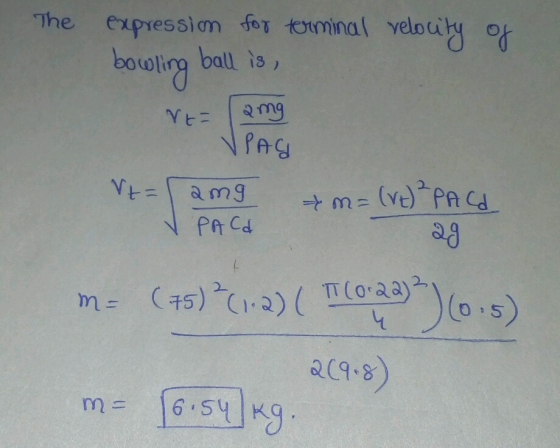
A 22 cm diameter bowling ball has a terminal speed of 75 m/s. Suppose that the density of air is 1.2 kg/m3. PART A: What...
A 22 cm diameter bowling ball has a terminal speed of 75 m/s. Suppose that the density of air is 1.2 kg/m3.
PART A: What is the ball's mass?
Homework Answers
Add Answer to:
A 22 cm diameter bowling ball has a terminal speed of 75 m/s. Suppose that the density of air is 1.2 kg/m3. PART A: What...
A 6.5-cm-diameter ball has a terminal speed of 26 m/s. What is the ball’s mass? Use...
A 6.5-cm-diameter ball has a terminal speed of 26 m/s. What is the ball’s mass? Use ρ = 1.2 kg/m3 for the density of air at room temperature.
A 6.5 cm diameter ball has a terminal speed of 22 m/s. What is the ball's...
A 6.5 cm diameter ball has a terminal speed of 22 m/s. What is the ball's mass? *I keep getting 211 g but on my answer sheet the professor shows 53g.
A bowling ball of mass 7.5 kg and diameter 18 cm rolls without skipping down a 10-m bowling lane with a constant speed...
A bowling ball of mass 7.5 kg and diameter 18 cm rolls without skipping down a 10-m bowling lane with a constant speed 4.3 m/s. A. Through what angle does the bowling ball turn as it travels the length of the lane? B. What is the angular speed of the bowling ball? C. Calculate the maximum radial acceleration that a point in the surface of the bowling ball could have. D. Calculate the tangential acceleration of a point on the...
A soccer ball has a diameter of about 23 cm and a mass of about 425...
A soccer ball has a diameter of about 23 cm and a mass of about 425 g. What is its terminal velocity? (The density of air is 1.3 kg/m3.) ___ m/s
12. What is the terminal velocity for a 4.5kg bowling ball with a diameter of 21.6...
 12. What is the terminal velocity for a 4.5kg bowling ball with
a diameter of 21.6 cm? (6)* a. 16 m/s
What is the terminal velocity for a 4.5kg bowling ball with a diameter of 21.6 cm? (6) a. 16 m/s b. 32 m/s c. 45 m/s d. 63 m/s
12. What is the terminal velocity for a 4.5kg bowling ball with
a diameter of 21.6 cm? (6)* a. 16 m/s
What is the terminal velocity for a 4.5kg bowling ball with a diameter of 21.6 cm? (6) a. 16 m/s b. 32 m/s c. 45 m/s d. 63 m/s
1) It is friction that provides the force for a car to accelerate, so for high-performance...
1) It is friction that provides the force for a car to accelerate, so for high-performance cars the factor that limits acceleration isn't the engine; it's the tires. For typical rubber-on-concrete friction, what is the shortest time in which a car could accelerate from 0 to 60 mph? Suppose that μs=1.00 and μk=0.80. Express your answer to two significant figures and include the appropriate units. 2) A 22 cm diameter bowling ball has a terminal speed of 69 m/s. Suppose...
Air at 100 kPa and density of 1.2 kg/m3 flows upward through a 5-cm diameter inclined...
Air at 100 kPa and density of 1.2 kg/m3 flows upward through a 5-cm diameter inclined duct at a rate of 50 L/s. The duct diameter is then reduced to 4 cm through a reducer. The pressure change across the reducer is measured by a water manometer. The elevation difference between the two points on the pipe where the two arms of the manometer are attached is 0.1 m. Determine the differential height between the fluid levels of the two...
A bowling ball is far from uniform. Lightweight bowling balls are made of a relatively low-density...
A bowling ball is far from uniform. Lightweight bowling balls are made of a relatively low-density core surrounded by a thin shell with much higher density. A 7.0 lb (3.2 kg) bowling ball has a diameter of 0.216 m; 0.196 m of this is a 1.6 kg core, surrounded by a 1.6 kg shell. This composition gives the ball a higher moment of inertia than it would have if it were made of a uniform material. Given the importance of...
A 5.0 kg, 22cm diameter bowling ball is rolling down an alley at 1.3 m/s. [note...
A 5.0 kg, 22cm diameter bowling ball is rolling down an alley at 1.3 m/s. [note for a sphere: I=(2/5)MR^2] a.)What is the ball's angular momentum b.)What is the ball's total energy as it rolls down the alley
A Styrofoam ball of radius 20 cm falls with a terminal velocity of 9.06 m/s. What...
A Styrofoam ball of radius 20 cm falls with a terminal velocity of 9.06 m/s. What is the mass of the ball? You may assume that the drag coefficient is 1 and that the density of air is 1.3 kg/m^3.
 12. What is the terminal velocity for a 4.5kg bowling ball with
a diameter of 21.6 cm? (6)* a. 16 m/s
What is the terminal velocity for a 4.5kg bowling ball with a diameter of 21.6 cm? (6) a. 16 m/s b. 32 m/s c. 45 m/s d. 63 m/s
12. What is the terminal velocity for a 4.5kg bowling ball with
a diameter of 21.6 cm? (6)* a. 16 m/s
What is the terminal velocity for a 4.5kg bowling ball with a diameter of 21.6 cm? (6) a. 16 m/s b. 32 m/s c. 45 m/s d. 63 m/s
Most questions answered within 3 hours.
-
Where is the error in this code sequence?
String s1 = "Hello";
String s2 = "ello";...
asked 10 months ago -
Financial data for Joel de Paris, Inc., for last year
follow:
Joel de Paris, Inc.
Balance...
asked 10 months ago -
Consider this reaction:
Al2(SO4)3 (aq)+ BaCl3
(aq) Al2Cl6 (aq)- +
3BaSO4(s) . What is the...
asked 10 months ago -
Suppose that Savneet is considering increasing her
recent random sample from 20 car rentals to 40...
asked 10 months ago -
Trucks arrive at an unloading terminal at an average rate of 120
per hour.
Trucks arrive...
asked 10 months ago -
Why are methanol and ethanol completely soluble in water while
octanol is not very little soluble....
asked 10 months ago -
A facilities manager at a university reads in a research report
that the mean amount of...
asked 10 months ago -
When the CuSO4 is rehydrated by adding water to the anhydrous
compound, is this an endothermic...
asked 10 months ago -
A ray of sunlight is passing from diamond into crown glass; the
angle of incidence is...
asked 10 months ago -
A block of mass 0.249 kg is placed on top of a light, vertical
spring of...
asked 10 months ago -
how do the kidneys compensate in the presences of acidosis
a) trigger hyperventilate
b) reserve acid...
asked 10 months ago -
Question 501 pts
The rental rate of capital to the firm increases. Which of the
following...
asked 10 months ago