Which ligand is a stronger back-bonder to molybdenum, piperidine or triphenylphosphine?
Which ligand is a stronger back-bonder to molybdenum, piperidine or triphenylphosphine?
Homework Answers

Add Answer to:
Which ligand is a stronger back-bonder to molybdenum, piperidine or triphenylphosphine?
Given that Cl- stronger trans effect ligand than NH3 Predict the results of the following ligand substitution reactions....
Given that Cl- stronger trans effect ligand than NH3 Predict the results of the following ligand substitution reactions. Label your product as cis or trans a) Pt(NH3)3 Cl + Cl-=> b) Pt(NH3)Cl3+Cl-=>
A metal compound is treated with 2 different ligands. Ligand #1 turns the solution red. Ligand...
A metal compound is treated with 2 different ligands. Ligand #1 turns the solution red. Ligand #2 turns the solution yellow. Which ligand is stronger in the spectrochemical series? ligand #1 ligand #2
/Vo e)ruthenium(I) Preption of trichloronítrosylbis(triphenylphosphine)ruthenium(II): The ligand ...
 what is the equation for the reaction
/Vo e)ruthenium(I) Preption of trichloronítrosylbis(triphenylphosphine)ruthenium(II): The ligand NOt is considered to be isoelectronic with the CO ligan Like CO, it shows a variety ich it can bond and react, but it tends to be a little more difficult to make the complex ng the rst place. The method described below is an improvement on earlier methods, usi reagent N-methyl-N-nitroso-p-toluene-sulfonamide. This reagent is also known as Diazaldas it was marketed by Aldrich as the...
what is the equation for the reaction
/Vo e)ruthenium(I) Preption of trichloronítrosylbis(triphenylphosphine)ruthenium(II): The ligand NOt is considered to be isoelectronic with the CO ligan Like CO, it shows a variety ich it can bond and react, but it tends to be a little more difficult to make the complex ng the rst place. The method described below is an improvement on earlier methods, usi reagent N-methyl-N-nitroso-p-toluene-sulfonamide. This reagent is also known as Diazaldas it was marketed by Aldrich as the...
Consider a hypothetical scenario in which there is no piperidine in the lab to run this...
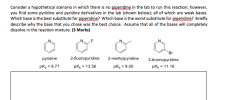 Consider a hypothetical scenario in which there is no piperidine in the lab to run this reaction; however you find some pyridine and pyridine derivatives in the lab (shown below); all of which are weak bases. Which base is the best substitute forpipidine? Which base is the worst substitute for piperidine? Briefly describe why the base that you chose was the best choice. Assume that all of the bases will completely dissolve in the reaction mixture. (3 Marks) pyridine 2-fluoropyridine...
For an octahedral transition metal complex, a stronger ligand field Select one or more: O results...
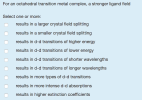 For an octahedral transition metal complex, a stronger ligand field Select one or more: O results in a larger crystal field splitting results in a smaller crystal field splitting results in d-d transitions of higher energy results in d-d transitions of lower energy results in d-d transitions of shorter wavelengths results in d-d transitions of longer wavelengths results in more types of d-d transitions results in more intense d-d absorptions results in higher extinction coefficients
dulude cds Reat wofh At the end of reaction IV, the ligand around Cu is HO,...
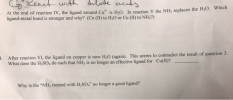 dulude cds Reat wofh At the end of reaction IV, the ligand around Cu is HO, In reaction V the NH, replaces the H2O. Which ligand-metal bond is stronger and why? (Cu (II) to H2O or Cu (II) to NH,?) . After reaction VI, the ligand on copper is now H2O (again). This seems to contradict the result of question 3. What does the H2SO4 do such that NH3 is no longer an effective ligand for Cu(II)? Why is the...
True or Flase. Molybdenum is a cofactor for nitrogenase, which means every nitrogen-fixing microorganisms will not...
True or Flase. Molybdenum is a cofactor for nitrogenase, which means every nitrogen-fixing microorganisms will not be able to fix nitrogen without Molybdenum in its diet.
78. a. Which is a stronger acid? OHے OH b. Which is a stronger base? ....
 78. a. Which is a stronger acid? OHے OH b. Which is a stronger base? . . . . .
Which is a stronger acid? Must explain with both, words and structures. Which is a stronger...
 Which is a stronger acid? Must explain with both, words and
structures.
Which is a stronger base? Must explain with both, words and
structures.
. Propose a mechanism for the following reaction:
2. a) Which is a stronger acid? Must explain with both, words and structures.10 pts. LOH OH 8 or b) Which is a stronger base? Must explain with both, words and structures. 5 pts. 3. Propose a mechanism for the following reaction: 15 pts. OH CH, CH H2SO4...
Which is a stronger acid? Must explain with both, words and
structures.
Which is a stronger base? Must explain with both, words and
structures.
. Propose a mechanism for the following reaction:
2. a) Which is a stronger acid? Must explain with both, words and structures.10 pts. LOH OH 8 or b) Which is a stronger base? Must explain with both, words and structures. 5 pts. 3. Propose a mechanism for the following reaction: 15 pts. OH CH, CH H2SO4...
78. a. Which is a stronger acid? HO or HO b. Which is a stronger base?...
 78. a. Which is a stronger acid? HO or HO b. Which is a stronger base? O 2. 1. or or
 what is the equation for the reaction
/Vo e)ruthenium(I) Preption of trichloronítrosylbis(triphenylphosphine)ruthenium(II): The ligand NOt is considered to be isoelectronic with the CO ligan Like CO, it shows a variety ich it can bond and react, but it tends to be a little more difficult to make the complex ng the rst place. The method described below is an improvement on earlier methods, usi reagent N-methyl-N-nitroso-p-toluene-sulfonamide. This reagent is also known as Diazaldas it was marketed by Aldrich as the...
what is the equation for the reaction
/Vo e)ruthenium(I) Preption of trichloronítrosylbis(triphenylphosphine)ruthenium(II): The ligand NOt is considered to be isoelectronic with the CO ligan Like CO, it shows a variety ich it can bond and react, but it tends to be a little more difficult to make the complex ng the rst place. The method described below is an improvement on earlier methods, usi reagent N-methyl-N-nitroso-p-toluene-sulfonamide. This reagent is also known as Diazaldas it was marketed by Aldrich as the...
 Consider a hypothetical scenario in which there is no piperidine in the lab to run this reaction; however you find some pyridine and pyridine derivatives in the lab (shown below); all of which are weak bases. Which base is the best substitute forpipidine? Which base is the worst substitute for piperidine? Briefly describe why the base that you chose was the best choice. Assume that all of the bases will completely dissolve in the reaction mixture. (3 Marks) pyridine 2-fluoropyridine...
 For an octahedral transition metal complex, a stronger ligand field Select one or more: O results in a larger crystal field splitting results in a smaller crystal field splitting results in d-d transitions of higher energy results in d-d transitions of lower energy results in d-d transitions of shorter wavelengths results in d-d transitions of longer wavelengths results in more types of d-d transitions results in more intense d-d absorptions results in higher extinction coefficients
 dulude cds Reat wofh At the end of reaction IV, the ligand around Cu is HO, In reaction V the NH, replaces the H2O. Which ligand-metal bond is stronger and why? (Cu (II) to H2O or Cu (II) to NH,?) . After reaction VI, the ligand on copper is now H2O (again). This seems to contradict the result of question 3. What does the H2SO4 do such that NH3 is no longer an effective ligand for Cu(II)? Why is the...
 78. a. Which is a stronger acid? OHے OH b. Which is a stronger base? . . . . .
 Which is a stronger acid? Must explain with both, words and
structures.
Which is a stronger base? Must explain with both, words and
structures.
. Propose a mechanism for the following reaction:
2. a) Which is a stronger acid? Must explain with both, words and structures.10 pts. LOH OH 8 or b) Which is a stronger base? Must explain with both, words and structures. 5 pts. 3. Propose a mechanism for the following reaction: 15 pts. OH CH, CH H2SO4...
Which is a stronger acid? Must explain with both, words and
structures.
Which is a stronger base? Must explain with both, words and
structures.
. Propose a mechanism for the following reaction:
2. a) Which is a stronger acid? Must explain with both, words and structures.10 pts. LOH OH 8 or b) Which is a stronger base? Must explain with both, words and structures. 5 pts. 3. Propose a mechanism for the following reaction: 15 pts. OH CH, CH H2SO4...
 78. a. Which is a stronger acid? HO or HO b. Which is a stronger base? O 2. 1. or or
Most questions answered within 3 hours.
-
Where is the error in this code sequence?
String s1 = "Hello";
String s2 = "ello";...
asked 11 months ago -
Financial data for Joel de Paris, Inc., for last year
follow:
Joel de Paris, Inc.
Balance...
asked 11 months ago -
Consider this reaction:
Al2(SO4)3 (aq)+ BaCl3
(aq) Al2Cl6 (aq)- +
3BaSO4(s) . What is the...
asked 11 months ago -
Suppose that Savneet is considering increasing her
recent random sample from 20 car rentals to 40...
asked 11 months ago -
Trucks arrive at an unloading terminal at an average rate of 120
per hour.
Trucks arrive...
asked 11 months ago -
Why are methanol and ethanol completely soluble in water while
octanol is not very little soluble....
asked 11 months ago -
A facilities manager at a university reads in a research report
that the mean amount of...
asked 11 months ago -
When the CuSO4 is rehydrated by adding water to the anhydrous
compound, is this an endothermic...
asked 11 months ago -
A ray of sunlight is passing from diamond into crown glass; the
angle of incidence is...
asked 11 months ago -
A block of mass 0.249 kg is placed on top of a light, vertical
spring of...
asked 11 months ago -
how do the kidneys compensate in the presences of acidosis
a) trigger hyperventilate
b) reserve acid...
asked 11 months ago -
Question 501 pts
The rental rate of capital to the firm increases. Which of the
following...
asked 11 months ago