a. Explain a Type II error and power in context of choosing a smaller level of significance. b. Explain a Type II error...
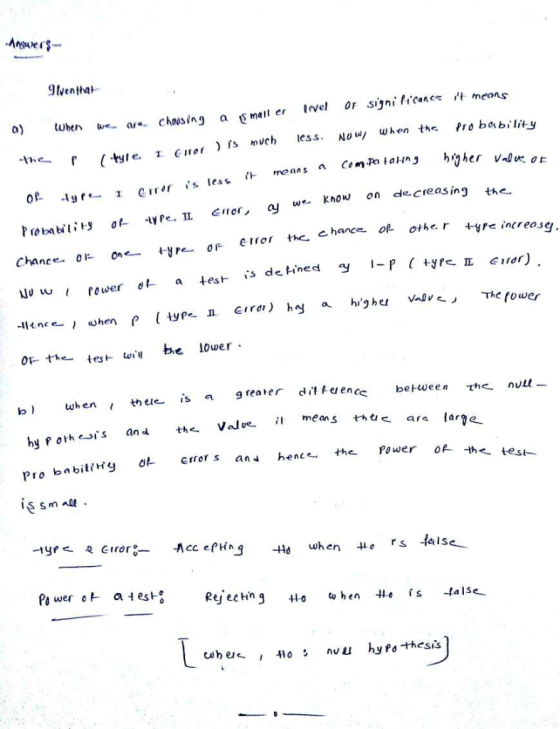
a. Explain a Type II error and power in context of choosing a smaller level of significance.
b. Explain a Type II error and power in context of a greater difference between the null hypothesis claim and the true value of the population parameter.
Homework Answers
Add Answer to:
a. Explain a Type II error and power in context of choosing a smaller level of significance. b. Explain a Type II error...
Which of the following will increase the power of a significance test? (A) Increase the Type...
Which of the following will increase the power of a significance test? (A) Increase the Type II Error probability (B) Increase the significance level alpha (C) Select a value for the alternative hypothesis closer to the value of the null hypothesis (D) Decrease the sample size. (E) Reject the null hypothesis only if the P-value is smaller than the level of significance.
α is the probability of a Type I error, which occurs when we accept the alternative...
α is the probability of a Type I error, which occurs when we accept the alternative H1 when the null hypothesis Ho is true. True False A Type II error occurs when when a false null hypothesis is rejected. True False If a null hypothesis is rejected at the 5% significance level but not at the 1% significance level, then the p-value of the test is less than 1%. True False The power of a test is the probability of...
State whether the following statements true or false, and Why? 1. The type I error and...
State whether the following statements true or false, and Why? 1. The type I error and type II error are related. A decrease in the probability of one generally results in an increase in the probability of the other. 2. The size of the critical region, and therefore the probability of committing a type I error, can always be reduced by adjusting the critical value(s). 3. An increase in the sample size n will reduce α and β simultaneously. 4....
If you make the significance level smaller (a) the p-value gets smaller (b) the t critical...
If you make the significance level smaller (a) the p-value gets smaller (b) the t critical value moves closer to zero (c) the probability of a Type I error increases (d) the probability of a Type II error increases
Determine if the following statements are true or false, and explain your reasoning. If false, state...
 Determine if the following statements are true or false, and explain your reasoning. If false, state how it could be corrected. (a) If a given value (for example, the null hypothesized value of a parameter) is within a 95% confidence interval, it will also be within a 99% confidence interval. O true false (b) Decreasing the significance level (a) will increase the probability of making a Type 1 Error. false O true (c) Suppose the null hypothesis is u =...
a smaller probability of type II error implies higher power of the test. true or false
a smaller probability of type II error implies higher power of the test. true or false
1. Which of the following statements are not generally true? a. A type I error is...
1. Which of the following statements are not generally true? a. A type I error is usually more serious than a type II error. b. A type II error is usually more serious than a type I error. c. A test with significance level is one for which the type I error probability is controlled at the specified level. d. When an experiment and a sample size are fixed, then decreasing the size of the rejection region to obtain...
A type ll error is: O A. the error you make when choosing type Il or...
 A type ll error is: O A. the error you make when choosing type Il or type I O B. typically smaller than the type l error. O C. the error you make when not rejecting the null hypothesis when it is false. O D. cannot be calculated when the alternative hypothesis contains an "-".
i need 9 though 15 please and thank you STAT 2480 Chapter 9: Significance Tests About...
 i need 9 though 15 please and thank you
STAT 2480 Chapter 9: Significance Tests About Hypotheses Across 1. In a significance test, the null hypothesis is presumed to unless the data give strong evidence against it. Down 2. The hypothesis is usually a statement of no treatment effect the null hypothesis 3. A Type 1 Error is when we when it is true. 4. When the null hypothesis is rejected because the P- value is less than or equal...
i need 9 though 15 please and thank you
STAT 2480 Chapter 9: Significance Tests About Hypotheses Across 1. In a significance test, the null hypothesis is presumed to unless the data give strong evidence against it. Down 2. The hypothesis is usually a statement of no treatment effect the null hypothesis 3. A Type 1 Error is when we when it is true. 4. When the null hypothesis is rejected because the P- value is less than or equal...
Q6.) A null hypothesis is not rejected at a given level of significance. As the assumed value of the mean gets further a...
Q6.) A null hypothesis is not rejected at a given level of significance. As the assumed value of the mean gets further away from the true population mean, the Type II error will _____________. A. Increase B. Decrease C. Stay the same D. Randomly fluctuate
 Determine if the following statements are true or false, and explain your reasoning. If false, state how it could be corrected. (a) If a given value (for example, the null hypothesized value of a parameter) is within a 95% confidence interval, it will also be within a 99% confidence interval. O true false (b) Decreasing the significance level (a) will increase the probability of making a Type 1 Error. false O true (c) Suppose the null hypothesis is u =...
 A type ll error is: O A. the error you make when choosing type Il or type I O B. typically smaller than the type l error. O C. the error you make when not rejecting the null hypothesis when it is false. O D. cannot be calculated when the alternative hypothesis contains an "-".
 i need 9 though 15 please and thank you
STAT 2480 Chapter 9: Significance Tests About Hypotheses Across 1. In a significance test, the null hypothesis is presumed to unless the data give strong evidence against it. Down 2. The hypothesis is usually a statement of no treatment effect the null hypothesis 3. A Type 1 Error is when we when it is true. 4. When the null hypothesis is rejected because the P- value is less than or equal...
i need 9 though 15 please and thank you
STAT 2480 Chapter 9: Significance Tests About Hypotheses Across 1. In a significance test, the null hypothesis is presumed to unless the data give strong evidence against it. Down 2. The hypothesis is usually a statement of no treatment effect the null hypothesis 3. A Type 1 Error is when we when it is true. 4. When the null hypothesis is rejected because the P- value is less than or equal...
Most questions answered within 3 hours.
-
Where is the error in this code sequence?
String s1 = "Hello";
String s2 = "ello";...
asked 10 months ago -
Financial data for Joel de Paris, Inc., for last year
follow:
Joel de Paris, Inc.
Balance...
asked 10 months ago -
Consider this reaction:
Al2(SO4)3 (aq)+ BaCl3
(aq) Al2Cl6 (aq)- +
3BaSO4(s) . What is the...
asked 10 months ago -
Suppose that Savneet is considering increasing her
recent random sample from 20 car rentals to 40...
asked 10 months ago -
Trucks arrive at an unloading terminal at an average rate of 120
per hour.
Trucks arrive...
asked 10 months ago -
Why are methanol and ethanol completely soluble in water while
octanol is not very little soluble....
asked 10 months ago -
A facilities manager at a university reads in a research report
that the mean amount of...
asked 10 months ago -
When the CuSO4 is rehydrated by adding water to the anhydrous
compound, is this an endothermic...
asked 10 months ago -
A ray of sunlight is passing from diamond into crown glass; the
angle of incidence is...
asked 10 months ago -
A block of mass 0.249 kg is placed on top of a light, vertical
spring of...
asked 10 months ago -
how do the kidneys compensate in the presences of acidosis
a) trigger hyperventilate
b) reserve acid...
asked 10 months ago -
Question 501 pts
The rental rate of capital to the firm increases. Which of the
following...
asked 10 months ago