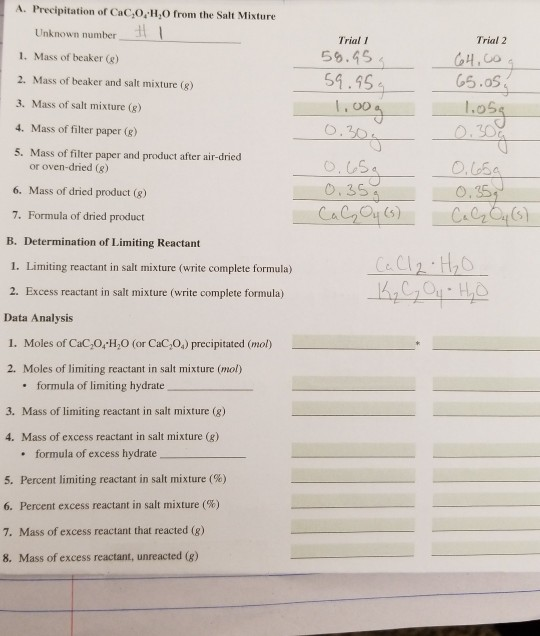
How do you calculate questions 1 - 8 for the data analysis
section?
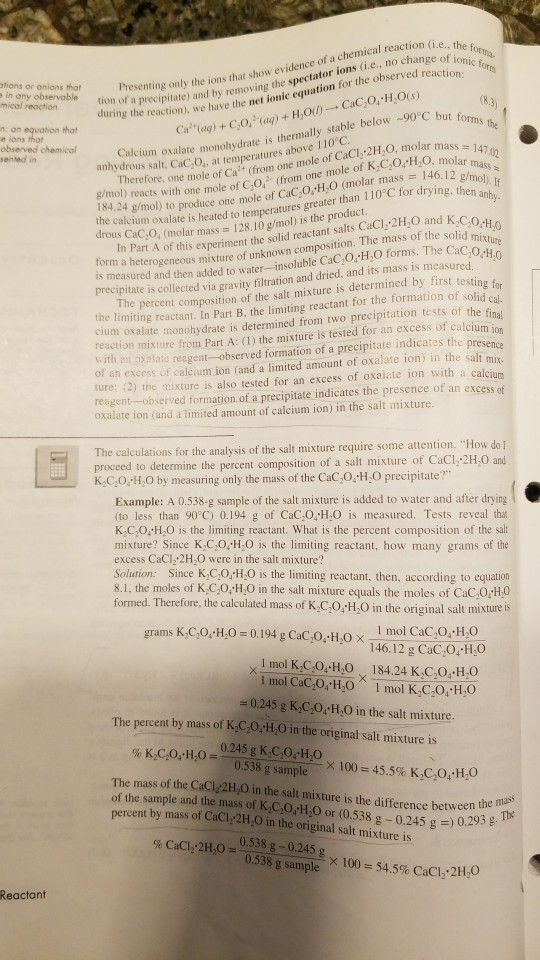
ing only the ions that show evidence of a chemical reaction ie precipitate) and by removing the spectator ions (i.e., no change he reaction), we have the net ionic equation for the observedr the forma- of ionic form ofío tions or anions that Presen in ony observable tion of a mical reoction ate monohydrate is thermally stable below -90 C bur of KCOHO, molar ma during the reacti that Calcium oxalate monohydrate is thermally anhydrous salt. CaC,04, at temperatures above Therefore, one mole of Ca+ (from one m g/mol) reacts with one mole of C,O (from one mo e ions observed chemical sented in O, molar mass = 147.02 le of CaCl, 2H,O, 146.12 g/mot the calcium oxalate is heated to temperatures greater than 110'rdying, then drous CaC20, (molar mass I 28. 10 g/mol) is the product. one mole of C,0,2 (from one mole of K,C,O, H,o 24 gmol) to produce one mole of CaC,O,H,O (molar mass form a heterogeneous mixture of unknown composition. The mass of the solid mi measured and then added to water-insoluble CaC,O:H,O forms. TheCacor is In Part A of this experiment the solid reactant salts CaCl2-2HO and K,C,0-H precipitate is collected via gravity filtration and dried, and its mass is measured The percent composition of the salt mixture is determined by first testir oxalate monohydrate is determined from two precipitation tests of the fi reaction ant. In Part B, the limiting reactant for the formation of solid the limiting react mixture from Part A: (1) the mixture is tested for an excess of calciu ith en gxplato reagent-observed formation of a precipitate indicates the presence of an excess of calcium ion (and a limited amount of oxalate ion) in the salt mit. ture: 12) the mixture is also tested for an excess of oxalate ion with a calcium reagentobserved formation of a precipitate indicates the presence of an excess of oxalate ion (and a Timited amount of calcium ion) in the salt mixture cium The calculations for the analysis of the salt mixture require some attention. "How do l proceed to determine the percent com K-C20,-H20 by measuring only the mass of the CaC2O'H2O precipitate?. position of a salt mixture of CaCl, 2H,0 and Example: A 0.538-g sample of the salt mixture is added to water and after drying (to less than 90°C) 0.194 g of CaC.O4H.O is measured. Tests reveal that KC,O,HO is the limiting reactant. What is the percent composition of the salt mixture? Since K,C,OHO is the limiting reactant, how many grams of the excess CaCl2 2H2O were in the salt mixture? Solution: Since K,C,O,H,0 is the limiting reactant, then, according to equation 8.1, the moles of K,C,O,H,0 in the salt mixture equals the moles of CaC,0:H0 formed. Therefore, the calculated mass of K.C,O, H 0 in the original salt mixture is I mol CaC,O, H O 146.12 g CaC,o., HO 1 mol K,C,O.HO 184.24 K,C,O H,0 l mol CaGO,H20 × l mol KC204-HO) -0.245 g KC,O H,O in the salt mixture. The percent by mass of K,C,O,H,0 in the original salt mixture is %K,C,O/H() = 0.538 g sample -× 100=4 The mass of the CaCl,2H,0 in the salt mixture is the difference between the n of the sample and the mass of K C,o H,0 or (0.538 g 0.245 g-) 0.293 percent by mass of CaCl:2H,0 in the original salt mixture is 0.538 g-0.245 g 2H,00.538 g sample % CaCl- 100-54.5% CaCl2-2H2O Reactant
Homework Answers
Data analysis:
1. Moles of CaC2O4. H2O = mass /molar mass = (0.35/146.12)
= 0.00239
2. As limiting reactant is CaCl2, H2O
Then, moles of CaC2O4 , H2O = moles of CaCl2, H2O = 0.00239
Mass of limiting reactant (CaCl2, H2O) = moles of limiting reactant *molar mass of limiting reactant = 0.00239*129 = 0.308 g
[ Molar mass of CaCl2.H2O = 129 g/mol]
3. Total mass of the reactants = 1.00 g
Then, total mass of excess reactant
= (1.00 - 0.308) = 0.692 g
4. Percent limiting reactant
= [ mass of limiting reactant)*100]÷ total mass of reactants
= [0.308)*100]/1.00
= 30.8 % .
5. Percent of excess reactant = ( mass of excess reactant *100)/total mass of reactant
= (0.692*100)/1.00
= 69.2 % .
6. Balanced reaction
K2C2O4.H2O +
CaCl2.H2O 
Then , moles of CaC2O4.H2O formed = moles of K2C2O4. H2O
= 0.00239
Then ,mass of K2C2O4.H2O (reacted ) = mole * molar mass = 0.00239*184.24 = 0.44 g
[Molar mass of K2C2O4, H2O = 184.24 g/mol]
7.
Again, mass of excess reactant ( unreacted) = ( 0.692 - 0.44) = 0.252 g
Add Answer to:
How do you calculate questions 1 - 8 for the data analysis section? A. Precipitation of CaC,O, H,O from the Salt...
Hey, i need help with the data analysis part of my HW. Thank You! Mass of...
 Hey, i need help with the data analysis part of my HW. Thank
You!
Mass of beaker (e) Trial I Trial 2 2 Mass of beaker and salt mixture (g) Mass of salt mixture (g) O63.9 1.2325 4 Mass of filter paper (e) 1,239 Mass of filter paper and product after air-dried oroven-dried (g) 1.S149 6Mass of dried product (g) 0.2824 252 CalaD,0 1. Formula of dried product CaCaOnHyO 0.2929 B. Determination of Limiting Reactant L. Limiting reactant in salt...
Hey, i need help with the data analysis part of my HW. Thank
You!
Mass of beaker (e) Trial I Trial 2 2 Mass of beaker and salt mixture (g) Mass of salt mixture (g) O63.9 1.2325 4 Mass of filter paper (e) 1,239 Mass of filter paper and product after air-dried oroven-dried (g) 1.S149 6Mass of dried product (g) 0.2824 252 CalaD,0 1. Formula of dried product CaCaOnHyO 0.2929 B. Determination of Limiting Reactant L. Limiting reactant in salt...
4. a. A sample of a CaCI 2HO/K C,0, HO solid salt mixture is dissolved in...
 4. a. A sample of a CaCI 2HO/K C,0, HO solid salt mixture is dissolved in -150 mL of deionized water previously adjusted to a pH that is basic. The precipitate, after having been filtered, was air-dried and weighed. Data for Trial I were obtained as shown. Complete the following table. (See Report Sheet.) Record calculated values with the cor- rect number of significant figures. A. Precipitation of CaC,0,H from the Calculation Zone Salt Mixture 3. Mass of salt mixture...
i need help with data Analysis Experiment & Report Sheet Limiting Reactant Desk No. to Lab...
 i need help with data Analysis
Experiment & Report Sheet Limiting Reactant Desk No. to Lab Sec. - Lab Sec. Name Precipitation of CaC,OH,O from the Salt Mixture Unknown number_ 2 I Mass of beaker() Mass of beaker and salt mixture (8) Trial Trial 2 3. Mass of salt mixture (8) 4. Mass of filter paper() 5. Mass of filter paper and product after air-dried roven-dried (e) 6. Mass of dried product() (NEE with 0.3889 0.6189 -0.280T0 Cal2o4•H2O 0.998 g...
i need help with data Analysis
Experiment & Report Sheet Limiting Reactant Desk No. to Lab Sec. - Lab Sec. Name Precipitation of CaC,OH,O from the Salt Mixture Unknown number_ 2 I Mass of beaker() Mass of beaker and salt mixture (8) Trial Trial 2 3. Mass of salt mixture (8) 4. Mass of filter paper() 5. Mass of filter paper and product after air-dried roven-dried (e) 6. Mass of dried product() (NEE with 0.3889 0.6189 -0.280T0 Cal2o4•H2O 0.998 g...
12 Limiting reactant in salt mixture (write complete formula) Excess reactant in salt mixture (wr...
 12 Limiting reactant in salt mixture (write complete formula) Excess reactant in salt mixture (write complete formula) Analysis Moles of CCOrHO(orCC04) precipitated (mol) 0.0024 naal- 00021 Moles of CaC,o, HO (or CaC,0,) precipitated (mol) Moles of limiting reactant in salt mixture (mol) . formula of limiting hydrate eac'4 Mass of limiting reactant in salt mixture (8) Mass of excess reactant in salt mixtyre . formula of excess hydrate r C22 0 Percent limiting reactant in salt mixture (%) Percent excess...
question 4 and 5 4. A 2.00-g sample mixture of CaCl 211O and K:CO H:O is...
 question 4 and 5
4. A 2.00-g sample mixture of CaCl 211O and K:CO H:O is added to water. Afler drying, the mass of the recovered CaC O HO precipitate is 0.654 g. Upon addition of K.CO HO to the supernatant there is a small amount of precipitate formed indicating that K CO.H O is the limiting reactant. What is the percent composition of the salt mixture? Suppose that the CaCO..Ha0 in question 4 is mistakenly dried at 120°C rather...
question 4 and 5
4. A 2.00-g sample mixture of CaCl 211O and K:CO H:O is added to water. Afler drying, the mass of the recovered CaC O HO precipitate is 0.654 g. Upon addition of K.CO HO to the supernatant there is a small amount of precipitate formed indicating that K CO.H O is the limiting reactant. What is the percent composition of the salt mixture? Suppose that the CaCO..Ha0 in question 4 is mistakenly dried at 120°C rather...
Based on the data, please answer question 3 (a,b, and c). thank you! CHEM 2115 Limiting...
 Based on the data, please answer question 3 (a,b, and c).
thank you!
CHEM 2115 Limiting Reagent Lab Report #6 Chem I Lab Name Mikhayla D'Anne Section# Station# A5 Date 1%4/19 Overall equation: CaCl (aq) + K:C:04H:0 (aq) = CaC,O4+H20 (8) +2 KCI (aq) Net lonic Equation: Ca"? (aq) + CO. (aq) + H20 (1 = CaC20. H:0 (5) 1. Data & Calculations : CaCl K2C2O4+H2O Concentration of solution 0.75 mol/L Volume of solution 15 ml Moles of CaCl2 used...
Based on the data, please answer question 3 (a,b, and c).
thank you!
CHEM 2115 Limiting Reagent Lab Report #6 Chem I Lab Name Mikhayla D'Anne Section# Station# A5 Date 1%4/19 Overall equation: CaCl (aq) + K:C:04H:0 (aq) = CaC,O4+H20 (8) +2 KCI (aq) Net lonic Equation: Ca"? (aq) + CO. (aq) + H20 (1 = CaC20. H:0 (5) 1. Data & Calculations : CaCl K2C2O4+H2O Concentration of solution 0.75 mol/L Volume of solution 15 ml Moles of CaCl2 used...
Unsure of how to do question 3 a. "based on the number of moles of each...
 Unsure of how to do question 3 a. "based on the number of
moles of each reactant you started with, determine which was the
limiting reactant. what is the excess reactant. please show
detailed work, thank you!!
Word File Edit View Insert Format Tools Table Window Help - AutoSave s . Experin O.. Autolavere AutoSave ñ @ s lab 6 a resign Insert Draw Design Layout References Mailings Review View Share Comments Times New. 12 A A Aa A A...
Unsure of how to do question 3 a. "based on the number of
moles of each reactant you started with, determine which was the
limiting reactant. what is the excess reactant. please show
detailed work, thank you!!
Word File Edit View Insert Format Tools Table Window Help - AutoSave s . Experin O.. Autolavere AutoSave ñ @ s lab 6 a resign Insert Draw Design Layout References Mailings Review View Share Comments Times New. 12 A A Aa A A...
I’m not sure what I’ve done wrong since the rest of my calculations were correct, so...
 I’m
not sure what I’ve done wrong since the rest of my calculations
were correct, so will someone please explain to me how to solve
these. I’ve tried everything i can think of and nothing is working.
We were unable to transcribe this imagebalanced chemical equation: Pb(NO), (aq) + 2Cl(aq) - PbCl2(s) + 2KNO3(aq) What is the limiting reactant? lead(II) nitrate O potassium chloride The percent yield for the reaction is 80.6%. How many grams of precipitate is recovered? precipitate...
I’m
not sure what I’ve done wrong since the rest of my calculations
were correct, so will someone please explain to me how to solve
these. I’ve tried everything i can think of and nothing is working.
We were unable to transcribe this imagebalanced chemical equation: Pb(NO), (aq) + 2Cl(aq) - PbCl2(s) + 2KNO3(aq) What is the limiting reactant? lead(II) nitrate O potassium chloride The percent yield for the reaction is 80.6%. How many grams of precipitate is recovered? precipitate...
help with # 7 Data Table: Reactant 1 Identity_NaCO,H,O 124.00 g/mol Mass 1.02 g Reactant 2...
 help with # 7
Data Table: Reactant 1 Identity_NaCO,H,O 124.00 g/mol Mass 1.02 g Reactant 2 Identity_MnS0, H,0 169.02 g/mol Mass_1.04 g Observation of chemical reaction. Include observations about color of precipitate! Immediately after adding the two aqueous solutions together a pale pink precipitate formed. 1.49 g Mass of filter paper + precipitate Mass of filter paper Mass of precipitate (actual yield) 0.83 g 0.66 g Analysis: 1. Write the balanced chemical equation for this reaction. 2. Use a solubility...
help with # 7
Data Table: Reactant 1 Identity_NaCO,H,O 124.00 g/mol Mass 1.02 g Reactant 2 Identity_MnS0, H,0 169.02 g/mol Mass_1.04 g Observation of chemical reaction. Include observations about color of precipitate! Immediately after adding the two aqueous solutions together a pale pink precipitate formed. 1.49 g Mass of filter paper + precipitate Mass of filter paper Mass of precipitate (actual yield) 0.83 g 0.66 g Analysis: 1. Write the balanced chemical equation for this reaction. 2. Use a solubility...
H2 and O, react to form H,O according to the equation: 2H,(g)+02(8) 2H,0(8). If 2.00 g...
 H2 and O, react to form H,O according to the equation: 2H,(g)+02(8) 2H,0(8). If 2.00 g of hydrogen gas and 20.0 g of oxygen gas are placed in a 100.0 L container at 37.0°C, a) What is the total pressure of the mixture of gases at the end of the reaction? (hint identify your limiting reactant, identify the gases in the mixture at the end of the reaction) b) If the temperature was raised to 47°C, what would the new...
 Hey, i need help with the data analysis part of my HW. Thank
You!
Mass of beaker (e) Trial I Trial 2 2 Mass of beaker and salt mixture (g) Mass of salt mixture (g) O63.9 1.2325 4 Mass of filter paper (e) 1,239 Mass of filter paper and product after air-dried oroven-dried (g) 1.S149 6Mass of dried product (g) 0.2824 252 CalaD,0 1. Formula of dried product CaCaOnHyO 0.2929 B. Determination of Limiting Reactant L. Limiting reactant in salt...
Hey, i need help with the data analysis part of my HW. Thank
You!
Mass of beaker (e) Trial I Trial 2 2 Mass of beaker and salt mixture (g) Mass of salt mixture (g) O63.9 1.2325 4 Mass of filter paper (e) 1,239 Mass of filter paper and product after air-dried oroven-dried (g) 1.S149 6Mass of dried product (g) 0.2824 252 CalaD,0 1. Formula of dried product CaCaOnHyO 0.2929 B. Determination of Limiting Reactant L. Limiting reactant in salt...
 4. a. A sample of a CaCI 2HO/K C,0, HO solid salt mixture is dissolved in -150 mL of deionized water previously adjusted to a pH that is basic. The precipitate, after having been filtered, was air-dried and weighed. Data for Trial I were obtained as shown. Complete the following table. (See Report Sheet.) Record calculated values with the cor- rect number of significant figures. A. Precipitation of CaC,0,H from the Calculation Zone Salt Mixture 3. Mass of salt mixture...
 i need help with data Analysis
Experiment & Report Sheet Limiting Reactant Desk No. to Lab Sec. - Lab Sec. Name Precipitation of CaC,OH,O from the Salt Mixture Unknown number_ 2 I Mass of beaker() Mass of beaker and salt mixture (8) Trial Trial 2 3. Mass of salt mixture (8) 4. Mass of filter paper() 5. Mass of filter paper and product after air-dried roven-dried (e) 6. Mass of dried product() (NEE with 0.3889 0.6189 -0.280T0 Cal2o4•H2O 0.998 g...
i need help with data Analysis
Experiment & Report Sheet Limiting Reactant Desk No. to Lab Sec. - Lab Sec. Name Precipitation of CaC,OH,O from the Salt Mixture Unknown number_ 2 I Mass of beaker() Mass of beaker and salt mixture (8) Trial Trial 2 3. Mass of salt mixture (8) 4. Mass of filter paper() 5. Mass of filter paper and product after air-dried roven-dried (e) 6. Mass of dried product() (NEE with 0.3889 0.6189 -0.280T0 Cal2o4•H2O 0.998 g...
 12 Limiting reactant in salt mixture (write complete formula) Excess reactant in salt mixture (write complete formula) Analysis Moles of CCOrHO(orCC04) precipitated (mol) 0.0024 naal- 00021 Moles of CaC,o, HO (or CaC,0,) precipitated (mol) Moles of limiting reactant in salt mixture (mol) . formula of limiting hydrate eac'4 Mass of limiting reactant in salt mixture (8) Mass of excess reactant in salt mixtyre . formula of excess hydrate r C22 0 Percent limiting reactant in salt mixture (%) Percent excess...
 question 4 and 5
4. A 2.00-g sample mixture of CaCl 211O and K:CO H:O is added to water. Afler drying, the mass of the recovered CaC O HO precipitate is 0.654 g. Upon addition of K.CO HO to the supernatant there is a small amount of precipitate formed indicating that K CO.H O is the limiting reactant. What is the percent composition of the salt mixture? Suppose that the CaCO..Ha0 in question 4 is mistakenly dried at 120°C rather...
question 4 and 5
4. A 2.00-g sample mixture of CaCl 211O and K:CO H:O is added to water. Afler drying, the mass of the recovered CaC O HO precipitate is 0.654 g. Upon addition of K.CO HO to the supernatant there is a small amount of precipitate formed indicating that K CO.H O is the limiting reactant. What is the percent composition of the salt mixture? Suppose that the CaCO..Ha0 in question 4 is mistakenly dried at 120°C rather...
 Based on the data, please answer question 3 (a,b, and c).
thank you!
CHEM 2115 Limiting Reagent Lab Report #6 Chem I Lab Name Mikhayla D'Anne Section# Station# A5 Date 1%4/19 Overall equation: CaCl (aq) + K:C:04H:0 (aq) = CaC,O4+H20 (8) +2 KCI (aq) Net lonic Equation: Ca"? (aq) + CO. (aq) + H20 (1 = CaC20. H:0 (5) 1. Data & Calculations : CaCl K2C2O4+H2O Concentration of solution 0.75 mol/L Volume of solution 15 ml Moles of CaCl2 used...
Based on the data, please answer question 3 (a,b, and c).
thank you!
CHEM 2115 Limiting Reagent Lab Report #6 Chem I Lab Name Mikhayla D'Anne Section# Station# A5 Date 1%4/19 Overall equation: CaCl (aq) + K:C:04H:0 (aq) = CaC,O4+H20 (8) +2 KCI (aq) Net lonic Equation: Ca"? (aq) + CO. (aq) + H20 (1 = CaC20. H:0 (5) 1. Data & Calculations : CaCl K2C2O4+H2O Concentration of solution 0.75 mol/L Volume of solution 15 ml Moles of CaCl2 used...
 Unsure of how to do question 3 a. "based on the number of
moles of each reactant you started with, determine which was the
limiting reactant. what is the excess reactant. please show
detailed work, thank you!!
Word File Edit View Insert Format Tools Table Window Help - AutoSave s . Experin O.. Autolavere AutoSave ñ @ s lab 6 a resign Insert Draw Design Layout References Mailings Review View Share Comments Times New. 12 A A Aa A A...
Unsure of how to do question 3 a. "based on the number of
moles of each reactant you started with, determine which was the
limiting reactant. what is the excess reactant. please show
detailed work, thank you!!
Word File Edit View Insert Format Tools Table Window Help - AutoSave s . Experin O.. Autolavere AutoSave ñ @ s lab 6 a resign Insert Draw Design Layout References Mailings Review View Share Comments Times New. 12 A A Aa A A...
 I’m
not sure what I’ve done wrong since the rest of my calculations
were correct, so will someone please explain to me how to solve
these. I’ve tried everything i can think of and nothing is working.
We were unable to transcribe this imagebalanced chemical equation: Pb(NO), (aq) + 2Cl(aq) - PbCl2(s) + 2KNO3(aq) What is the limiting reactant? lead(II) nitrate O potassium chloride The percent yield for the reaction is 80.6%. How many grams of precipitate is recovered? precipitate...
I’m
not sure what I’ve done wrong since the rest of my calculations
were correct, so will someone please explain to me how to solve
these. I’ve tried everything i can think of and nothing is working.
We were unable to transcribe this imagebalanced chemical equation: Pb(NO), (aq) + 2Cl(aq) - PbCl2(s) + 2KNO3(aq) What is the limiting reactant? lead(II) nitrate O potassium chloride The percent yield for the reaction is 80.6%. How many grams of precipitate is recovered? precipitate...
 help with # 7
Data Table: Reactant 1 Identity_NaCO,H,O 124.00 g/mol Mass 1.02 g Reactant 2 Identity_MnS0, H,0 169.02 g/mol Mass_1.04 g Observation of chemical reaction. Include observations about color of precipitate! Immediately after adding the two aqueous solutions together a pale pink precipitate formed. 1.49 g Mass of filter paper + precipitate Mass of filter paper Mass of precipitate (actual yield) 0.83 g 0.66 g Analysis: 1. Write the balanced chemical equation for this reaction. 2. Use a solubility...
help with # 7
Data Table: Reactant 1 Identity_NaCO,H,O 124.00 g/mol Mass 1.02 g Reactant 2 Identity_MnS0, H,0 169.02 g/mol Mass_1.04 g Observation of chemical reaction. Include observations about color of precipitate! Immediately after adding the two aqueous solutions together a pale pink precipitate formed. 1.49 g Mass of filter paper + precipitate Mass of filter paper Mass of precipitate (actual yield) 0.83 g 0.66 g Analysis: 1. Write the balanced chemical equation for this reaction. 2. Use a solubility...
 H2 and O, react to form H,O according to the equation: 2H,(g)+02(8) 2H,0(8). If 2.00 g of hydrogen gas and 20.0 g of oxygen gas are placed in a 100.0 L container at 37.0°C, a) What is the total pressure of the mixture of gases at the end of the reaction? (hint identify your limiting reactant, identify the gases in the mixture at the end of the reaction) b) If the temperature was raised to 47°C, what would the new...
Most questions answered within 3 hours.
-
Where is the error in this code sequence?
String s1 = "Hello";
String s2 = "ello";...
asked 10 months ago -
Financial data for Joel de Paris, Inc., for last year
follow:
Joel de Paris, Inc.
Balance...
asked 10 months ago -
Consider this reaction:
Al2(SO4)3 (aq)+ BaCl3
(aq) Al2Cl6 (aq)- +
3BaSO4(s) . What is the...
asked 10 months ago -
Suppose that Savneet is considering increasing her
recent random sample from 20 car rentals to 40...
asked 10 months ago -
Trucks arrive at an unloading terminal at an average rate of 120
per hour.
Trucks arrive...
asked 10 months ago -
Why are methanol and ethanol completely soluble in water while
octanol is not very little soluble....
asked 10 months ago -
A facilities manager at a university reads in a research report
that the mean amount of...
asked 10 months ago -
When the CuSO4 is rehydrated by adding water to the anhydrous
compound, is this an endothermic...
asked 10 months ago -
A ray of sunlight is passing from diamond into crown glass; the
angle of incidence is...
asked 10 months ago -
A block of mass 0.249 kg is placed on top of a light, vertical
spring of...
asked 10 months ago -
how do the kidneys compensate in the presences of acidosis
a) trigger hyperventilate
b) reserve acid...
asked 10 months ago -
Question 501 pts
The rental rate of capital to the firm increases. Which of the
following...
asked 10 months ago