
Consider the attack tree shown below. The integer outside a circle represents the node ID and integer inside a circle represents the cost of an attack is attempted on the node.
(1) Identify all the possible paths (i.e., the sequence of nodes in each path) for the attack tree. For clarity, label each path with a unique number.
(8 marks)
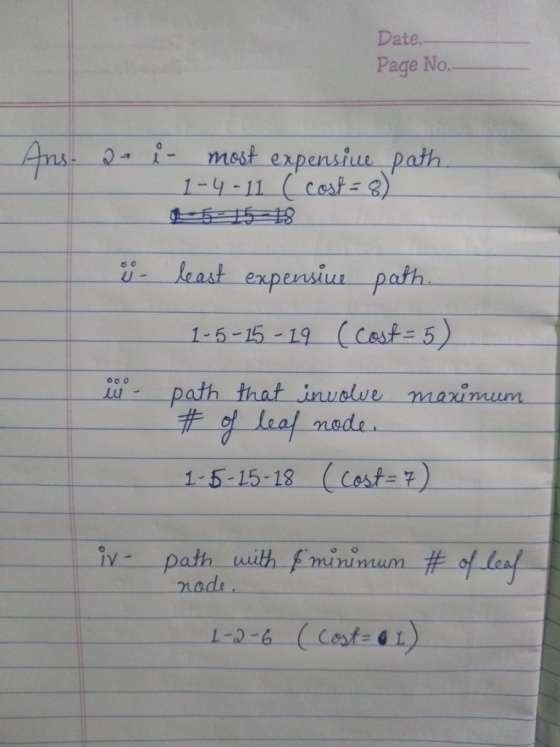
(2) For each of the paths identified, compute the cost for the attack leading to the root node Based on the paths, and the probability of apprehension determined, identify the paths according to each of the following criterion:
(i) The most expensive path. (3 marks)
(ii) The least expensive path. (3 marks)
(iii) The attack path that involves the maximum # of leaf nodes (break any tie by choosing the most expensive path). (3 marks)
(iv) The attack path that involves the minimum # of leaf
nodes (break any tie by choosing the least expensive path). (3
marks)
Homework Answers
Please ask for any query in the comment box before giving dislike to it if u didn't understand anything. Thank you
Add Answer to:
Consider the attack tree shown below. The integer outside a circle represents the node ID and integer inside a circle...
Question 3. (25 points) Consider the B+ tree index shown below. Each intermediate node can hold up to five pointers and four key values. Each leaf can hold up to four records, and leaf nodes are doub...
 Question 3. (25 points) Consider the B+ tree index shown below. Each intermediate node can hold up to five pointers and four key values. Each leaf can hold up to four records, and leaf nodes are doubly linked as usual, although these links are not shown in the figure. If you can borrow from or merge with both siblings, choose the right sibling. Answer the following questions 3080 I1 35425065 9098 12 68 69 70 79 98 99 1001105 30...
 Question 3. (25 points) Consider the B+ tree index shown below. Each intermediate node can hold up to five pointers and four key values. Each leaf can hold up to four records, and leaf nodes are doubly linked as usual, although these links are not shown in the figure. If you can borrow from or merge with both siblings, choose the right sibling. Answer the following questions 3080 I1 35425065 9098 12 68 69 70 79 98 99 1001105 30...
Most questions answered within 3 hours.
-
Where is the error in this code sequence?
String s1 = "Hello";
String s2 = "ello";...
asked 10 months ago -
Financial data for Joel de Paris, Inc., for last year
follow:
Joel de Paris, Inc.
Balance...
asked 10 months ago -
Consider this reaction:
Al2(SO4)3 (aq)+ BaCl3
(aq) Al2Cl6 (aq)- +
3BaSO4(s) . What is the...
asked 10 months ago -
Suppose that Savneet is considering increasing her
recent random sample from 20 car rentals to 40...
asked 10 months ago -
Trucks arrive at an unloading terminal at an average rate of 120
per hour.
Trucks arrive...
asked 10 months ago -
Why are methanol and ethanol completely soluble in water while
octanol is not very little soluble....
asked 10 months ago -
A facilities manager at a university reads in a research report
that the mean amount of...
asked 10 months ago -
When the CuSO4 is rehydrated by adding water to the anhydrous
compound, is this an endothermic...
asked 10 months ago -
A ray of sunlight is passing from diamond into crown glass; the
angle of incidence is...
asked 10 months ago -
A block of mass 0.249 kg is placed on top of a light, vertical
spring of...
asked 10 months ago -
how do the kidneys compensate in the presences of acidosis
a) trigger hyperventilate
b) reserve acid...
asked 10 months ago -
Question 501 pts
The rental rate of capital to the firm increases. Which of the
following...
asked 10 months ago