
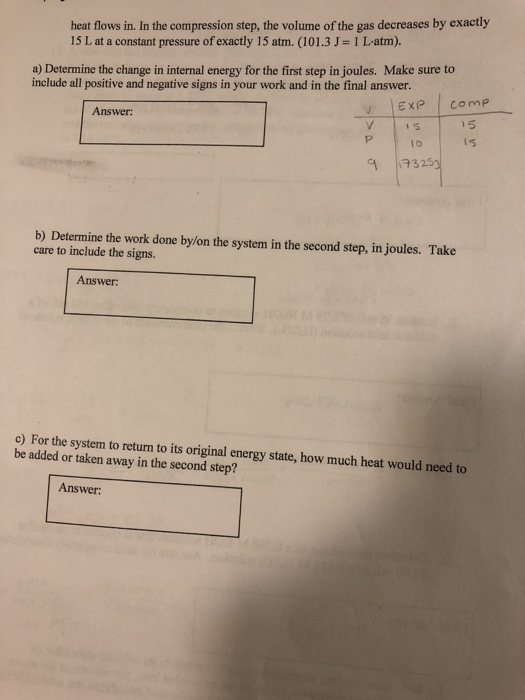
heat flows in. In the compression step, the volume of the gas decreases by exactly 15 L at a constant pressure of exactly 15 atm. (101.3 J 1 L-atm). a) Determine the change in internal energy for the first step in joules. Make sure to include all positive and negative signs in your work and in the final answer. ExP Comp 5 Answer: 93251 b) Determine the work done by/on the system in the second step, in joules. Take care to include the signs. Answer c) For the system to return to its original energy state, how much heat would need to be added or taken away in the second step? Answer:
Homework Answers
Add Answer to:
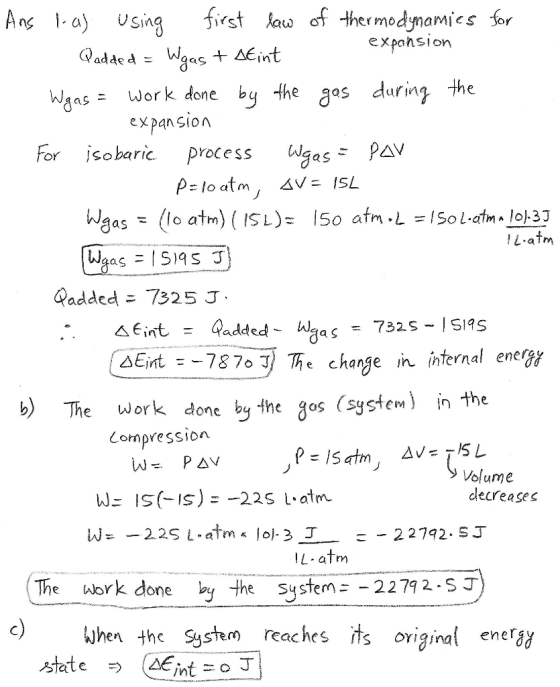
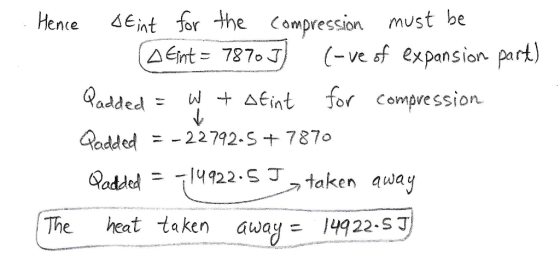
help on 1a and b please Final Answer: 43 125 1. In a steam engine, steam in a cylinder returns to its original stat...
2 more answer choices to question 9 6. One mole of an ideal gas is expanded...
 2 more answer choices to
question 9
6. One mole of an ideal gas is expanded from a volume of 1.00 liter to a volume of 3.83 liters against a constant extemal pressure of 1.00 atm. How much work (in joules) is performed on the surroundings? Ignore significant figures for this problem. (T = 300 K; 1 L'atm = 101.3 J) a. 143j b. 287 C. 8.60 x 10² J d. 388 J e, none of these 7. Calculate the...
2 more answer choices to
question 9
6. One mole of an ideal gas is expanded from a volume of 1.00 liter to a volume of 3.83 liters against a constant extemal pressure of 1.00 atm. How much work (in joules) is performed on the surroundings? Ignore significant figures for this problem. (T = 300 K; 1 L'atm = 101.3 J) a. 143j b. 287 C. 8.60 x 10² J d. 388 J e, none of these 7. Calculate the...
ylinder equipped with a piston. The initial volume of the cylinder 2. A fuel is burned...
 ylinder equipped with a piston. The initial volume of the cylinder 2. A fuel is burned in a cylinder equipped with a piston. 0.750 L, and the final volume is 0.990 L. If the piston expanas akan Il volume is 0.990 L. If the piston expands against a constant pressure of 2.35 atm, how much work (in J) is done? (1 L-atm = 101.3 J) Section: Name: Answer ALL questions. Show calculations for full credit. 1. A metallic pan which...
An engine using 1 mol of an ideal gas initially at 22.3 L and 454 K...
An engine using 1 mol of an ideal gas initially at 22.3 L and 454 K performs a cycle consisting of four steps: 1) an isothermal expansion at 454 K from 22.3 L to 40 L ; 2) cooling at constant volume to 270 K ; 3) an isothermal compression to its original volume of 22.3 L; and 4) heating at constant volume to its original temperature of 454 K . Find its efficiency. Assume that the heat capacity is...
An engine using 1 mol of an ideal gas initially at 22.3 L and 353 K...
An engine using 1 mol of an ideal gas initially at 22.3 L and 353 K performs a cycle consisting of four steps: 1) an isothermal expansion at 353 K from 22.3 L to 41.5 L; 2) cooling at constant volume to 170 K; 3) an isothermal compression to its original volume of 22.3 L; and 4) heating at constant volume to its original temperature of 353 K. Find its efficiency. Assume that the heat capacity is 21 J/K and...
An ideal gas is allowed to expand isothermally until it reaches its final volume. It is...
 An ideal gas is allowed to expand isothermally until it reaches its final volume. It is then heated at constant volume until it reaches its final pressure. The initial state of the gas is P1 = 2.93 atm, V1 = 1.00 L, and Eint 1 = 414 J, and its final state has volume V2 = 2.93 L and Eint 2 = 951 J. 1) Calculate the work done by the gas. Be careful with signs: if the work you...
The change in internal energy of a system (ΔE) can be described in terms of heat...
The change in internal energy of a system (ΔE) can be described in terms of heat (q) and work (w) according to the equation ΔE = q + w. The conversion of 40 g of liquid H2O to steam at 1.0 atm leads to an increase in its volume. This expansion exerts 4.545 kJ of work on the surroundings. If the increase in internal energy of the H2O is 85.724 kJ, how much heat energy does this vaporization process use?...
Professor Modyn owns another piston-cylinder device, which initially (State 1) contains 0.236 m3 of saturated water...
 Professor Modyn owns another piston-cylinder device, which initially (State 1) contains 0.236 m3 of saturated water vapor at 400.0 kPa. Heat is now slowly transferred to the steam until the volume doubles. Consider the expansion a two step process. First, constant volume heating occurs until the pressure reaches 500.0 kPa (State 2). Finally, a constant pressure expansion occurs resulting in the doubling of the initial volume (State 3) Note: The IUPAC sign convention for work is used. Work into the...
1. A crackpot inventor designs the following heat engine. (An annotated PV plot might help.) Step...
 1. A crackpot inventor designs the following heat engine. (An annotated PV plot might help.) Step D: Starting at State A (PA, VA, and TA25.0 °C), the gas undergoes a reversible and isothermal expansion until it reaches State B (PB = 1.000 atm, VB, and TB). Step : A dry ice / acetone bath is used to isochorically bring the gas to State C (Pc, Vc, and Tc -78.5 °C) Step : The gas undergoes a reversible adiabatic compression until...
Difference in final temperatures? Please show all steps Two containers (call them A and B) with...
 Difference in final temperatures? Please show all steps
Two containers (call them A and B) with the same initial volume, V 31 L, hold the same amount of monatomic ideal gas, say helium, at the same initial temperature T = 301 K and the same initial pressure Pi 1 atm. Container A holds the gas at a constant volume and Container B holds the gas at a constant pressure If you add Q 5389 J of heat to both containers,...
Difference in final temperatures? Please show all steps
Two containers (call them A and B) with the same initial volume, V 31 L, hold the same amount of monatomic ideal gas, say helium, at the same initial temperature T = 301 K and the same initial pressure Pi 1 atm. Container A holds the gas at a constant volume and Container B holds the gas at a constant pressure If you add Q 5389 J of heat to both containers,...
PLEASE ANSWER PART A AND B A Review Constants Periodic Table An expandable cube, initially 19...
 PLEASE ANSWER PART A AND B
A Review Constants Periodic Table An expandable cube, initially 19 cm on each side contains 2.3 g of helium at 20°C. 1100 J of heat energy are transferred to this gas. What is the final pressure if the process is at constant volume? Express your answer in atmospheres. ΙπΙ ΑΣΦ ? p = atm Submit Request Answer Part B What is the final volume if the process is at constant pressure? Express your answer...
PLEASE ANSWER PART A AND B
A Review Constants Periodic Table An expandable cube, initially 19 cm on each side contains 2.3 g of helium at 20°C. 1100 J of heat energy are transferred to this gas. What is the final pressure if the process is at constant volume? Express your answer in atmospheres. ΙπΙ ΑΣΦ ? p = atm Submit Request Answer Part B What is the final volume if the process is at constant pressure? Express your answer...
 2 more answer choices to
question 9
6. One mole of an ideal gas is expanded from a volume of 1.00 liter to a volume of 3.83 liters against a constant extemal pressure of 1.00 atm. How much work (in joules) is performed on the surroundings? Ignore significant figures for this problem. (T = 300 K; 1 L'atm = 101.3 J) a. 143j b. 287 C. 8.60 x 10² J d. 388 J e, none of these 7. Calculate the...
2 more answer choices to
question 9
6. One mole of an ideal gas is expanded from a volume of 1.00 liter to a volume of 3.83 liters against a constant extemal pressure of 1.00 atm. How much work (in joules) is performed on the surroundings? Ignore significant figures for this problem. (T = 300 K; 1 L'atm = 101.3 J) a. 143j b. 287 C. 8.60 x 10² J d. 388 J e, none of these 7. Calculate the...
 ylinder equipped with a piston. The initial volume of the cylinder 2. A fuel is burned in a cylinder equipped with a piston. 0.750 L, and the final volume is 0.990 L. If the piston expanas akan Il volume is 0.990 L. If the piston expands against a constant pressure of 2.35 atm, how much work (in J) is done? (1 L-atm = 101.3 J) Section: Name: Answer ALL questions. Show calculations for full credit. 1. A metallic pan which...
 An ideal gas is allowed to expand isothermally until it reaches its final volume. It is then heated at constant volume until it reaches its final pressure. The initial state of the gas is P1 = 2.93 atm, V1 = 1.00 L, and Eint 1 = 414 J, and its final state has volume V2 = 2.93 L and Eint 2 = 951 J. 1) Calculate the work done by the gas. Be careful with signs: if the work you...
 Professor Modyn owns another piston-cylinder device, which initially (State 1) contains 0.236 m3 of saturated water vapor at 400.0 kPa. Heat is now slowly transferred to the steam until the volume doubles. Consider the expansion a two step process. First, constant volume heating occurs until the pressure reaches 500.0 kPa (State 2). Finally, a constant pressure expansion occurs resulting in the doubling of the initial volume (State 3) Note: The IUPAC sign convention for work is used. Work into the...
 1. A crackpot inventor designs the following heat engine. (An annotated PV plot might help.) Step D: Starting at State A (PA, VA, and TA25.0 °C), the gas undergoes a reversible and isothermal expansion until it reaches State B (PB = 1.000 atm, VB, and TB). Step : A dry ice / acetone bath is used to isochorically bring the gas to State C (Pc, Vc, and Tc -78.5 °C) Step : The gas undergoes a reversible adiabatic compression until...
 Difference in final temperatures? Please show all steps
Two containers (call them A and B) with the same initial volume, V 31 L, hold the same amount of monatomic ideal gas, say helium, at the same initial temperature T = 301 K and the same initial pressure Pi 1 atm. Container A holds the gas at a constant volume and Container B holds the gas at a constant pressure If you add Q 5389 J of heat to both containers,...
Difference in final temperatures? Please show all steps
Two containers (call them A and B) with the same initial volume, V 31 L, hold the same amount of monatomic ideal gas, say helium, at the same initial temperature T = 301 K and the same initial pressure Pi 1 atm. Container A holds the gas at a constant volume and Container B holds the gas at a constant pressure If you add Q 5389 J of heat to both containers,...
 PLEASE ANSWER PART A AND B
A Review Constants Periodic Table An expandable cube, initially 19 cm on each side contains 2.3 g of helium at 20°C. 1100 J of heat energy are transferred to this gas. What is the final pressure if the process is at constant volume? Express your answer in atmospheres. ΙπΙ ΑΣΦ ? p = atm Submit Request Answer Part B What is the final volume if the process is at constant pressure? Express your answer...
PLEASE ANSWER PART A AND B
A Review Constants Periodic Table An expandable cube, initially 19 cm on each side contains 2.3 g of helium at 20°C. 1100 J of heat energy are transferred to this gas. What is the final pressure if the process is at constant volume? Express your answer in atmospheres. ΙπΙ ΑΣΦ ? p = atm Submit Request Answer Part B What is the final volume if the process is at constant pressure? Express your answer...
Most questions answered within 3 hours.
-
Where is the error in this code sequence?
String s1 = "Hello";
String s2 = "ello";...
asked 10 months ago -
Financial data for Joel de Paris, Inc., for last year
follow:
Joel de Paris, Inc.
Balance...
asked 10 months ago -
Consider this reaction:
Al2(SO4)3 (aq)+ BaCl3
(aq) Al2Cl6 (aq)- +
3BaSO4(s) . What is the...
asked 10 months ago -
Suppose that Savneet is considering increasing her
recent random sample from 20 car rentals to 40...
asked 10 months ago -
Trucks arrive at an unloading terminal at an average rate of 120
per hour.
Trucks arrive...
asked 10 months ago -
Why are methanol and ethanol completely soluble in water while
octanol is not very little soluble....
asked 10 months ago -
A facilities manager at a university reads in a research report
that the mean amount of...
asked 10 months ago -
When the CuSO4 is rehydrated by adding water to the anhydrous
compound, is this an endothermic...
asked 10 months ago -
A ray of sunlight is passing from diamond into crown glass; the
angle of incidence is...
asked 10 months ago -
A block of mass 0.249 kg is placed on top of a light, vertical
spring of...
asked 10 months ago -
how do the kidneys compensate in the presences of acidosis
a) trigger hyperventilate
b) reserve acid...
asked 10 months ago -
Question 501 pts
The rental rate of capital to the firm increases. Which of the
following...
asked 10 months ago