how to predict how much load can a truss bridge carry using matlab?
Homework Answers
PLEASE SOLVED AND EXPLAIN The joints C, D and E of a bridge truss carry equal...
 PLEASE SOLVED AND EXPLAIN
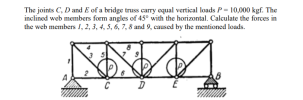
The joints C, D and E of a bridge truss carry equal vertical loads P = 10,000 kgf. The inclined web members form angles of 45° with the horizontal. Calculate the forces in the web members 1, 2, 3, 4, 5, 6, 7, 8 and 9, caused by the mentioned loads.
PLEASE SOLVED AND EXPLAIN
The joints C, D and E of a bridge truss carry equal vertical loads P = 10,000 kgf. The inclined web members form angles of 45° with the horizontal. Calculate the forces in the web members 1, 2, 3, 4, 5, 6, 7, 8 and 9, caused by the mentioned loads.
A) What can we predict that there are some problems in simply supported beam bridge and...
 A) What can we predict that there are some problems in
simply supported beam bridge and how do we improve or prevent the
situation?
B) How to conclude the significance of the simply
supported beam bridge construction and what is the implication of
it?
C) How to summarize the impact of simply supported
beam applied on the bridge as shown in figure below
like how the load are been used and how the support functioned on
the bridge.
D) Why...
A) What can we predict that there are some problems in
simply supported beam bridge and how do we improve or prevent the
situation?
B) How to conclude the significance of the simply
supported beam bridge construction and what is the implication of
it?
C) How to summarize the impact of simply supported
beam applied on the bridge as shown in figure below
like how the load are been used and how the support functioned on
the bridge.
D) Why...
Designing a truss bridge This lab involves the design of a truss bridge, which is a...
 Designing a truss bridge This lab involves the design of a truss bridge, which is a Pratt truss and should be designed to handle the loads shown in Fig- ure l (1 kip = 1000 lb). Note that the loads are the same on each of the two trusses for the bridge, so what is in Figure 1 is only half the loading on the bridge. Your job is to develop an optimal design for the bridge, Figure 1. Schematic...
A bucking analysis of the bridge section reveals that the vertical truss members can safely support...
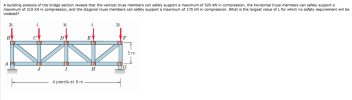 A bucking analysis of the bridge section reveals that the
vertical truss members can safely support a maximum of 525 kN in
compression, the horizontal truss members can safely support a
maximum of 310 kN in compression, and the diagonal truss members
can safely support a maximum of 170 kN in compression. What is the
largest value of L for which no safety requirement will be
violated?
A buckling analysis of the bridge section reveals that the vertical truss members...
A bucking analysis of the bridge section reveals that the
vertical truss members can safely support a maximum of 525 kN in
compression, the horizontal truss members can safely support a
maximum of 310 kN in compression, and the diagonal truss members
can safely support a maximum of 170 kN in compression. What is the
largest value of L for which no safety requirement will be
violated?
A buckling analysis of the bridge section reveals that the vertical truss members...
Problem 1 (Scorelator) Consider the truss bridge diagrammed below. The bridge is composed of trus...
 solve a-c
Problem 1 (Scorelator) Consider the truss bridge diagrammed below. The bridge is composed of trusses (steel beams) that are connected at joints or nodes. Each truss exerts a force, F, on the nodes that t touches. When the bridge is at rest, these forces balance. A positive force means that the beam is in tension: it is being pulled apart by the nodes. A negative force means that the beam is being pushed inwards and is in compression...
solve a-c
Problem 1 (Scorelator) Consider the truss bridge diagrammed below. The bridge is composed of trusses (steel beams) that are connected at joints or nodes. Each truss exerts a force, F, on the nodes that t touches. When the bridge is at rest, these forces balance. A positive force means that the beam is in tension: it is being pulled apart by the nodes. A negative force means that the beam is being pushed inwards and is in compression...
Q.3 For the non-parallel chord truss bridge shown in Fig. 3(a) (1) determine the influence lines...
 Q.3 For the non-parallel chord truss bridge shown in Fig. 3(a) (1) determine the influence lines for Fco, Fca and Fee: (2) The bridge is to be designed for the equivalent moving load detailed in Fig. 3(b). Compute the maximum tensile and compressive axial forces in member Cd. (Answer: Fcd max, T = 133.46 kN) L L P-115 kN JI ,-10 kN/m 4.5m 6@5m (Note that L2 may be varied or split up to achieve the desired effects, and that...
Consider the truss If the roller at B can sustain a maximum load of 3KN. determine the largest magnitude of each of the three forces F that can be Supported by the truss.
Consider the truss If the roller at B can sustain a maximum load of 3KN. determine the largest magnitude of each of the three forces F that can be Supported by the truss.
Students are required to simulate the diode half bridge and full bridge rectifier using MATLAB. Together...
Students are required to simulate the diode half bridge and full bridge rectifier using MATLAB. Together with the simulation, students are required to show the waveform associated with the respective circuits. Suggest ways to improve the output DC voltage by connecting the following filters: 1. Capacitor filters. 2. Inductor filters, 3. π filter 4. L filters.
Problem 2: Calculate the force in all members of the truss shown in Fig. 2 by using MATLAB code. ...
 Problem 2: Calculate the force in all members of the truss shown in Fig. 2 by using MATLAB code. 50 kN 30 KN 4 m 5 m E 3 m 4 m 4 m Figure 2. Schematic of problem 2.
Problem 2: Calculate the force in all members of the truss shown in Fig. 2 by using MATLAB code. 50 kN 30 KN 4 m 5 m E 3 m 4 m 4 m Figure 2. Schematic of problem 2.
Problem 2: Calculate the force in all members of the truss shown in Fig. 2 by using MATLAB code. 50 kN 30 KN 4 m 5 m E 3 m 4 m 4 m Figure 2. Schematic of problem 2.
Problem #11 Draw the influence line for the force in member IH of the bridge truss....
 Problem #11 Draw the influence line for the force in member IH of the bridge truss. Determine the maximum force (tension or compression) that can be developed in this member due to a 72-k truck having the wheel loads shown. Assume the truck can travel in either direction along the center of the deck, so that half its load is transferred to each of the two side trusses. Also assume the members are pin connected at the gusset plates. 32...
 PLEASE SOLVED AND EXPLAIN
The joints C, D and E of a bridge truss carry equal vertical loads P = 10,000 kgf. The inclined web members form angles of 45° with the horizontal. Calculate the forces in the web members 1, 2, 3, 4, 5, 6, 7, 8 and 9, caused by the mentioned loads.
PLEASE SOLVED AND EXPLAIN
The joints C, D and E of a bridge truss carry equal vertical loads P = 10,000 kgf. The inclined web members form angles of 45° with the horizontal. Calculate the forces in the web members 1, 2, 3, 4, 5, 6, 7, 8 and 9, caused by the mentioned loads.
 A) What can we predict that there are some problems in
simply supported beam bridge and how do we improve or prevent the
situation?
B) How to conclude the significance of the simply
supported beam bridge construction and what is the implication of
it?
C) How to summarize the impact of simply supported
beam applied on the bridge as shown in figure below
like how the load are been used and how the support functioned on
the bridge.
D) Why...
A) What can we predict that there are some problems in
simply supported beam bridge and how do we improve or prevent the
situation?
B) How to conclude the significance of the simply
supported beam bridge construction and what is the implication of
it?
C) How to summarize the impact of simply supported
beam applied on the bridge as shown in figure below
like how the load are been used and how the support functioned on
the bridge.
D) Why...
 Designing a truss bridge This lab involves the design of a truss bridge, which is a Pratt truss and should be designed to handle the loads shown in Fig- ure l (1 kip = 1000 lb). Note that the loads are the same on each of the two trusses for the bridge, so what is in Figure 1 is only half the loading on the bridge. Your job is to develop an optimal design for the bridge, Figure 1. Schematic...
 A bucking analysis of the bridge section reveals that the
vertical truss members can safely support a maximum of 525 kN in
compression, the horizontal truss members can safely support a
maximum of 310 kN in compression, and the diagonal truss members
can safely support a maximum of 170 kN in compression. What is the
largest value of L for which no safety requirement will be
violated?
A buckling analysis of the bridge section reveals that the vertical truss members...
A bucking analysis of the bridge section reveals that the
vertical truss members can safely support a maximum of 525 kN in
compression, the horizontal truss members can safely support a
maximum of 310 kN in compression, and the diagonal truss members
can safely support a maximum of 170 kN in compression. What is the
largest value of L for which no safety requirement will be
violated?
A buckling analysis of the bridge section reveals that the vertical truss members...
 solve a-c
Problem 1 (Scorelator) Consider the truss bridge diagrammed below. The bridge is composed of trusses (steel beams) that are connected at joints or nodes. Each truss exerts a force, F, on the nodes that t touches. When the bridge is at rest, these forces balance. A positive force means that the beam is in tension: it is being pulled apart by the nodes. A negative force means that the beam is being pushed inwards and is in compression...
solve a-c
Problem 1 (Scorelator) Consider the truss bridge diagrammed below. The bridge is composed of trusses (steel beams) that are connected at joints or nodes. Each truss exerts a force, F, on the nodes that t touches. When the bridge is at rest, these forces balance. A positive force means that the beam is in tension: it is being pulled apart by the nodes. A negative force means that the beam is being pushed inwards and is in compression...
 Q.3 For the non-parallel chord truss bridge shown in Fig. 3(a) (1) determine the influence lines for Fco, Fca and Fee: (2) The bridge is to be designed for the equivalent moving load detailed in Fig. 3(b). Compute the maximum tensile and compressive axial forces in member Cd. (Answer: Fcd max, T = 133.46 kN) L L P-115 kN JI ,-10 kN/m 4.5m 6@5m (Note that L2 may be varied or split up to achieve the desired effects, and that...
 Problem 2: Calculate the force in all members of the truss shown in Fig. 2 by using MATLAB code. 50 kN 30 KN 4 m 5 m E 3 m 4 m 4 m Figure 2. Schematic of problem 2.
Problem 2: Calculate the force in all members of the truss shown in Fig. 2 by using MATLAB code. 50 kN 30 KN 4 m 5 m E 3 m 4 m 4 m Figure 2. Schematic of problem 2.
Problem 2: Calculate the force in all members of the truss shown in Fig. 2 by using MATLAB code. 50 kN 30 KN 4 m 5 m E 3 m 4 m 4 m Figure 2. Schematic of problem 2.
 Problem #11 Draw the influence line for the force in member IH of the bridge truss. Determine the maximum force (tension or compression) that can be developed in this member due to a 72-k truck having the wheel loads shown. Assume the truck can travel in either direction along the center of the deck, so that half its load is transferred to each of the two side trusses. Also assume the members are pin connected at the gusset plates. 32...
Most questions answered within 3 hours.
-
Where is the error in this code sequence?
String s1 = "Hello";
String s2 = "ello";...
asked 10 months ago -
Financial data for Joel de Paris, Inc., for last year
follow:
Joel de Paris, Inc.
Balance...
asked 10 months ago -
Consider this reaction:
Al2(SO4)3 (aq)+ BaCl3
(aq) Al2Cl6 (aq)- +
3BaSO4(s) . What is the...
asked 10 months ago -
Suppose that Savneet is considering increasing her
recent random sample from 20 car rentals to 40...
asked 10 months ago -
Trucks arrive at an unloading terminal at an average rate of 120
per hour.
Trucks arrive...
asked 10 months ago -
Why are methanol and ethanol completely soluble in water while
octanol is not very little soluble....
asked 10 months ago -
A facilities manager at a university reads in a research report
that the mean amount of...
asked 10 months ago -
When the CuSO4 is rehydrated by adding water to the anhydrous
compound, is this an endothermic...
asked 10 months ago -
A ray of sunlight is passing from diamond into crown glass; the
angle of incidence is...
asked 10 months ago -
A block of mass 0.249 kg is placed on top of a light, vertical
spring of...
asked 10 months ago -
how do the kidneys compensate in the presences of acidosis
a) trigger hyperventilate
b) reserve acid...
asked 10 months ago -
Question 501 pts
The rental rate of capital to the firm increases. Which of the
following...
asked 10 months ago