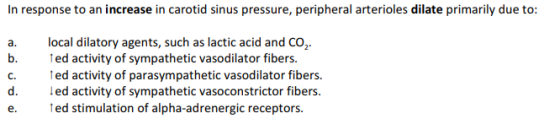
Increase in carotid sinus causes peripheral arterioles is due to
Homework Answers
Option C is the correct one as in response to an increase in carotid sinus pressure, peripheral arterioles dilate primarily due to increased activity of the parasympathetic vasoconstrictor fibers, incraesing the cardiac output and thus decrease the blood pressure.
Add Answer to:
Increase in carotid sinus causes peripheral arterioles is due to In response to an increase in carotid sinus pressure,...
Can you please help me to find Possible test questions? Course Here.com Test #4 " Autonomic...
 Can you please help me to find Possible test questions?
Course Here.com Test #4 " Autonomic Nervous System Overview of the Autonomic Nervous System (ANSH Maior Functions: maintain optimal muscle in order to maintain homeostatic state within the body Aalso is inv performance of visceral organs, glands, smooth muscle, and cardiac not under conscious control: regulates heart rate, blood pressure, MOST "effectors" (organs & tissues regulated) are visceral- r function, and secretions emperaturs smooth musele contraction, glandula most are not...
Can you please help me to find Possible test questions?
Course Here.com Test #4 " Autonomic Nervous System Overview of the Autonomic Nervous System (ANSH Maior Functions: maintain optimal muscle in order to maintain homeostatic state within the body Aalso is inv performance of visceral organs, glands, smooth muscle, and cardiac not under conscious control: regulates heart rate, blood pressure, MOST "effectors" (organs & tissues regulated) are visceral- r function, and secretions emperaturs smooth musele contraction, glandula most are not...
QUESTION 1 Vasovagal syncope is one of the most common causes of fainting and occurs in...
QUESTION 1 Vasovagal syncope is one of the most common causes of fainting and occurs in some individuals when they see blood or a needle. Which of the following physiological responses occurs? reduced cerebral blood flow decreased blood pressure decreased heart rate All the alternatives 2 points QUESTION 2 Calculate mean arterial pressure (MAP) if a person has a blood pressure reading of 107/72. 96 mm Hg 76 mm Hg 119 mm Hg 84 mm Hg 2 points ...
DATE: NURS 208A NAME: 1. The function of ribosomes is to: 6. Inb Digest foreign bacteria...
 DATE: NURS 208A NAME: 1. The function of ribosomes is to: 6. Inb Digest foreign bacteria and toxic substances Produces energy from glucose y Aid in cell division Synthesize proteins Which of the following statement is false about the cell membrane? 2. Cell membrane is composed of phospholipid layer The cell membrane prefers large molecules to pass through freely Cell membrane is a semipermeable boundary which determines what can enter and ex the cell The exterior surface is hydrophilic phosphate...
1. According to the paper, what does lactate dehydrogenase (LDH) do and what does it allow...
 1. According to the paper, what does lactate dehydrogenase
(LDH) do and what does it allow to happen within the myofiber? (5
points)
2. According to the paper, what is the major disadvantage of
relying on glycolysis during high-intensity exercise? (5
points)
3. Using Figure 1 in the paper, briefly describe the different
sources of ATP production at 50% versus 90% AND explain whether you
believe this depiction of ATP production applies to a Type IIX
myofiber in a human....
1. According to the paper, what does lactate dehydrogenase
(LDH) do and what does it allow to happen within the myofiber? (5
points)
2. According to the paper, what is the major disadvantage of
relying on glycolysis during high-intensity exercise? (5
points)
3. Using Figure 1 in the paper, briefly describe the different
sources of ATP production at 50% versus 90% AND explain whether you
believe this depiction of ATP production applies to a Type IIX
myofiber in a human....
 Can you please help me to find Possible test questions?
Course Here.com Test #4 " Autonomic Nervous System Overview of the Autonomic Nervous System (ANSH Maior Functions: maintain optimal muscle in order to maintain homeostatic state within the body Aalso is inv performance of visceral organs, glands, smooth muscle, and cardiac not under conscious control: regulates heart rate, blood pressure, MOST "effectors" (organs & tissues regulated) are visceral- r function, and secretions emperaturs smooth musele contraction, glandula most are not...
Can you please help me to find Possible test questions?
Course Here.com Test #4 " Autonomic Nervous System Overview of the Autonomic Nervous System (ANSH Maior Functions: maintain optimal muscle in order to maintain homeostatic state within the body Aalso is inv performance of visceral organs, glands, smooth muscle, and cardiac not under conscious control: regulates heart rate, blood pressure, MOST "effectors" (organs & tissues regulated) are visceral- r function, and secretions emperaturs smooth musele contraction, glandula most are not...
 DATE: NURS 208A NAME: 1. The function of ribosomes is to: 6. Inb Digest foreign bacteria and toxic substances Produces energy from glucose y Aid in cell division Synthesize proteins Which of the following statement is false about the cell membrane? 2. Cell membrane is composed of phospholipid layer The cell membrane prefers large molecules to pass through freely Cell membrane is a semipermeable boundary which determines what can enter and ex the cell The exterior surface is hydrophilic phosphate...
 1. According to the paper, what does lactate dehydrogenase
(LDH) do and what does it allow to happen within the myofiber? (5
points)
2. According to the paper, what is the major disadvantage of
relying on glycolysis during high-intensity exercise? (5
points)
3. Using Figure 1 in the paper, briefly describe the different
sources of ATP production at 50% versus 90% AND explain whether you
believe this depiction of ATP production applies to a Type IIX
myofiber in a human....
1. According to the paper, what does lactate dehydrogenase
(LDH) do and what does it allow to happen within the myofiber? (5
points)
2. According to the paper, what is the major disadvantage of
relying on glycolysis during high-intensity exercise? (5
points)
3. Using Figure 1 in the paper, briefly describe the different
sources of ATP production at 50% versus 90% AND explain whether you
believe this depiction of ATP production applies to a Type IIX
myofiber in a human....
Most questions answered within 3 hours.
-
Where is the error in this code sequence?
String s1 = "Hello";
String s2 = "ello";...
asked 10 months ago -
Financial data for Joel de Paris, Inc., for last year
follow:
Joel de Paris, Inc.
Balance...
asked 10 months ago -
Consider this reaction:
Al2(SO4)3 (aq)+ BaCl3
(aq) Al2Cl6 (aq)- +
3BaSO4(s) . What is the...
asked 10 months ago -
Suppose that Savneet is considering increasing her
recent random sample from 20 car rentals to 40...
asked 10 months ago -
Trucks arrive at an unloading terminal at an average rate of 120
per hour.
Trucks arrive...
asked 10 months ago -
Why are methanol and ethanol completely soluble in water while
octanol is not very little soluble....
asked 10 months ago -
A facilities manager at a university reads in a research report
that the mean amount of...
asked 10 months ago -
When the CuSO4 is rehydrated by adding water to the anhydrous
compound, is this an endothermic...
asked 10 months ago -
A ray of sunlight is passing from diamond into crown glass; the
angle of incidence is...
asked 10 months ago -
A block of mass 0.249 kg is placed on top of a light, vertical
spring of...
asked 10 months ago -
how do the kidneys compensate in the presences of acidosis
a) trigger hyperventilate
b) reserve acid...
asked 10 months ago -
Question 501 pts
The rental rate of capital to the firm increases. Which of the
following...
asked 10 months ago