
Homework Answers
- Total Hydrogens attached to Carbon are 3+2+2+2+2+1=12. Thus, no hydrogen attached to Oxygen.
- 2 Hydrogens are doublet with same chemical shift of 7.7 ppm and 2 other Hydrogens having same chemical shift of 7.3 ppm. This suggests a benzene ring with 2 substituent at para to each other.
- IR peak corresponding to 3040 confirms this.
- 3H (triplet) at 1.1 ppm suggests a Methyl group adjoining to a -CH2- group.
- IR Peak of 2850 and 2750 confirms this
- 2 Hydrogens (Quartet) also confirms this. These hydrogens belong to the -CH2- group which was adjoining to the Methyl group.
- However, notice that these hydrogens are quartet. This means that on the other side of -CH2- group., there is either a Heteroatom or the benzene ring itself.
- Moreover, the chemical shift of Hydrogen on -CH2- group. is 3.5 ppm. This suggests presence of an Oxygen on the other side.
- Degree of unsaturation is 5 out of which 4 are accounted for by the benzene ring and 1 double bond may be there.
- One H, singlet at 9.9 ppm indicates an aldehydic group (All the doubles bond accounted for.)
- So, till now, we have figured out the adjoining figure
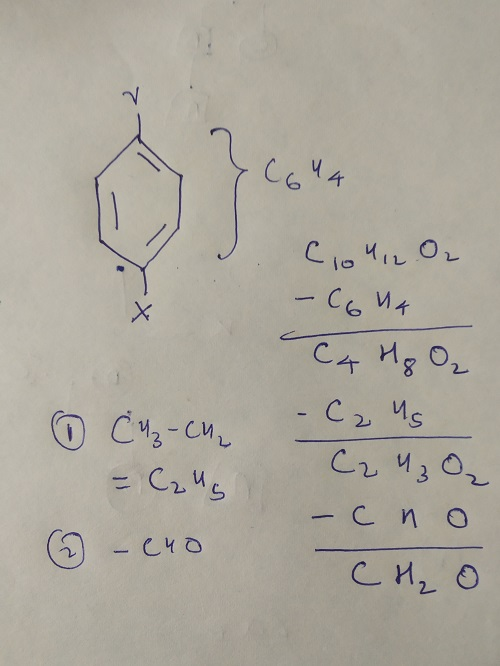
- The only thing remaining are a -CH2 group and an Oxygen atom, which possibly constitutes an ether group. Further, the remaining Hydrogens on -CH2- are a singlet and are chemically shifted by 4.5 ppm. This indicates presence of Oxygen adjoining to this -CH2- as well.
- Finally, we place all the things together and find out that this is our structure.
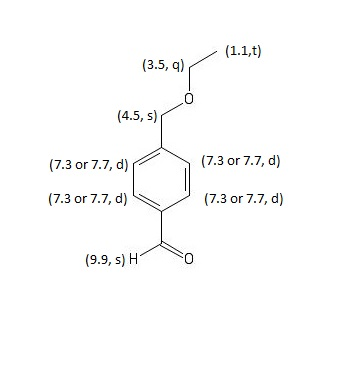
In the above figure, the value of Chemical shifts is only for your understanding. The question asks you only to mention the multiplicity i.e. s, d, t or q.
Add Answer to:
57. A C10H12O2 molecule shows IR absorptions at 3040, 2850, 2750, 1695, 1600, 1587, and 1270 cm. The ratio of carbo...
56. A CuH12O2 molecule shows IR absorptions at 3040, 2850, 2750, 1705, 1600, 1587, and 1230...
 56. A CuH12O2 molecule shows IR absorptions at 3040, 2850, 2750, 1705, 1600, 1587, and 1230 cm! The ratio of carbon-bonded hydrogens in it's 'H-NMR spectrum is, 2:2:2:2:1:1:1:1, with corresponding signal multiplicities of d, d, d, d, ddt, dd, dd & t. The corresponding chemical shifts are 8 = 7.1, 6.9, 4.7, 3.7, 6.1, 5.4, 5.3 and 9.7. The proton decoupled "3C-NMR spectrum has 9 signals. Predict the structure & match the multiplicity and chemical shift of each nonequivalent set...
36. SPECTROSCOPY: A C1H100 molecule shows IR absorptions at 3070, 1710, 1601, and 1590 cm"! The...
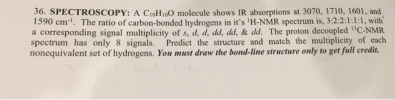 36. SPECTROSCOPY: A C1H100 molecule shows IR absorptions at 3070, 1710, 1601, and 1590 cm"! The ratio of carbon-bonded hydrogens in it's 'H-NMR spectrum is, 3:2:2:1:1:1, with a corresponding signal multiplicity of s, d, d, dd, dd, & dd. The proton decoupled "C-NMR spectrum has only 8 signals. Predict the structure and match the multiplicity of each nonequivalent set of hydrogens. You must draw the bond-line structure only to get full credit.
C7H120 molecule shows strong peaks at 3050. 1690, and 1600 cm. The ratio of carbon- bonded...
 C7H120 molecule shows strong peaks at 3050. 1690, and 1600 cm. The ratio of carbon- bonded hydrogens in its 'HNMR spectrum is, 3:3:3:2:1, with a corresponding signal multiplicity of s, , 1, 9, and s. Its proton decoupled 13CNMR spectrum has 7 signals, Predict the structure and match the multiplicity of each nonequivalent set of hydrogens.
33. A C6H100 molecule shows IR peaks at 3060. 1710 and 1601cm. It's proton decoupled "C....
 33. A C6H100 molecule shows IR peaks at 3060. 1710 and 1601cm. It's proton decoupled "C. NMR spectrum has 6 signals. The ratio of carbon-bonded hydrogens in its 'H-NMR spectrum is, 3:3:2:1:1, with a corresponding signal multiplicity of s, d, d, d oft, &d of q. The corresponding chemical shifts are 2.25, 2.05, 3.12, 5.72, and 5.62. Predict the structure and match the multiplicity of each nonequivalent set of hydrogens.
A CH100 molecule shows IR peaks at 3060. 1710 and 1601cm. It's proton NMR spectrum has...
 A CH100 molecule shows IR peaks at 3060. 1710 and 1601cm. It's proton NMR spectrum has 6 signals. The ratio of carbon bonded hydrogens in its 'HR 3:3:2:1:1, with a corresponding signal multiplicity of d, t, q, d, &d of q. The corte chemical shifts are 2.05, 1.11, 2.98, 6.08, and 6.82. Predict the structure and mate multiplicity of each nonequivalent set of hydrogens. . It's proton decoupled 13C- ed hydrogens in its 'H-NMR spectrum is, 1.9, d, & d...
Combined Spectroscopy Problem: Determine the structure of the following comp on the IR, 'H & C...
 Combined Spectroscopy Problem: Determine the structure of the following comp on the IR, 'H & C NMR information given. Draw the bond line structure for ne following compounds based ne structure for full credit. 52.A C1H160 molecule shows a broad IR peak at 3400 cm: absorptions at 3045 and 2 strong absorptions at 1600, 1498 cm '; and 1205 cm! The ratio of carbon-bonded hya its 'H-NMR spectrum is, 6:3:2:2:1:1, with a corresponding signal multiplicity of d, a, a, 4:4...
 56. A CuH12O2 molecule shows IR absorptions at 3040, 2850, 2750, 1705, 1600, 1587, and 1230 cm! The ratio of carbon-bonded hydrogens in it's 'H-NMR spectrum is, 2:2:2:2:1:1:1:1, with corresponding signal multiplicities of d, d, d, d, ddt, dd, dd & t. The corresponding chemical shifts are 8 = 7.1, 6.9, 4.7, 3.7, 6.1, 5.4, 5.3 and 9.7. The proton decoupled "3C-NMR spectrum has 9 signals. Predict the structure & match the multiplicity and chemical shift of each nonequivalent set...
 36. SPECTROSCOPY: A C1H100 molecule shows IR absorptions at 3070, 1710, 1601, and 1590 cm"! The ratio of carbon-bonded hydrogens in it's 'H-NMR spectrum is, 3:2:2:1:1:1, with a corresponding signal multiplicity of s, d, d, dd, dd, & dd. The proton decoupled "C-NMR spectrum has only 8 signals. Predict the structure and match the multiplicity of each nonequivalent set of hydrogens. You must draw the bond-line structure only to get full credit.
 C7H120 molecule shows strong peaks at 3050. 1690, and 1600 cm. The ratio of carbon- bonded hydrogens in its 'HNMR spectrum is, 3:3:3:2:1, with a corresponding signal multiplicity of s, , 1, 9, and s. Its proton decoupled 13CNMR spectrum has 7 signals, Predict the structure and match the multiplicity of each nonequivalent set of hydrogens.
 33. A C6H100 molecule shows IR peaks at 3060. 1710 and 1601cm. It's proton decoupled "C. NMR spectrum has 6 signals. The ratio of carbon-bonded hydrogens in its 'H-NMR spectrum is, 3:3:2:1:1, with a corresponding signal multiplicity of s, d, d, d oft, &d of q. The corresponding chemical shifts are 2.25, 2.05, 3.12, 5.72, and 5.62. Predict the structure and match the multiplicity of each nonequivalent set of hydrogens.
 A CH100 molecule shows IR peaks at 3060. 1710 and 1601cm. It's proton NMR spectrum has 6 signals. The ratio of carbon bonded hydrogens in its 'HR 3:3:2:1:1, with a corresponding signal multiplicity of d, t, q, d, &d of q. The corte chemical shifts are 2.05, 1.11, 2.98, 6.08, and 6.82. Predict the structure and mate multiplicity of each nonequivalent set of hydrogens. . It's proton decoupled 13C- ed hydrogens in its 'H-NMR spectrum is, 1.9, d, & d...
 Combined Spectroscopy Problem: Determine the structure of the following comp on the IR, 'H & C NMR information given. Draw the bond line structure for ne following compounds based ne structure for full credit. 52.A C1H160 molecule shows a broad IR peak at 3400 cm: absorptions at 3045 and 2 strong absorptions at 1600, 1498 cm '; and 1205 cm! The ratio of carbon-bonded hya its 'H-NMR spectrum is, 6:3:2:2:1:1, with a corresponding signal multiplicity of d, a, a, 4:4...
Most questions answered within 3 hours.
-
Where is the error in this code sequence?
String s1 = "Hello";
String s2 = "ello";...
asked 10 months ago -
Financial data for Joel de Paris, Inc., for last year
follow:
Joel de Paris, Inc.
Balance...
asked 10 months ago -
Consider this reaction:
Al2(SO4)3 (aq)+ BaCl3
(aq) Al2Cl6 (aq)- +
3BaSO4(s) . What is the...
asked 10 months ago -
Suppose that Savneet is considering increasing her
recent random sample from 20 car rentals to 40...
asked 10 months ago -
Trucks arrive at an unloading terminal at an average rate of 120
per hour.
Trucks arrive...
asked 10 months ago -
Why are methanol and ethanol completely soluble in water while
octanol is not very little soluble....
asked 10 months ago -
A facilities manager at a university reads in a research report
that the mean amount of...
asked 10 months ago -
When the CuSO4 is rehydrated by adding water to the anhydrous
compound, is this an endothermic...
asked 10 months ago -
A ray of sunlight is passing from diamond into crown glass; the
angle of incidence is...
asked 10 months ago -
A block of mass 0.249 kg is placed on top of a light, vertical
spring of...
asked 10 months ago -
how do the kidneys compensate in the presences of acidosis
a) trigger hyperventilate
b) reserve acid...
asked 10 months ago -
Question 501 pts
The rental rate of capital to the firm increases. Which of the
following...
asked 10 months ago