
Homework Answers
Add Answer to:
The final step in the synthesis of naproxen (the active ingredient in the commercial painkiller Aleve) involves a Willi...
The final step in the synthesis of naproxen (the active ingredient in the commercial painkiller Aleve)...
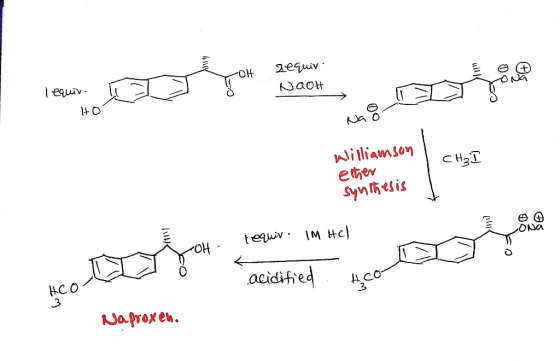
 The final step in the synthesis of naproxen (the active ingredient in the commercial painkiller Aleve) involves a Williamson ether synthesis. Propose a mechanism for the transformation shown below. Include all charges and intermediates and stoichiometric equivalents of each of the reagents used (.e. 1 equivalent, 2 equivalents, excess, etc...). [3 Marks] LOH hoben naproxen
The final step in the synthesis of naproxen (the active ingredient in the commercial painkiller Aleve) involves a Willi...
 The final step in the synthesis of naproxen (the active
ingredient in the commercial painkiller Aleve) involves a
Williamson ether synthesis. Propose a mechanism for the
transformation shown below. Include all charges and intermediates
and stoichiometric equivalents of each of the reagents used (i.e. 1
equivalent, 2 equivalents, excess, etc...).
Synthesis Scenario: Propose a mechanism for the Williamson ether synthesis of diphenhydramine hydrochloride (Benadryl) from bromodiphenylmethane, and 2-dimethylamino)ethanol. Include all charges and intermediates. To achieve full marks, use arrows to...
The final step in the synthesis of naproxen (the active
ingredient in the commercial painkiller Aleve) involves a
Williamson ether synthesis. Propose a mechanism for the
transformation shown below. Include all charges and intermediates
and stoichiometric equivalents of each of the reagents used (i.e. 1
equivalent, 2 equivalents, excess, etc...).
Synthesis Scenario: Propose a mechanism for the Williamson ether synthesis of diphenhydramine hydrochloride (Benadryl) from bromodiphenylmethane, and 2-dimethylamino)ethanol. Include all charges and intermediates. To achieve full marks, use arrows to...
Please show all steps and include how to determine the equivalents needed The final step in...
 Please show all steps and include how to
determine the equivalents needed
The final step in the synthesis of naproxen (the active ingredient in the commercial painkiller Aleve) involves a Williamson ether synthesis. Propose a mechanism for the transformation shown below. Include all charges and intermediates and stoichiometric equivalents of each of the reagents used (i.e. 1 equivalent, 2 equivalents, excess, etc...). [3 Marks] OH DY" – 6607 naproxen
Please show all steps and include how to
determine the equivalents needed
The final step in the synthesis of naproxen (the active ingredient in the commercial painkiller Aleve) involves a Williamson ether synthesis. Propose a mechanism for the transformation shown below. Include all charges and intermediates and stoichiometric equivalents of each of the reagents used (i.e. 1 equivalent, 2 equivalents, excess, etc...). [3 Marks] OH DY" – 6607 naproxen
5. Naproxen is a nonsteroidal anti-inflammatory drug (NSAID) used to treat pain and inflammation of various kinds,...
 5. Naproxen is a nonsteroidal anti-inflammatory drug (NSAID) used to treat pain and inflammation of various kinds, and is the active ingredient in the over-the-counter drug called Aleve. It operates by inhibiting the enzyme cyclooxygenase (COX) similarly to the more common ibuprofen, but does so with a stronger binding affinity The following pathway shows one example of a multistep synthesis that has been used to access naproxen. a Provide the missing intermediates, reagents, or major organic product in each box...
The picture below is an example of how this assignment should be done. This experiment involves...
 The picture below is an example of how this assignment should be
done.
This experiment involves the synthesis of a target molecule using Grignard reagents. You must do the following: 1. Perform a retrosynthetic analysis on the target molecule. The organic starting material (what you have to work backwards toward) is provided. Draw a retrosythetic scheme; use the rightwards double arrow to show functional group transformations and disconnections. Provide synthons and synthetic equivalents for every disconnection made. 2. Propose the...
The picture below is an example of how this assignment should be
done.
This experiment involves the synthesis of a target molecule using Grignard reagents. You must do the following: 1. Perform a retrosynthetic analysis on the target molecule. The organic starting material (what you have to work backwards toward) is provided. Draw a retrosythetic scheme; use the rightwards double arrow to show functional group transformations and disconnections. Provide synthons and synthetic equivalents for every disconnection made. 2. Propose the...
 The final step in the synthesis of naproxen (the active ingredient in the commercial painkiller Aleve) involves a Williamson ether synthesis. Propose a mechanism for the transformation shown below. Include all charges and intermediates and stoichiometric equivalents of each of the reagents used (.e. 1 equivalent, 2 equivalents, excess, etc...). [3 Marks] LOH hoben naproxen
 The final step in the synthesis of naproxen (the active
ingredient in the commercial painkiller Aleve) involves a
Williamson ether synthesis. Propose a mechanism for the
transformation shown below. Include all charges and intermediates
and stoichiometric equivalents of each of the reagents used (i.e. 1
equivalent, 2 equivalents, excess, etc...).
Synthesis Scenario: Propose a mechanism for the Williamson ether synthesis of diphenhydramine hydrochloride (Benadryl) from bromodiphenylmethane, and 2-dimethylamino)ethanol. Include all charges and intermediates. To achieve full marks, use arrows to...
The final step in the synthesis of naproxen (the active
ingredient in the commercial painkiller Aleve) involves a
Williamson ether synthesis. Propose a mechanism for the
transformation shown below. Include all charges and intermediates
and stoichiometric equivalents of each of the reagents used (i.e. 1
equivalent, 2 equivalents, excess, etc...).
Synthesis Scenario: Propose a mechanism for the Williamson ether synthesis of diphenhydramine hydrochloride (Benadryl) from bromodiphenylmethane, and 2-dimethylamino)ethanol. Include all charges and intermediates. To achieve full marks, use arrows to...
 Please show all steps and include how to
determine the equivalents needed
The final step in the synthesis of naproxen (the active ingredient in the commercial painkiller Aleve) involves a Williamson ether synthesis. Propose a mechanism for the transformation shown below. Include all charges and intermediates and stoichiometric equivalents of each of the reagents used (i.e. 1 equivalent, 2 equivalents, excess, etc...). [3 Marks] OH DY" – 6607 naproxen
Please show all steps and include how to
determine the equivalents needed
The final step in the synthesis of naproxen (the active ingredient in the commercial painkiller Aleve) involves a Williamson ether synthesis. Propose a mechanism for the transformation shown below. Include all charges and intermediates and stoichiometric equivalents of each of the reagents used (i.e. 1 equivalent, 2 equivalents, excess, etc...). [3 Marks] OH DY" – 6607 naproxen
 5. Naproxen is a nonsteroidal anti-inflammatory drug (NSAID) used to treat pain and inflammation of various kinds, and is the active ingredient in the over-the-counter drug called Aleve. It operates by inhibiting the enzyme cyclooxygenase (COX) similarly to the more common ibuprofen, but does so with a stronger binding affinity The following pathway shows one example of a multistep synthesis that has been used to access naproxen. a Provide the missing intermediates, reagents, or major organic product in each box...
 The picture below is an example of how this assignment should be
done.
This experiment involves the synthesis of a target molecule using Grignard reagents. You must do the following: 1. Perform a retrosynthetic analysis on the target molecule. The organic starting material (what you have to work backwards toward) is provided. Draw a retrosythetic scheme; use the rightwards double arrow to show functional group transformations and disconnections. Provide synthons and synthetic equivalents for every disconnection made. 2. Propose the...
The picture below is an example of how this assignment should be
done.
This experiment involves the synthesis of a target molecule using Grignard reagents. You must do the following: 1. Perform a retrosynthetic analysis on the target molecule. The organic starting material (what you have to work backwards toward) is provided. Draw a retrosythetic scheme; use the rightwards double arrow to show functional group transformations and disconnections. Provide synthons and synthetic equivalents for every disconnection made. 2. Propose the...
Most questions answered within 3 hours.
-
Where is the error in this code sequence?
String s1 = "Hello";
String s2 = "ello";...
asked 11 months ago -
Financial data for Joel de Paris, Inc., for last year
follow:
Joel de Paris, Inc.
Balance...
asked 11 months ago -
Consider this reaction:
Al2(SO4)3 (aq)+ BaCl3
(aq) Al2Cl6 (aq)- +
3BaSO4(s) . What is the...
asked 11 months ago -
Suppose that Savneet is considering increasing her
recent random sample from 20 car rentals to 40...
asked 11 months ago -
Trucks arrive at an unloading terminal at an average rate of 120
per hour.
Trucks arrive...
asked 11 months ago -
Why are methanol and ethanol completely soluble in water while
octanol is not very little soluble....
asked 11 months ago -
A facilities manager at a university reads in a research report
that the mean amount of...
asked 11 months ago -
When the CuSO4 is rehydrated by adding water to the anhydrous
compound, is this an endothermic...
asked 11 months ago -
A ray of sunlight is passing from diamond into crown glass; the
angle of incidence is...
asked 11 months ago -
A block of mass 0.249 kg is placed on top of a light, vertical
spring of...
asked 11 months ago -
how do the kidneys compensate in the presences of acidosis
a) trigger hyperventilate
b) reserve acid...
asked 11 months ago -
Question 501 pts
The rental rate of capital to the firm increases. Which of the
following...
asked 11 months ago