
Homework Answers
Add Answer to:
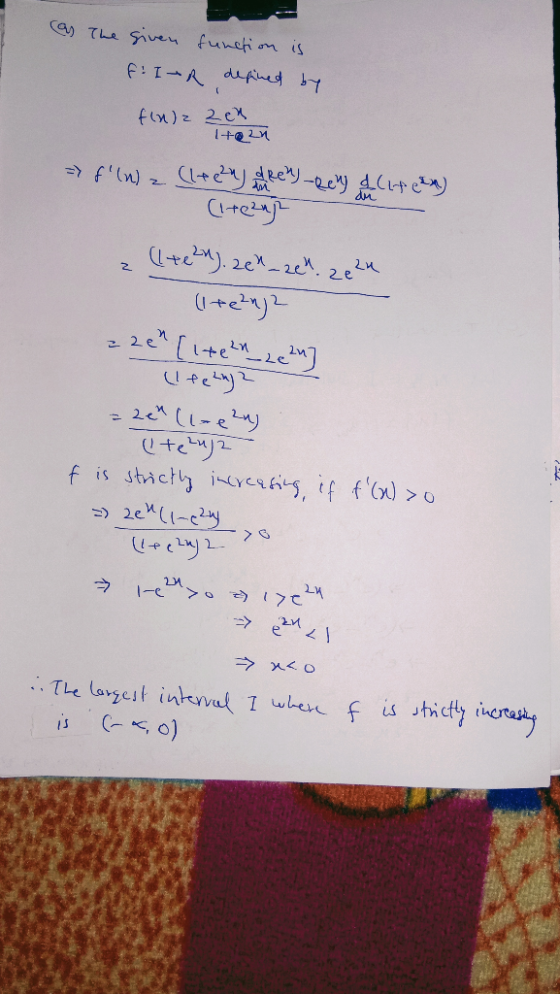
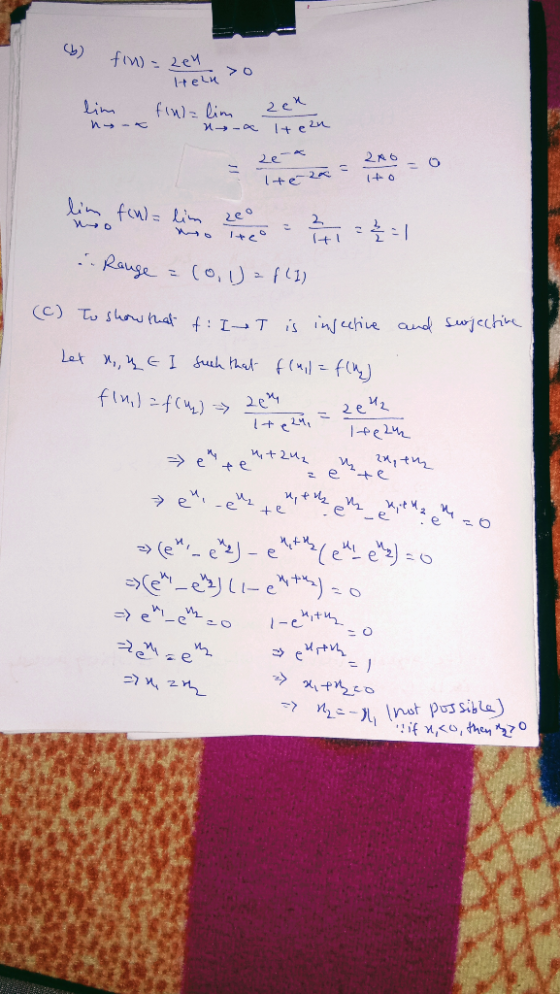
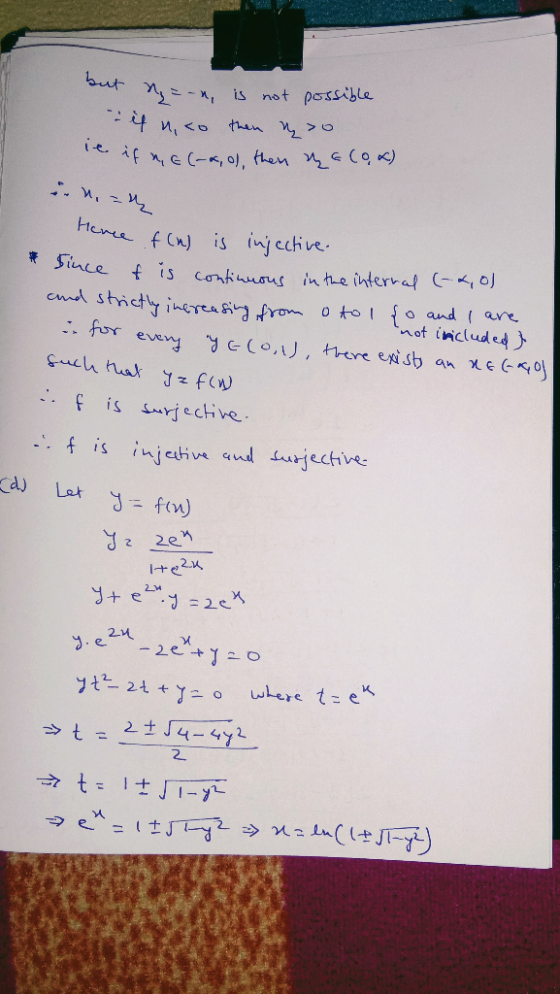
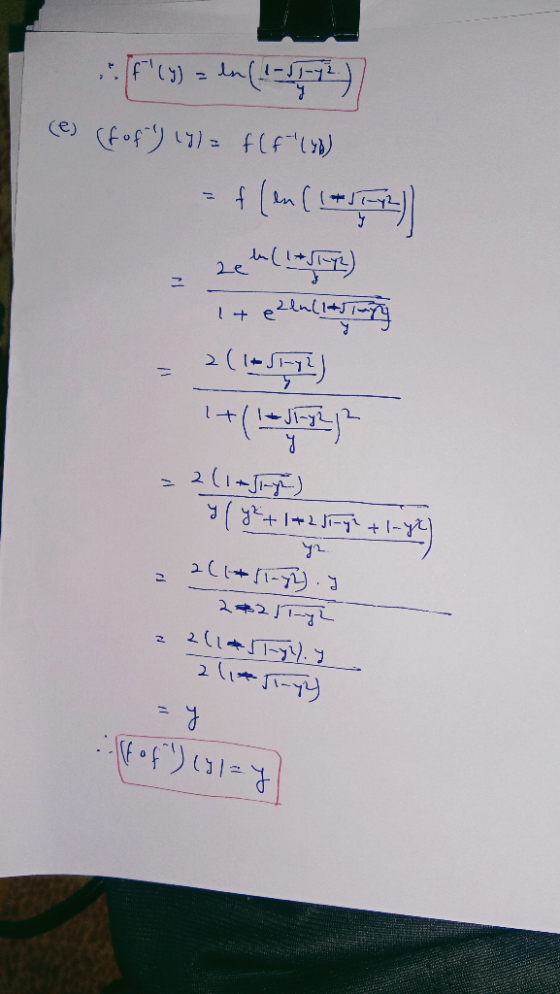
2 er Let I be an interval of R, and define the function f :I→ R by f(x) 1 +e2z or every z EZ. (a) Find the largest...
5. Let A = P(R). Define f : R → A by the formula f(x) =...
 5. Let A = P(R). Define f : R → A by the formula f(x) = {y E RIy2 < x). (a) Find f(2). (b) Is f injective, surjective, both (bijective), or neither? Z given by f(u)n+l, ifn is even n - 3, if n is odd 6. Consider the function f : Z → Z given by f(n) = (a) Is f injective? Prove your answer. (b) Is f surjective? Prove your answer
2. Let f : A ! B. DeÖne a relation R on A by xRy i§ f (x) = f (y). a. Prove that R is an equivalence relation on A. b. Let Ex = fy 2 A : xRyg be the equivalence class of x 2 A. DeÖne E = fEx : x 2 Ag...
 2. Let f : A ! B. DeÖne a relation R on A by xRy i§ f (x) = f
(y). a. Prove that R is an equivalence relation on A. b. Let Ex =
fy 2 A : xRyg be the equivalence class of x 2 A. DeÖne E = fEx : x
2 Ag to be the collection of all equivalence classes. Prove that
the function g : A ! E deÖned by g (x) = Ex is...
2. Let f : A ! B. DeÖne a relation R on A by xRy i§ f (x) = f
(y). a. Prove that R is an equivalence relation on A. b. Let Ex =
fy 2 A : xRyg be the equivalence class of x 2 A. DeÖne E = fEx : x
2 Ag to be the collection of all equivalence classes. Prove that
the function g : A ! E deÖned by g (x) = Ex is...
Let f : R2-R2 be a function defin ed by f(x,y) (3+ z +y,) (a) Determine if f is injective. Explai...
 Let f : R2-R2 be a function defin ed by f(x,y) (3+ z +y,) (a) Determine if f is injective. Explain why. (b) Determine if f is surjective. Explain why
Let f : R2-R2 be a function defin ed by f(x,y) (3+ z +y,) (a) Determine if f is injective. Explain why. (b) Determine if f is surjective. Explain why
Let f : R2-R2 be a function defin ed by f(x,y) (3+ z +y,) (a) Determine if f is injective. Explain why. (b) Determine if f is surjective. Explain why
Question 8 (6 marks) Consider the function f: [-2, 2] shown in the diagram. R whose...
 Question 8 (6 marks) Consider the function f: [-2, 2] shown in the diagram. R whose graph is (a) State the largest intervals on which f is injective f(z) (b) For each interval I you found in (a), sketch the graph of the inverse g of the restriction of f to I and state the domain and range of g (c) If we know that f(-x) = f(x) for all r e dom(f), what can we conclude about the relationship...
How do I prove this function is not surjective? 3.) Let f: R-R, f(x)-x2+ x+1 and...
 How do I prove this function is not surjective?
3.) Let f: R-R, f(x)-x2+ x+1 and Show that f is not injective and not surjective Justify that g is bijective and find gt. PIR, Show all the wortky) Not Surtechive: fx) RB Surjective: ye(o,oo) hng (g) 8 gon)-es is bijecelive g(x)-ex+s
How do I prove this function is not surjective?
3.) Let f: R-R, f(x)-x2+ x+1 and Show that f is not injective and not surjective Justify that g is bijective and find gt. PIR, Show all the wortky) Not Surtechive: fx) RB Surjective: ye(o,oo) hng (g) 8 gon)-es is bijecelive g(x)-ex+s
I. Let f : R → R be a continuous function. Show that ER sup is a Fo set
 I. Let f : R → R be a continuous function. Show that ER sup is a Fo set
I. Let f : R → R be a continuous function. Show that ER sup is a Fo set
I. Let f : R → R be a continuous function. Show that ER sup is a Fo set
Let R be an interval (open, closed, neither are all fine) and let f: I-> R be a continuous strictly increasing funct...
 Let R be an interval (open, closed, neither are all fine) and let f: I-> R be a continuous strictly increasing function. Do the following: (1) Show that the inverse function f -1 exists. (2) Prove that f is an open map (in the relative topology on I) (3) Prove that f1 is continuous
Let R be an interval (open, closed, neither are all fine) and let f: I-> R be a continuous strictly increasing function. Do the following: (1)...
Let R be an interval (open, closed, neither are all fine) and let f: I-> R be a continuous strictly increasing function. Do the following: (1) Show that the inverse function f -1 exists. (2) Prove that f is an open map (in the relative topology on I) (3) Prove that f1 is continuous
Let R be an interval (open, closed, neither are all fine) and let f: I-> R be a continuous strictly increasing function. Do the following: (1)...
Let X = {0, 1, 2} and Y = {0,1,2}. Now we define f={(0,1),(1,0),(2,1)] Please enter...
 Let X = {0, 1, 2} and Y = {0,1,2}. Now we define f={(0,1),(1,0),(2,1)] Please enter your answer as a sum of the following numbers (they are not mutually exclusive): • 1 ifff is a function f : X Y • 2 ifff is a function and it is also injective • 4ifff is a function and it is also surjective This means that your answer can be 0 (not a function), 1 (a function but neither injective or surjective)....
Question 8 (15 marks) Consider the function f: R2 R2 given by 1 (, y)(0,0) f(r,y) (a) Consider the surface z f(x, y). (...
 Question 8 (15 marks) Consider the function f: R2 R2 given by 1 (, y)(0,0) f(r,y) (a) Consider the surface z f(x, y). (i Determine the level curves for the surface when z on the same diagram in the r-y plane. 1 and 2, Sketch the level curves (i) Determine the cross-sectional curves of the surface in the r-z plane and in the y- plane. Sketch the two cross-sectional curves (iii) Sketch the surface. (b) For the point (r, y)...
2. Let E CRn+m. For every x ER", let Ex := {y € R™ st. (,y)...
 2. Let E CRn+m. For every x ER", let Ex := {y € R™ st. (,y) € E}. Let fel'(E). Proved that • for a.e. 2 ER", the function Ex = y + f(x,y) belongs to L'(Ex), • the function R"3o-. s(z. y) dy belongs to L (RM), • we have that sss=fen (562, )dy) ds. This is a slightly stronger version of the Fubini's Theorem that we proved in class, for instance one could define fxs and use the...
 5. Let A = P(R). Define f : R → A by the formula f(x) = {y E RIy2 < x). (a) Find f(2). (b) Is f injective, surjective, both (bijective), or neither? Z given by f(u)n+l, ifn is even n - 3, if n is odd 6. Consider the function f : Z → Z given by f(n) = (a) Is f injective? Prove your answer. (b) Is f surjective? Prove your answer
 2. Let f : A ! B. DeÖne a relation R on A by xRy i§ f (x) = f
(y). a. Prove that R is an equivalence relation on A. b. Let Ex =
fy 2 A : xRyg be the equivalence class of x 2 A. DeÖne E = fEx : x
2 Ag to be the collection of all equivalence classes. Prove that
the function g : A ! E deÖned by g (x) = Ex is...
2. Let f : A ! B. DeÖne a relation R on A by xRy i§ f (x) = f
(y). a. Prove that R is an equivalence relation on A. b. Let Ex =
fy 2 A : xRyg be the equivalence class of x 2 A. DeÖne E = fEx : x
2 Ag to be the collection of all equivalence classes. Prove that
the function g : A ! E deÖned by g (x) = Ex is...
 Let f : R2-R2 be a function defin ed by f(x,y) (3+ z +y,) (a) Determine if f is injective. Explain why. (b) Determine if f is surjective. Explain why
Let f : R2-R2 be a function defin ed by f(x,y) (3+ z +y,) (a) Determine if f is injective. Explain why. (b) Determine if f is surjective. Explain why
Let f : R2-R2 be a function defin ed by f(x,y) (3+ z +y,) (a) Determine if f is injective. Explain why. (b) Determine if f is surjective. Explain why
 Question 8 (6 marks) Consider the function f: [-2, 2] shown in the diagram. R whose graph is (a) State the largest intervals on which f is injective f(z) (b) For each interval I you found in (a), sketch the graph of the inverse g of the restriction of f to I and state the domain and range of g (c) If we know that f(-x) = f(x) for all r e dom(f), what can we conclude about the relationship...
 How do I prove this function is not surjective?
3.) Let f: R-R, f(x)-x2+ x+1 and Show that f is not injective and not surjective Justify that g is bijective and find gt. PIR, Show all the wortky) Not Surtechive: fx) RB Surjective: ye(o,oo) hng (g) 8 gon)-es is bijecelive g(x)-ex+s
How do I prove this function is not surjective?
3.) Let f: R-R, f(x)-x2+ x+1 and Show that f is not injective and not surjective Justify that g is bijective and find gt. PIR, Show all the wortky) Not Surtechive: fx) RB Surjective: ye(o,oo) hng (g) 8 gon)-es is bijecelive g(x)-ex+s
 I. Let f : R → R be a continuous function. Show that ER sup is a Fo set
I. Let f : R → R be a continuous function. Show that ER sup is a Fo set
I. Let f : R → R be a continuous function. Show that ER sup is a Fo set
 Let R be an interval (open, closed, neither are all fine) and let f: I-> R be a continuous strictly increasing function. Do the following: (1) Show that the inverse function f -1 exists. (2) Prove that f is an open map (in the relative topology on I) (3) Prove that f1 is continuous
Let R be an interval (open, closed, neither are all fine) and let f: I-> R be a continuous strictly increasing function. Do the following: (1)...
Let R be an interval (open, closed, neither are all fine) and let f: I-> R be a continuous strictly increasing function. Do the following: (1) Show that the inverse function f -1 exists. (2) Prove that f is an open map (in the relative topology on I) (3) Prove that f1 is continuous
Let R be an interval (open, closed, neither are all fine) and let f: I-> R be a continuous strictly increasing function. Do the following: (1)...
 Let X = {0, 1, 2} and Y = {0,1,2}. Now we define f={(0,1),(1,0),(2,1)] Please enter your answer as a sum of the following numbers (they are not mutually exclusive): • 1 ifff is a function f : X Y • 2 ifff is a function and it is also injective • 4ifff is a function and it is also surjective This means that your answer can be 0 (not a function), 1 (a function but neither injective or surjective)....
 Question 8 (15 marks) Consider the function f: R2 R2 given by 1 (, y)(0,0) f(r,y) (a) Consider the surface z f(x, y). (i Determine the level curves for the surface when z on the same diagram in the r-y plane. 1 and 2, Sketch the level curves (i) Determine the cross-sectional curves of the surface in the r-z plane and in the y- plane. Sketch the two cross-sectional curves (iii) Sketch the surface. (b) For the point (r, y)...
 2. Let E CRn+m. For every x ER", let Ex := {y € R™ st. (,y) € E}. Let fel'(E). Proved that • for a.e. 2 ER", the function Ex = y + f(x,y) belongs to L'(Ex), • the function R"3o-. s(z. y) dy belongs to L (RM), • we have that sss=fen (562, )dy) ds. This is a slightly stronger version of the Fubini's Theorem that we proved in class, for instance one could define fxs and use the...
Most questions answered within 3 hours.
-
Where is the error in this code sequence?
String s1 = "Hello";
String s2 = "ello";...
asked 11 months ago -
Financial data for Joel de Paris, Inc., for last year
follow:
Joel de Paris, Inc.
Balance...
asked 11 months ago -
Consider this reaction:
Al2(SO4)3 (aq)+ BaCl3
(aq) Al2Cl6 (aq)- +
3BaSO4(s) . What is the...
asked 11 months ago -
Suppose that Savneet is considering increasing her
recent random sample from 20 car rentals to 40...
asked 11 months ago -
Trucks arrive at an unloading terminal at an average rate of 120
per hour.
Trucks arrive...
asked 11 months ago -
Why are methanol and ethanol completely soluble in water while
octanol is not very little soluble....
asked 11 months ago -
A facilities manager at a university reads in a research report
that the mean amount of...
asked 11 months ago -
When the CuSO4 is rehydrated by adding water to the anhydrous
compound, is this an endothermic...
asked 11 months ago -
A ray of sunlight is passing from diamond into crown glass; the
angle of incidence is...
asked 11 months ago -
A block of mass 0.249 kg is placed on top of a light, vertical
spring of...
asked 11 months ago -
how do the kidneys compensate in the presences of acidosis
a) trigger hyperventilate
b) reserve acid...
asked 11 months ago -
Question 501 pts
The rental rate of capital to the firm increases. Which of the
following...
asked 11 months ago