
Homework Answers
Add Answer to:
1. (10%) in this question, you'll draw graphs similar to that of Figure 5.1 from the textbook. Feel free to use the...
2. (10%) In this question, you'll draw graphs similar to that of Figure 5.2 from the textbook. Feel free to use the...
 2. (10%) In this question, you'll draw graphs similar to that of Figure 5.2 from the textbook. Feel free to use the attached grid paper at the end of the problem set. When graphing, make sure you are showing the correct budget constraints and ordered pairs, don't just draw random lines. An individual consumes two goods, clothing and food. The information below shows how this individual changes his consumption bundle as income changes, ceteris paribus. a. Illustrate each of the...
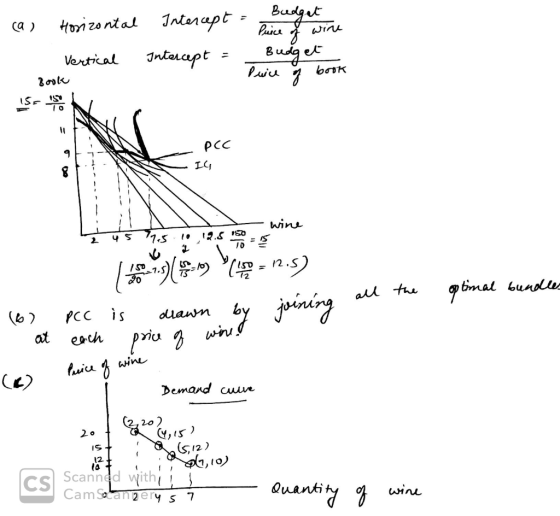
An individual sets aside a certain amount of his income per month to spend on his...
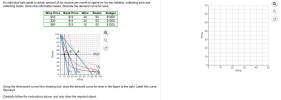 An individual sets aside a certain amount of his income per month to spend on his two hobbies, collecting wine and collecting books. Given the information below, illustrate the demand curve for wine Wine Price Book Price Wine Books Bud $15 $30 $60 40 20 10 50 50 50 $1200 $1200 1200 $12 PCC 10 20 30 40 50 Wine 0 10 20 30 40 50 60 70 80 90 1 Wine Using the three-point curved line drawing tool, draw...
10. Deriving demand from an Indifference map Megan lives in Dallas and enjoys drinking lattes and...
 10. Deriving demand from an Indifference map Megan lives in Dallas and enjoys drinking lattes and eating scones. The price of a latte is held constant at $3 throughout this problem. On the following graph, the purple curves (I, and I?) represent two of Megan's Indifference curves. The lines BC and BC show two budget constraints. Points X and Y show Megan's optimum consumption bundles subject to these budget constraints. 20 18 16 14 12 LATTES 10 2 BC BC...
10. Deriving demand from an indifference map Beth lives in San Diego and enjoys drinking lattes...
 10. Deriving demand from an indifference map Beth lives in San Diego and enjoys drinking lattes and eating scones. The price of a latte is held constant at $4 throughout this problem. On the following graph, the purple curves (I and Is) represent two of Beth's indifference curves. The lines BC and BC, show two budget constraints. Points X and Y show Beth's optimum consumption bundles subject to these budget constraints. ? 20 18 16 14 12 LATTES 10 8...
Homework (Ch 21) 10. Deriving demand from an indifference map Janet lives in Denver and enjoys...
 Homework (Ch 21) 10. Deriving demand from an indifference map Janet lives in Denver and enjoys drinking lattes and eating scones. The price of a latte is held constant at $2 throughout this problem. On the following graph, the purple curves (I and I)) represent two of Janet's indifference curves. The lines BC and BC, show two budget constraints. Points X and Y show Janet's optimum consumption bundles subject to these budget constraints. 20 18 18 14 12 LATTES 10...
LATTES t 10. Deriving demand from an indifference map Lucia lives in Philadelphia and enjoys drinking...
 LATTES t 10. Deriving demand from an indifference map Lucia lives in Philadelphia and enjoys drinking lattes and eating scones. The price of a latte is held constant at $4 throughout this problem. On the following graph, the purple curves (I I2) represent two of Lucia's indifference curves. The lines BC and BC2 show two budget and constraints. Points X and Y show Lucia's optimum consumption bundles subject to these budget constraints. 20 18 16 14 12 10 E LATTES...
Please Answer Question number two A) (10 points) Draw the aggregate production possibility curve of fruit production i...
 Please Answer Question number two
A) (10 points) Draw the aggregate production possibility curve of fruit production in Washington State. Label carefully. Assume it is linear for each company. B) (5 points) Using one company as an example, explain what the slope of a producer's PPF means. C) (10 points) Suppose apples are $1 per pound and grapes are $5 per pound. Show how many grapes and apples each country will produce (a) graphically and (b) write your answer numerically....
Please Answer Question number two
A) (10 points) Draw the aggregate production possibility curve of fruit production in Washington State. Label carefully. Assume it is linear for each company. B) (5 points) Using one company as an example, explain what the slope of a producer's PPF means. C) (10 points) Suppose apples are $1 per pound and grapes are $5 per pound. Show how many grapes and apples each country will produce (a) graphically and (b) write your answer numerically....
Get On Question 3: Use indifference curve and constraint analysis to show how Pizza Hut can...
 Get On Question 3: Use indifference curve and constraint analysis to show how Pizza Hut can get customers to spend more money on less pizza than if Pizza Hut charged a uniform price for all pizzas. 1/2 price August 15-21 FOx To begin analysis, divide all consumption into two categories: pizza and "all other goods". Suppose "all other goods" cost $1 per unit. (If it makes analysis simpler for you, divide consumption into pizza and coke, with the price of...
24. Consider a consumer with a utility function of u(x,y)=xy. (10 total) a) Draw to scale...
 24. Consider a consumer with a utility function of u(x,y)=xy. (10 total) a) Draw to scale the consumer's indifference curves for u(x,y)=100 and u(xy)=400. (2) b) Verify the both x and y are "goods" rather than "bads." (3) c) Verify that the law of diminishing marginal rate of substitution holds. (3) d) Suppose that the utility numbers assigned to bundles are determined by the formula (xy) Vxy, instead of u(x,y)= xy. How does the change in the formula change the...
Suppose an individual’s utility function for two goods X and Y is givenby U(X,Y) = X^(3/4)Y^(1/4)...
Suppose an individual’s utility function for two goods X and Y is givenby U(X,Y) = X^(3/4)Y^(1/4) Denote the price of good X by Px, price of good Y by Py and the income of the consumer by I. a) (2 points) Write down the budget constraint for the individual. b) (4 points) Derive the marginal utilities of X and Y. c) (3 points) Derive the expression for the marginal rate of substitution of X for Y. Write down the tangency...
 2. (10%) In this question, you'll draw graphs similar to that of Figure 5.2 from the textbook. Feel free to use the attached grid paper at the end of the problem set. When graphing, make sure you are showing the correct budget constraints and ordered pairs, don't just draw random lines. An individual consumes two goods, clothing and food. The information below shows how this individual changes his consumption bundle as income changes, ceteris paribus. a. Illustrate each of the...
 An individual sets aside a certain amount of his income per month to spend on his two hobbies, collecting wine and collecting books. Given the information below, illustrate the demand curve for wine Wine Price Book Price Wine Books Bud $15 $30 $60 40 20 10 50 50 50 $1200 $1200 1200 $12 PCC 10 20 30 40 50 Wine 0 10 20 30 40 50 60 70 80 90 1 Wine Using the three-point curved line drawing tool, draw...
 10. Deriving demand from an Indifference map Megan lives in Dallas and enjoys drinking lattes and eating scones. The price of a latte is held constant at $3 throughout this problem. On the following graph, the purple curves (I, and I?) represent two of Megan's Indifference curves. The lines BC and BC show two budget constraints. Points X and Y show Megan's optimum consumption bundles subject to these budget constraints. 20 18 16 14 12 LATTES 10 2 BC BC...
 10. Deriving demand from an indifference map Beth lives in San Diego and enjoys drinking lattes and eating scones. The price of a latte is held constant at $4 throughout this problem. On the following graph, the purple curves (I and Is) represent two of Beth's indifference curves. The lines BC and BC, show two budget constraints. Points X and Y show Beth's optimum consumption bundles subject to these budget constraints. ? 20 18 16 14 12 LATTES 10 8...
 Homework (Ch 21) 10. Deriving demand from an indifference map Janet lives in Denver and enjoys drinking lattes and eating scones. The price of a latte is held constant at $2 throughout this problem. On the following graph, the purple curves (I and I)) represent two of Janet's indifference curves. The lines BC and BC, show two budget constraints. Points X and Y show Janet's optimum consumption bundles subject to these budget constraints. 20 18 18 14 12 LATTES 10...
 LATTES t 10. Deriving demand from an indifference map Lucia lives in Philadelphia and enjoys drinking lattes and eating scones. The price of a latte is held constant at $4 throughout this problem. On the following graph, the purple curves (I I2) represent two of Lucia's indifference curves. The lines BC and BC2 show two budget and constraints. Points X and Y show Lucia's optimum consumption bundles subject to these budget constraints. 20 18 16 14 12 10 E LATTES...
 Please Answer Question number two
A) (10 points) Draw the aggregate production possibility curve of fruit production in Washington State. Label carefully. Assume it is linear for each company. B) (5 points) Using one company as an example, explain what the slope of a producer's PPF means. C) (10 points) Suppose apples are $1 per pound and grapes are $5 per pound. Show how many grapes and apples each country will produce (a) graphically and (b) write your answer numerically....
Please Answer Question number two
A) (10 points) Draw the aggregate production possibility curve of fruit production in Washington State. Label carefully. Assume it is linear for each company. B) (5 points) Using one company as an example, explain what the slope of a producer's PPF means. C) (10 points) Suppose apples are $1 per pound and grapes are $5 per pound. Show how many grapes and apples each country will produce (a) graphically and (b) write your answer numerically....
 Get On Question 3: Use indifference curve and constraint analysis to show how Pizza Hut can get customers to spend more money on less pizza than if Pizza Hut charged a uniform price for all pizzas. 1/2 price August 15-21 FOx To begin analysis, divide all consumption into two categories: pizza and "all other goods". Suppose "all other goods" cost $1 per unit. (If it makes analysis simpler for you, divide consumption into pizza and coke, with the price of...
 24. Consider a consumer with a utility function of u(x,y)=xy. (10 total) a) Draw to scale the consumer's indifference curves for u(x,y)=100 and u(xy)=400. (2) b) Verify the both x and y are "goods" rather than "bads." (3) c) Verify that the law of diminishing marginal rate of substitution holds. (3) d) Suppose that the utility numbers assigned to bundles are determined by the formula (xy) Vxy, instead of u(x,y)= xy. How does the change in the formula change the...
Most questions answered within 3 hours.
-
Where is the error in this code sequence?
String s1 = "Hello";
String s2 = "ello";...
asked 10 months ago -
Financial data for Joel de Paris, Inc., for last year
follow:
Joel de Paris, Inc.
Balance...
asked 10 months ago -
Consider this reaction:
Al2(SO4)3 (aq)+ BaCl3
(aq) Al2Cl6 (aq)- +
3BaSO4(s) . What is the...
asked 10 months ago -
Suppose that Savneet is considering increasing her
recent random sample from 20 car rentals to 40...
asked 10 months ago -
Trucks arrive at an unloading terminal at an average rate of 120
per hour.
Trucks arrive...
asked 10 months ago -
Why are methanol and ethanol completely soluble in water while
octanol is not very little soluble....
asked 10 months ago -
A facilities manager at a university reads in a research report
that the mean amount of...
asked 10 months ago -
When the CuSO4 is rehydrated by adding water to the anhydrous
compound, is this an endothermic...
asked 10 months ago -
A ray of sunlight is passing from diamond into crown glass; the
angle of incidence is...
asked 10 months ago -
A block of mass 0.249 kg is placed on top of a light, vertical
spring of...
asked 10 months ago -
how do the kidneys compensate in the presences of acidosis
a) trigger hyperventilate
b) reserve acid...
asked 10 months ago -
Question 501 pts
The rental rate of capital to the firm increases. Which of the
following...
asked 10 months ago