
Homework Answers
Enterprise systems (ES) are large-scale application software packages that support business processes, information flows, reporting, and data analytics in complex organizations. While ES are generally packaged enterprise application software (PEAS) systems they can also be bespoke, custom developed systems created to support a specific organization's needs.
History of ERP solutions started from calculating machines in 1940s. It has evolved to the highly capable solutions that we see today.
How it began
The history of ERP began with early attempts at using calculating machines for business in the 1940’s. The focus on factory output increased and computing solutions were created in the 1960s. In the 1960’s, applications that handled inventory management and control were introduced. In the 1960s, Enterprise Resource Planning (ERP) was born in infancy in the early 1960s . It was a joint effort between J.I. Case, the manufacturer of tractors and other construction machinery, and their IT partner IBM. This further led to the creation of software known as Materials Requirements Planning(MRP). MRP in the 1970’s helped plan raw material requirements for manufacturing, purchasing and delivery.
The Early Days in the history of ERP
By 1975, MRP software was running in hundreds of large companies though it was only affordable for the larger firms. The system ran on huge mainframe computers that were very expensive though their computing power was not comparable even to some of the portable computers of today.
In 1972, the firm SAP was started in Germany. The company initials stood for “Systems, Applications & Products”. SAP aimed to create business software that worked in real time. This was really path breaking in an era of reel-to-reel tapes and punch cards. SAP launched its first financial accounting system in 1973.
In the 1980s, MRP evolved to what many termed MRP II, or Manufacturing Resource Planning by adding more manufacturing processes and capabilities in order to manage as a one stop production planning solution.
The term ERP is first used
The term ERP – Enterprise Resource Planning was first used in the 1990’s. It was able to deal with other business functions like engineering, finance and accounting, HR and project management etc. The approach was modular applications with advanced features. All the systems in the 1990’s used a legacy on-premise model till Netsuite came into being in 1996. Netsuite created an ERP system that worked across the business functions of a company but was not on-premise and was delivered over the internet.
In 2000, the Gartner Group defined ERP II as internet enabled software that gave real time access to the ERP solution. It also provided functionalities outside of the business like supply chain management, customer relationship management (CRM) and business intelligence.
The Cloud appears in the history of ERP
After 2005 or so, the trend has turned towards cloud software solutions and moved away from traditional client servers models. Cloud ERP software solutions provided comparable functionalities to on-premise ERP at a much lower cost. They were attractive especially for small and mid-sized businesses.
They now have remote, web-based access via advanced apps that run even on mobile devices. Today’s Cloud ERP systems cover every necessary aspect of business. They have advanced reporting, analytics, business intelligence tools and functionalities. Cloud ERP is also as secure if not more than legacy ERP solutions. The future will see the integration of Cloud ERP with IoT, IoE, social media and even greater security competence.
1. what is the journal entey to record raw materials used in production? (if no entry...
 1. what is the journal entey to record raw materials used in
production? (if no entry is required for a transaction/event,
select "no journal entey required" in the first account
field.)
2. What is the ending balance in Raw Materials?
3. What is the journal entry to record the labor costs
incurred during the year?
4. What is the total amount of manufacturing overhead applied
to production during the
year?
5. What is the total manufacturing cost added to Work...
1. what is the journal entey to record raw materials used in
production? (if no entry is required for a transaction/event,
select "no journal entey required" in the first account
field.)
2. What is the ending balance in Raw Materials?
3. What is the journal entry to record the labor costs
incurred during the year?
4. What is the total amount of manufacturing overhead applied
to production during the
year?
5. What is the total manufacturing cost added to Work...
1. what is the journal entey to record raw materials used in production? (if no entry...
 1. what is the journal entey to record raw materials used in
production? (if no entry is required for a transaction/event,
select "no journal entey required" in the first account
field.)
2. What is the ending balance in Raw Materials?
3. What is the journal entry to record the labor costs
incurred during the year?
4. What is the total amount of manufacturing overhead applied
to production during the
year?
Required information The following information applies to the questions displayed...
1. what is the journal entey to record raw materials used in
production? (if no entry is required for a transaction/event,
select "no journal entey required" in the first account
field.)
2. What is the ending balance in Raw Materials?
3. What is the journal entry to record the labor costs
incurred during the year?
4. What is the total amount of manufacturing overhead applied
to production during the
year?
Required information The following information applies to the questions displayed...
For a process at constant pressure. AE = q and w = 0 AE = w and q = 0. AE=AH AH = 0 Submit Request Answer
 For a process at constant pressure. AE = q and w = 0 AE = w and q = 0. AE=AH AH = 0 Submit Request Answer
Multiple Choice Question: a.) (Cash + AR + Inventory) - AE b.) Revenue - AE c.)...
 Multiple Choice Question:
a.) (Cash + AR + Inventory) - AE
b.) Revenue - AE
c.) Cash + AR + Revenue
d.) Cash + AR + Inventory
e.) (Cash + AR + Inventory) - (AE + AP)
QUESTION 4 / 11 According to the trial balance, what is the working capital? Trial Balance Cash Accounts Receivable (AR) Inventory Accounts Payable (AP) Accrued Expenses (AE) Revenue $ 10,000 $ 2,000 $ 3,000 $ 2,000 $ 3,000 $ 15,000
Multiple Choice Question:
a.) (Cash + AR + Inventory) - AE
b.) Revenue - AE
c.) Cash + AR + Revenue
d.) Cash + AR + Inventory
e.) (Cash + AR + Inventory) - (AE + AP)
QUESTION 4 / 11 According to the trial balance, what is the working capital? Trial Balance Cash Accounts Receivable (AR) Inventory Accounts Payable (AP) Accrued Expenses (AE) Revenue $ 10,000 $ 2,000 $ 3,000 $ 2,000 $ 3,000 $ 15,000
Question 25 1 pts What is the nation's Marginal Propensity to Consume? Y-AE AE = C...
 Question 25 1 pts What is the nation's Marginal Propensity to Consume? Y-AE AE = C + | C = 1,200 + 0.6Y 1 = P = 200 Question 26 1 pts What is the nation's Marginal Propensity to Save? YAE AE = C + C - 1,200+ 0.6Y 1-IP = 200 Attc 1 H Question 27 1 pts By only considering the consumer sector (C) of AE, how much would the nation consume if the nation only produced Y...
Using this information how do you do the amorization schedule and the other journal entey and...
 Using this information how do you do the amorization schedule and
the other journal entey and last two question?
The following information applies to the questions displayed below! On January 1, 2018, Gundy Enterprises purchases an office for $239,000, paying $49.000 down and borrowing the remaining are due at the end of each month, with the first payment due on January 31, 2018 and borrowing the remaining $190,000, signing a 9%, 10-year mortgage. Installment payments of $2,406.84 2. Complete the...
Using this information how do you do the amorization schedule and
the other journal entey and last two question?
The following information applies to the questions displayed below! On January 1, 2018, Gundy Enterprises purchases an office for $239,000, paying $49.000 down and borrowing the remaining are due at the end of each month, with the first payment due on January 31, 2018 and borrowing the remaining $190,000, signing a 9%, 10-year mortgage. Installment payments of $2,406.84 2. Complete the...
Find AE, if AC 11, BE-6, ED-3, and AE CE. Round your answer to two decimal...
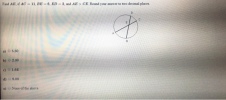 Find AE, if AC 11, BE-6, ED-3, and AE CE. Round your answer to two decimal places. a) 5.50 b) 2.00 c) 1.64 d) 9.00 e) None of the above
from the formula E(aX+b)=aE(x)+b, setting b = 0 we see that E(aX)= aE(X) Prove E(aX) =...
from the formula E(aX+b)=aE(x)+b, setting b = 0 we see that E(aX)= aE(X) Prove E(aX) = aE(x).
ty nursing interventioms that are imporiunes a ae
 ty nursing interventioms that are imporiunes a ae
Select the correct range for the project's equivalent annual cost (AE). The project's cash flow is...
Select the correct range for the project's equivalent annual cost (AE). The project's cash flow is in the table below. n Net Cash Flow 0 -50,000 1 -60,000 2 -70,000 3 -80,000 4 -90,000 5 -100,000 AE < -400,000 -400,000 < AE < -50,000 -50,000 < AE < 50,000 50,000 < AE < 400,000 400,000 < AE
 1. what is the journal entey to record raw materials used in
production? (if no entry is required for a transaction/event,
select "no journal entey required" in the first account
field.)
2. What is the ending balance in Raw Materials?
3. What is the journal entry to record the labor costs
incurred during the year?
4. What is the total amount of manufacturing overhead applied
to production during the
year?
5. What is the total manufacturing cost added to Work...
1. what is the journal entey to record raw materials used in
production? (if no entry is required for a transaction/event,
select "no journal entey required" in the first account
field.)
2. What is the ending balance in Raw Materials?
3. What is the journal entry to record the labor costs
incurred during the year?
4. What is the total amount of manufacturing overhead applied
to production during the
year?
5. What is the total manufacturing cost added to Work...
 1. what is the journal entey to record raw materials used in
production? (if no entry is required for a transaction/event,
select "no journal entey required" in the first account
field.)
2. What is the ending balance in Raw Materials?
3. What is the journal entry to record the labor costs
incurred during the year?
4. What is the total amount of manufacturing overhead applied
to production during the
year?
Required information The following information applies to the questions displayed...
1. what is the journal entey to record raw materials used in
production? (if no entry is required for a transaction/event,
select "no journal entey required" in the first account
field.)
2. What is the ending balance in Raw Materials?
3. What is the journal entry to record the labor costs
incurred during the year?
4. What is the total amount of manufacturing overhead applied
to production during the
year?
Required information The following information applies to the questions displayed...
 For a process at constant pressure. AE = q and w = 0 AE = w and q = 0. AE=AH AH = 0 Submit Request Answer
 Multiple Choice Question:
a.) (Cash + AR + Inventory) - AE
b.) Revenue - AE
c.) Cash + AR + Revenue
d.) Cash + AR + Inventory
e.) (Cash + AR + Inventory) - (AE + AP)
QUESTION 4 / 11 According to the trial balance, what is the working capital? Trial Balance Cash Accounts Receivable (AR) Inventory Accounts Payable (AP) Accrued Expenses (AE) Revenue $ 10,000 $ 2,000 $ 3,000 $ 2,000 $ 3,000 $ 15,000
Multiple Choice Question:
a.) (Cash + AR + Inventory) - AE
b.) Revenue - AE
c.) Cash + AR + Revenue
d.) Cash + AR + Inventory
e.) (Cash + AR + Inventory) - (AE + AP)
QUESTION 4 / 11 According to the trial balance, what is the working capital? Trial Balance Cash Accounts Receivable (AR) Inventory Accounts Payable (AP) Accrued Expenses (AE) Revenue $ 10,000 $ 2,000 $ 3,000 $ 2,000 $ 3,000 $ 15,000
 Question 25 1 pts What is the nation's Marginal Propensity to Consume? Y-AE AE = C + | C = 1,200 + 0.6Y 1 = P = 200 Question 26 1 pts What is the nation's Marginal Propensity to Save? YAE AE = C + C - 1,200+ 0.6Y 1-IP = 200 Attc 1 H Question 27 1 pts By only considering the consumer sector (C) of AE, how much would the nation consume if the nation only produced Y...
 Using this information how do you do the amorization schedule and
the other journal entey and last two question?
The following information applies to the questions displayed below! On January 1, 2018, Gundy Enterprises purchases an office for $239,000, paying $49.000 down and borrowing the remaining are due at the end of each month, with the first payment due on January 31, 2018 and borrowing the remaining $190,000, signing a 9%, 10-year mortgage. Installment payments of $2,406.84 2. Complete the...
Using this information how do you do the amorization schedule and
the other journal entey and last two question?
The following information applies to the questions displayed below! On January 1, 2018, Gundy Enterprises purchases an office for $239,000, paying $49.000 down and borrowing the remaining are due at the end of each month, with the first payment due on January 31, 2018 and borrowing the remaining $190,000, signing a 9%, 10-year mortgage. Installment payments of $2,406.84 2. Complete the...
 Find AE, if AC 11, BE-6, ED-3, and AE CE. Round your answer to two decimal places. a) 5.50 b) 2.00 c) 1.64 d) 9.00 e) None of the above
 ty nursing interventioms that are imporiunes a ae
Most questions answered within 3 hours.
-
Where is the error in this code sequence?
String s1 = "Hello";
String s2 = "ello";...
asked 10 months ago -
Financial data for Joel de Paris, Inc., for last year
follow:
Joel de Paris, Inc.
Balance...
asked 10 months ago -
Consider this reaction:
Al2(SO4)3 (aq)+ BaCl3
(aq) Al2Cl6 (aq)- +
3BaSO4(s) . What is the...
asked 10 months ago -
Suppose that Savneet is considering increasing her
recent random sample from 20 car rentals to 40...
asked 10 months ago -
Trucks arrive at an unloading terminal at an average rate of 120
per hour.
Trucks arrive...
asked 10 months ago -
Why are methanol and ethanol completely soluble in water while
octanol is not very little soluble....
asked 10 months ago -
A facilities manager at a university reads in a research report
that the mean amount of...
asked 10 months ago -
When the CuSO4 is rehydrated by adding water to the anhydrous
compound, is this an endothermic...
asked 10 months ago -
A ray of sunlight is passing from diamond into crown glass; the
angle of incidence is...
asked 10 months ago -
A block of mass 0.249 kg is placed on top of a light, vertical
spring of...
asked 10 months ago -
how do the kidneys compensate in the presences of acidosis
a) trigger hyperventilate
b) reserve acid...
asked 10 months ago -
Question 501 pts
The rental rate of capital to the firm increases. Which of the
following...
asked 10 months ago