
Homework Answers
Add Answer to:
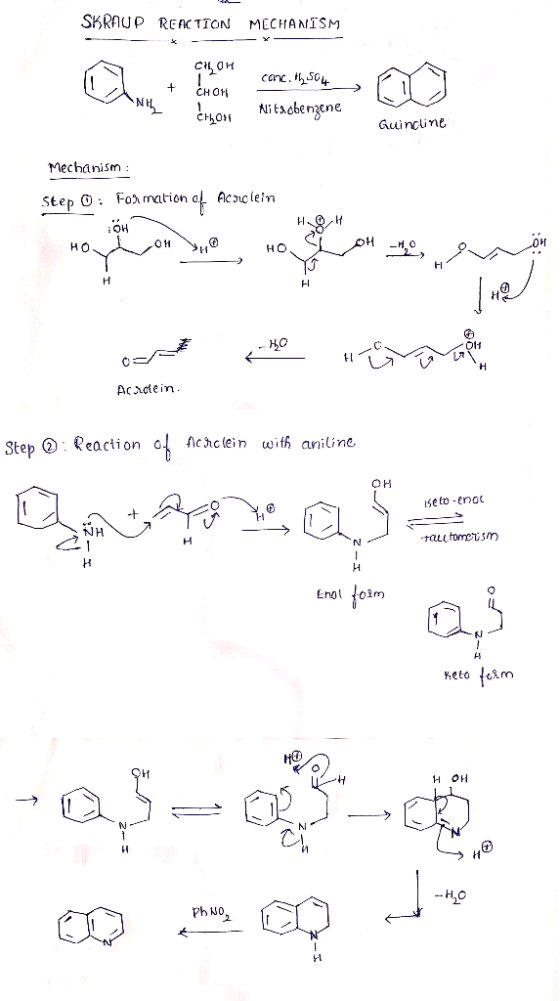
Draw the detailed mechanism for Skraup synthesis of quinoline. Aniline Glycerol Nitrobenzene + H2SO4 Quinoline
Draw the mechanism and label products and reactants for the synthesis of aniline to 4-Bromo-2-Chloroacetanilide: Aniline...
Draw the mechanism and label products and reactants for the synthesis of aniline to 4-Bromo-2-Chloroacetanilide: Aniline + Acetic Anhydride --> Acetanilide + Acetic Acid Acetanilide + Bromine --> 4-Bromoacetanilide STEP 1: Hydrochloric Acid + Sodium Chlorate --> Chlorine + Water + Sodium Chloride STEP 2: 4-Bromoacetanilide + Chlorine --> 4-Bromo-2-Chloroacetanilide 4-Bromo-2-Chloroacetanilide + Ethanol --> 4-Bromo-2-Chloroaniline + Ethyl Acetate Show all lone pairs or formal charges.
1. Draw a detailed arrow pushing mechanism for the following 2. Provide a reasonable synthesis for...
 1. Draw a detailed arrow pushing mechanism for the
following
2. Provide a reasonable synthesis for the following
1. Draw a detailed arrow pushing mechanism for the following: (6 pts) pTSA + HS SH 2. Provide a reasonable synthesis for the following: (4 pts) or On
1. Draw a detailed arrow pushing mechanism for the
following
2. Provide a reasonable synthesis for the following
1. Draw a detailed arrow pushing mechanism for the following: (6 pts) pTSA + HS SH 2. Provide a reasonable synthesis for the following: (4 pts) or On
Draw a detailed arrow pushing mechanism for the following 1. Draw a detailed arrow pushing mechanism...
 Draw a detailed arrow pushing mechanism for the following
1. Draw a detailed arrow pushing mechanism for the following: (5 pts) H2O, H2SO4 ОН но +
Draw a detailed arrow pushing mechanism for the following
1. Draw a detailed arrow pushing mechanism for the following: (5 pts) H2O, H2SO4 ОН но +
Draw a stepwise, detailed mechanism for the following reactions: H2SO4 +H2O + PBr OH | --- | + H-0
 Draw a stepwise, detailed mechanism for the following reactions: H2SO4 +H2O + PBr OH | --- | + H-0
A detailed mechanism for the following: HNO3 H2SO4 -NO₂
 A detailed mechanism for the following:
HNO3 H2SO4 -NO₂
A detailed mechanism for the following:
HNO3 H2SO4 -NO₂
Write a detailed procedure describing the work up you would use to separate the aniline product...
Write a detailed procedure describing the work up you would use to separate the aniline product from the nitrobenzene starting material. The following solvents/solutions can be used: diethyl ether, water, 10% HCl, and/or 5% NaHCO3.
Draw the major products in the following SN1 reaction and draw a detailed mechanism for the...
 Draw the major products in the following SN1 reaction and draw a
detailed mechanism for the transformation. Marks will be given for
the proper use of arrows. What stereochemical relationship do the
products have with each other?
Draw your answers as line structures and show
stereochemistry of asymmetric centers with wedges and
dashes.
ОН H2SO4 NaBr
Draw the major products in the following SN1 reaction and draw a
detailed mechanism for the transformation. Marks will be given for
the proper use of arrows. What stereochemical relationship do the
products have with each other?
Draw your answers as line structures and show
stereochemistry of asymmetric centers with wedges and
dashes.
ОН H2SO4 NaBr
Draw out the detailed mechanisms for each step of bromination of acetanilide, aniline, and anisol...
 Draw out the detailed mechanisms for each step of bromination of
acetanilide, aniline, and anisole while including the most stable
resonance contributor for each intermediate. Then rank the three in
order of activating ability and clearly explain why.
C-CH3 NH2 OCH3 Acetanilide Aniline Anisole
C-CH3 NH2 OCH3 Acetanilide Aniline Anisole
Draw out the detailed mechanisms for each step of bromination of
acetanilide, aniline, and anisole while including the most stable
resonance contributor for each intermediate. Then rank the three in
order of activating ability and clearly explain why.
C-CH3 NH2 OCH3 Acetanilide Aniline Anisole
C-CH3 NH2 OCH3 Acetanilide Aniline Anisole
Ethylene oxide is the starting material for the synthesis of 1, 4-dioxane. Write a detailed mechanism...
 Ethylene oxide is the starting material for the synthesis of 1, 4-dioxane. Write a detailed mechanism for this synthesis (shown above). Then draw curved arrows that depict electron reorganization for Step 2 of the mechanism shown below. Unless specified otherwise, do not count proton transfers when counting steps. The starting materials of this step are provided.
propose a detailed mechanism for the synthesis of the osazone derivative for fructose.
propose a detailed mechanism for the synthesis of the osazone derivative for fructose.
 1. Draw a detailed arrow pushing mechanism for the
following
2. Provide a reasonable synthesis for the following
1. Draw a detailed arrow pushing mechanism for the following: (6 pts) pTSA + HS SH 2. Provide a reasonable synthesis for the following: (4 pts) or On
1. Draw a detailed arrow pushing mechanism for the
following
2. Provide a reasonable synthesis for the following
1. Draw a detailed arrow pushing mechanism for the following: (6 pts) pTSA + HS SH 2. Provide a reasonable synthesis for the following: (4 pts) or On
 Draw a detailed arrow pushing mechanism for the following
1. Draw a detailed arrow pushing mechanism for the following: (5 pts) H2O, H2SO4 ОН но +
Draw a detailed arrow pushing mechanism for the following
1. Draw a detailed arrow pushing mechanism for the following: (5 pts) H2O, H2SO4 ОН но +
 Draw a stepwise, detailed mechanism for the following reactions: H2SO4 +H2O + PBr OH | --- | + H-0
 A detailed mechanism for the following:
HNO3 H2SO4 -NO₂
A detailed mechanism for the following:
HNO3 H2SO4 -NO₂
 Draw the major products in the following SN1 reaction and draw a
detailed mechanism for the transformation. Marks will be given for
the proper use of arrows. What stereochemical relationship do the
products have with each other?
Draw your answers as line structures and show
stereochemistry of asymmetric centers with wedges and
dashes.
ОН H2SO4 NaBr
Draw the major products in the following SN1 reaction and draw a
detailed mechanism for the transformation. Marks will be given for
the proper use of arrows. What stereochemical relationship do the
products have with each other?
Draw your answers as line structures and show
stereochemistry of asymmetric centers with wedges and
dashes.
ОН H2SO4 NaBr
 Draw out the detailed mechanisms for each step of bromination of
acetanilide, aniline, and anisole while including the most stable
resonance contributor for each intermediate. Then rank the three in
order of activating ability and clearly explain why.
C-CH3 NH2 OCH3 Acetanilide Aniline Anisole
C-CH3 NH2 OCH3 Acetanilide Aniline Anisole
Draw out the detailed mechanisms for each step of bromination of
acetanilide, aniline, and anisole while including the most stable
resonance contributor for each intermediate. Then rank the three in
order of activating ability and clearly explain why.
C-CH3 NH2 OCH3 Acetanilide Aniline Anisole
C-CH3 NH2 OCH3 Acetanilide Aniline Anisole
 Ethylene oxide is the starting material for the synthesis of 1, 4-dioxane. Write a detailed mechanism for this synthesis (shown above). Then draw curved arrows that depict electron reorganization for Step 2 of the mechanism shown below. Unless specified otherwise, do not count proton transfers when counting steps. The starting materials of this step are provided.
Most questions answered within 3 hours.
-
Where is the error in this code sequence?
String s1 = "Hello";
String s2 = "ello";...
asked 11 months ago -
Financial data for Joel de Paris, Inc., for last year
follow:
Joel de Paris, Inc.
Balance...
asked 11 months ago -
Consider this reaction:
Al2(SO4)3 (aq)+ BaCl3
(aq) Al2Cl6 (aq)- +
3BaSO4(s) . What is the...
asked 11 months ago -
Suppose that Savneet is considering increasing her
recent random sample from 20 car rentals to 40...
asked 11 months ago -
Trucks arrive at an unloading terminal at an average rate of 120
per hour.
Trucks arrive...
asked 11 months ago -
Why are methanol and ethanol completely soluble in water while
octanol is not very little soluble....
asked 11 months ago -
A facilities manager at a university reads in a research report
that the mean amount of...
asked 11 months ago -
When the CuSO4 is rehydrated by adding water to the anhydrous
compound, is this an endothermic...
asked 11 months ago -
A ray of sunlight is passing from diamond into crown glass; the
angle of incidence is...
asked 11 months ago -
A block of mass 0.249 kg is placed on top of a light, vertical
spring of...
asked 11 months ago -
how do the kidneys compensate in the presences of acidosis
a) trigger hyperventilate
b) reserve acid...
asked 11 months ago -
Question 501 pts
The rental rate of capital to the firm increases. Which of the
following...
asked 11 months ago