A company that ships a large quantity of its products from its manufacturing plant to a warehouse that it leases until t...
A company that ships a large quantity of its products from its manufacturing plant to a warehouse that it leases until the customer is ready for the product should record the delivery as revenue.
True
False
Homework Answers
Ans. : According to AS 9 i.e. Revenue recognition, revenue is recognised when all the risk and reward have been transferred.
In this case, company ships products from manufacturing unit to warehouse that it leases ( agreement to use assets for fixed period of time in return of rent).
Since customer is not ready for the product therefore, company should not record the delivery as revenue.
Add Answer to:
A company that ships a large quantity of its products from its manufacturing plant to a warehouse that it leases until t...
To reduce its total batch-level costs, a company should produce its products in large batches. True...
 To reduce its total batch-level costs, a company should produce its products in large batches. True or False True True False False
41. When a manufacturing company has a highly automated manufacturing plant producing many different products, what...
 41. When a manufacturing company has a highly automated manufacturing plant producing many different products, what is probably the most appropriate basis of applying overhead costs to work-in-process? A. Direct labor hours. B. Direct labor costs C. Machine hours. D. Direct material cost. 42. In a labor intensive company in which more overhead is used by the more highly skilled and paid employees, which activity base would be most appropriate for applying overhead to production? A. Direct labor hours. B....
Cullumber Manufacturing Inc. is a local manufacturing company. Rather than sell its product directly. Cullumber ships...
 Cullumber Manufacturing Inc. is a local manufacturing company. Rather than sell its product directly. Cullumber ships its finished goods inventory to CMR Retailing Ltd., who sells the product for Cullumber on consignment. During 2020, Cullumber ships $101,500 in merchandise to CMR. At the end of 2020, CMR has sold 65% of the merchandise for $73,500. CMR notifies Cullumber of the sales, retains a 20% commission, and remits the cash due to Cullumbat Prepare all the necessary journal entries on the...
Ultima Company offers its customers discounts to purchase goods and take title before they actually need...
Ultima Company offers its customers discounts to purchase goods and take title before they actually need the goods. The company offers to hold the goods for the customers until they request delivery. This relieves the customers from making room in their warehouses for merchandise not needed yet. The goods are on hand and ready for delivery to the buyer at the time the sale is made. Ultima Company pays the cost of storage and insurance prior to shipment. Customers are...
A large company owns 4 manufacturing plants. At each of the 4 plants, they collected a sample of 100 products and for each product, they determined whether or not the product was defective. The compan...
A large company owns 4 manufacturing plants. At each of the 4 plants, they collected a sample of 100 products and for each product, they determined whether or not the product was defective. The company would like to know if the rate of defects significantly differs across the 4 manufacturing plants. They can use ANOVA to test their hypothesis. True False
A company manufactures a product at its plants in Q, R, and S; then ships the product to its cust...
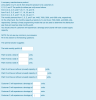 A company manufactures a product at its plants in Q, R, and S; then ships the product to its customers in C, D, E, and F. The profits (in dollars per unit) are as follows: from Q to C, D, E, and F: 20, 17, 16, and 19 from R to C, D, E, and F: 17, 18, 20, and 16 from S to C, D, E, and F: 18, 20, 18, and 17 The monthly demand from C, D,...
Jones company has two manufacturing plants A and B, and three warehouses, W1, W2, W3. Each...
Jones company has two manufacturing plants A and B, and three warehouses, W1, W2, W3. Each week Jones ships product from the plants to the warehouses. The system is balanced: A produces 500 units of product and B produces 300 units of product. Warehouse W1 needs 200 units of product, W2 needs 300 units of product, and W3 needs 300 units of product. Thus, over the entire system, there are 800 units produced by the two plants and 800 units...
A manufacturing company receives orders for engines from two assembly plants. Plant I needs at least...
 A manufacturing company receives orders for engines from two assembly plants. Plant I needs at least 45 engines, and plant II needs at least 32 engines. The company can send at most 140 engines to these assembly plants. It costs $35 per engine to ship to plant I and $50 per engine to ship to plant II. Plant I gives the manufacturing company $20 in rebates toward its products for each engine they buy, while plant II gives similar $...
A manufacturing company receives orders for engines from two assembly plants. Plant I needs at least...
 A manufacturing company receives orders for engines from two assembly plants. Plant I needs at least 45 engines, and plant II needs at least 32 engines. The company can send at most 140 engines to these assembly plants. It costs $35 per engine to ship to plant I and $50 per engine to ship to plant II. Plant I gives the manufacturing company $20 in rebates toward its products for each engine they buy, while plant II gives similar $15...
A manufacturing company receives orders for engines from two assembly plants. Plant I needs at least...
A manufacturing company receives orders for engines from two assembly plants. Plant I needs at least 45 engines, and plant II needs at least 32 engines. The company can send at most 140 engines to these assembly plants. It costs $30 per engine to ship to plant I and $40 per engine to ship to plant II. Plant I gives the manufacturing company $20 in rebates toward its products for each engine theybuy, while plant II gives similar $15 rebates....
 To reduce its total batch-level costs, a company should produce its products in large batches. True or False True True False False
 41. When a manufacturing company has a highly automated manufacturing plant producing many different products, what is probably the most appropriate basis of applying overhead costs to work-in-process? A. Direct labor hours. B. Direct labor costs C. Machine hours. D. Direct material cost. 42. In a labor intensive company in which more overhead is used by the more highly skilled and paid employees, which activity base would be most appropriate for applying overhead to production? A. Direct labor hours. B....
 Cullumber Manufacturing Inc. is a local manufacturing company. Rather than sell its product directly. Cullumber ships its finished goods inventory to CMR Retailing Ltd., who sells the product for Cullumber on consignment. During 2020, Cullumber ships $101,500 in merchandise to CMR. At the end of 2020, CMR has sold 65% of the merchandise for $73,500. CMR notifies Cullumber of the sales, retains a 20% commission, and remits the cash due to Cullumbat Prepare all the necessary journal entries on the...
 A company manufactures a product at its plants in Q, R, and S; then ships the product to its customers in C, D, E, and F. The profits (in dollars per unit) are as follows: from Q to C, D, E, and F: 20, 17, 16, and 19 from R to C, D, E, and F: 17, 18, 20, and 16 from S to C, D, E, and F: 18, 20, 18, and 17 The monthly demand from C, D,...
 A manufacturing company receives orders for engines from two assembly plants. Plant I needs at least 45 engines, and plant II needs at least 32 engines. The company can send at most 140 engines to these assembly plants. It costs $35 per engine to ship to plant I and $50 per engine to ship to plant II. Plant I gives the manufacturing company $20 in rebates toward its products for each engine they buy, while plant II gives similar $...
 A manufacturing company receives orders for engines from two assembly plants. Plant I needs at least 45 engines, and plant II needs at least 32 engines. The company can send at most 140 engines to these assembly plants. It costs $35 per engine to ship to plant I and $50 per engine to ship to plant II. Plant I gives the manufacturing company $20 in rebates toward its products for each engine they buy, while plant II gives similar $15...
Most questions answered within 3 hours.
-
Where is the error in this code sequence?
String s1 = "Hello";
String s2 = "ello";...
asked 11 months ago -
Financial data for Joel de Paris, Inc., for last year
follow:
Joel de Paris, Inc.
Balance...
asked 11 months ago -
Consider this reaction:
Al2(SO4)3 (aq)+ BaCl3
(aq) Al2Cl6 (aq)- +
3BaSO4(s) . What is the...
asked 11 months ago -
Suppose that Savneet is considering increasing her
recent random sample from 20 car rentals to 40...
asked 11 months ago -
Trucks arrive at an unloading terminal at an average rate of 120
per hour.
Trucks arrive...
asked 11 months ago -
Why are methanol and ethanol completely soluble in water while
octanol is not very little soluble....
asked 11 months ago -
A facilities manager at a university reads in a research report
that the mean amount of...
asked 11 months ago -
When the CuSO4 is rehydrated by adding water to the anhydrous
compound, is this an endothermic...
asked 11 months ago -
A ray of sunlight is passing from diamond into crown glass; the
angle of incidence is...
asked 11 months ago -
A block of mass 0.249 kg is placed on top of a light, vertical
spring of...
asked 11 months ago -
how do the kidneys compensate in the presences of acidosis
a) trigger hyperventilate
b) reserve acid...
asked 11 months ago -
Question 501 pts
The rental rate of capital to the firm increases. Which of the
following...
asked 11 months ago