
Homework Answers
Add Answer to:
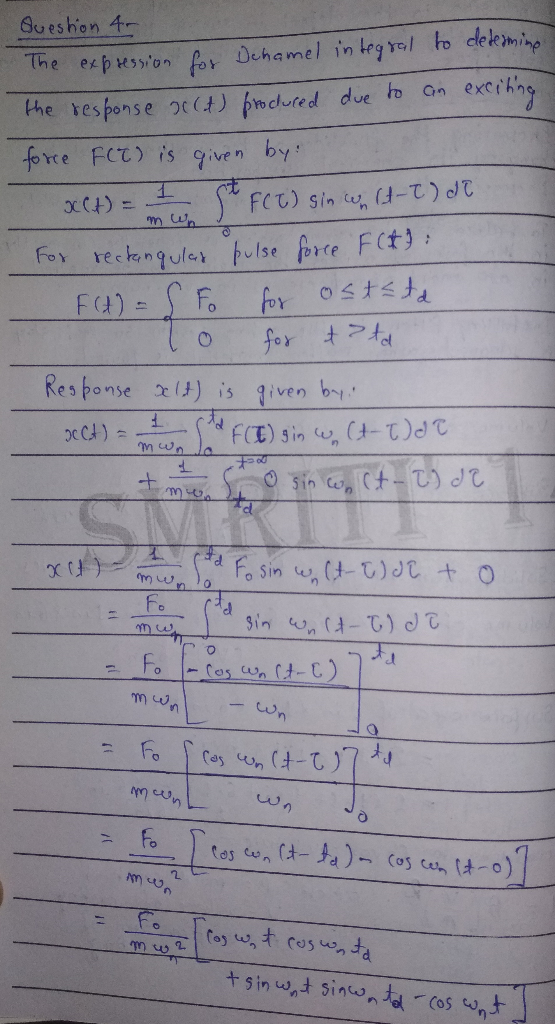
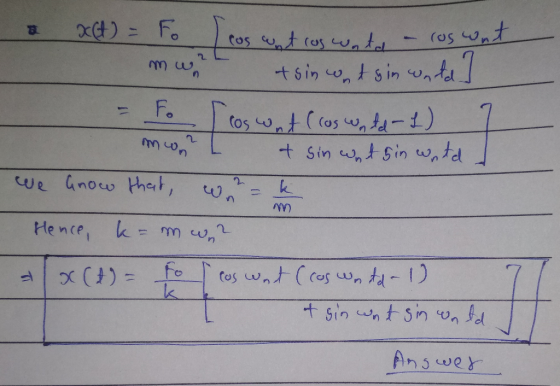
Question 4 (25% total) Use the Duhamel Integral method to determine expression for the response x(t) of an undamped SDO...
2. (25%) Consider an undamped system subject to a rectangular pulse given by F(t) Fo for...
 2. (25%) Consider an undamped system subject to a rectangular pulse given by F(t) Fo for 0sts to and Ft) = 0 for t > to (a) Find the displacement response x() for 0ststo and t>to, respectively. (b) Find xmax for 0ststo and t> to, respectively.
2. (25%) Consider an undamped system subject to a rectangular pulse given by F(t) Fo for 0sts to and Ft) = 0 for t > to (a) Find the displacement response x() for 0ststo...
2. (25%) Consider an undamped system subject to a rectangular pulse given by F(t) Fo for 0sts to and Ft) = 0 for t > to (a) Find the displacement response x() for 0ststo and t>to, respectively. (b) Find xmax for 0ststo and t> to, respectively.
2. (25%) Consider an undamped system subject to a rectangular pulse given by F(t) Fo for 0sts to and Ft) = 0 for t > to (a) Find the displacement response x() for 0ststo...
2) Use the Duhamel integral method to derive the expressions for the response of the undamped...
 2) Use the Duhamel integral method to derive the expressions for the response of the undamped system subjected to the forcing functions shown in fig A. Set up the expression for x[t) in fig. B Ft 0.sto MA 2+ 0.5 € Fig A
Question Four (a) Determine the response x() for the undamped system subjected to the force F...
 Question Four (a) Determine the response x() for the undamped system subjected to the force F as shown below and given by: ts 0.1s F(t) =-600t +120 0.1 <t s 0.2 s t> 0.2s 600t 0 The mass is initially at rest with x 0 at time 1 0. (b) Find the displacement of the mass at 1 0.25 s. k 75 N/m 0.75 kg F), N 1, S 0.2 0.1
Question Four (a) Determine the response x() for the...
Question Four (a) Determine the response x() for the undamped system subjected to the force F as shown below and given by: ts 0.1s F(t) =-600t +120 0.1 <t s 0.2 s t> 0.2s 600t 0 The mass is initially at rest with x 0 at time 1 0. (b) Find the displacement of the mass at 1 0.25 s. k 75 N/m 0.75 kg F), N 1, S 0.2 0.1
Question Four (a) Determine the response x() for the...
State vIIU F(0) 3) (25 pts.) Find the response of an undamped single degree of freedom systerm to the excitation F(t...
 State vIIU F(0) 3) (25 pts.) Find the response of an undamped single degree of freedom systerm to the excitation F(t) shown on the right using the convolution integral. cos 21 to
State vIIU F(0) 3) (25 pts.) Find the response of an undamped single degree of freedom systerm to the excitation F(t) shown on the right using the convolution integral. cos 21 to
State vIIU F(0) 3) (25 pts.) Find the response of an undamped single degree of freedom systerm to the excitation F(t) shown on the right using the convolution integral. cos 21 to
3) (30 points) A machine tool with a mass of 30 kg is mounted on an...
 3) (30 points) A machine tool with a mass of 30 kg is mounted on an undamped foundation of stiffness 1500 N/m. During operation, it is subject to the machining forces shown in the figure below. Use the principle of superposition and the convolution integral to determine the response of the system to each force. (Fo= 250 N, to=1 sec) (Hint: use table 5.1) F(1) 2F F 10 210
Problem 4. Use the convolution integral to find the response y(t) of the LTI system with...
 Problem 4. Use the convolution integral to find the response y(t) of the LTI system with impulse response h(t) to input x(t) a) x(I)-2expl_2t)u(t) , h(1)-expl-t)u(t)
Find the convolution integral of the following figure pairs: use the graph method y(t) X(t) 0...
 Find the convolution integral of the following figure pairs: use
the graph method
y(t) X(t) 0 1 2 3 4
Find the convolution integral of the following figure pairs: use
the graph method
y(t) X(t) 0 1 2 3 4
A reciprocating pump weighing W-150 lb, is mounted at a middle of a steel plate of thickness 0.5 ...
 A reciprocating pump weighing W-150 lb, is mounted at a middle of a steel plate of thickness 0.5 in., width of 20 in., and clamped along two edges as shown. During operation of pump, the plate is subjected to a harmonic force Ft)-Fo.t) ibl. 0.5 in. Fio),x(t) 100 in. where the amplitude of harmonic force is F俨50 lh and its angular frequency: 62.832 radls Model the system as a simple spring and mass system in the horizontal plane. The mass...
Problem 4: Evaluation of the convolution integral too y(t) = (f * h)(t) = f(t)h(t –...
 Problem 4: Evaluation of the convolution integral too y(t) = (f * h)(t) = f(t)h(t – 7)dt is greatly simplified when either the input f(t) or impulse response h(t) is the sum of weighted impulse functions. This fact will be used later in the semester when we study the operation of communication systems using Fourier analysis methods. a) Use the convolution integral to prove that f(t) *8(t – T) = f(t – T) and 8(t – T) *h(t) = h(t...
uestion 2 (25% total a) For a lightly-damped SDOF system, let x, and 1,- be the free vibration displacement amplitudes...
 uestion 2 (25% total a) For a lightly-damped SDOF system, let x, and 1,- be the free vibration displacement amplitudes at the initial (reference) moment and m cycles later, respectively. (15%) In the class we concluded that the damping ratio can be estimated using logarithmic decrement as (LI) 27m Does this method still work if instead of displacement amplitudes, we use velocity amplitudes? That is, can be estimated based on 1+m where v, and Vi+ are the free vibration velocity...
 2. (25%) Consider an undamped system subject to a rectangular pulse given by F(t) Fo for 0sts to and Ft) = 0 for t > to (a) Find the displacement response x() for 0ststo and t>to, respectively. (b) Find xmax for 0ststo and t> to, respectively.
2. (25%) Consider an undamped system subject to a rectangular pulse given by F(t) Fo for 0sts to and Ft) = 0 for t > to (a) Find the displacement response x() for 0ststo...
2. (25%) Consider an undamped system subject to a rectangular pulse given by F(t) Fo for 0sts to and Ft) = 0 for t > to (a) Find the displacement response x() for 0ststo and t>to, respectively. (b) Find xmax for 0ststo and t> to, respectively.
2. (25%) Consider an undamped system subject to a rectangular pulse given by F(t) Fo for 0sts to and Ft) = 0 for t > to (a) Find the displacement response x() for 0ststo...
 2) Use the Duhamel integral method to derive the expressions for the response of the undamped system subjected to the forcing functions shown in fig A. Set up the expression for x[t) in fig. B Ft 0.sto MA 2+ 0.5 € Fig A
 Question Four (a) Determine the response x() for the undamped system subjected to the force F as shown below and given by: ts 0.1s F(t) =-600t +120 0.1 <t s 0.2 s t> 0.2s 600t 0 The mass is initially at rest with x 0 at time 1 0. (b) Find the displacement of the mass at 1 0.25 s. k 75 N/m 0.75 kg F), N 1, S 0.2 0.1
Question Four (a) Determine the response x() for the...
Question Four (a) Determine the response x() for the undamped system subjected to the force F as shown below and given by: ts 0.1s F(t) =-600t +120 0.1 <t s 0.2 s t> 0.2s 600t 0 The mass is initially at rest with x 0 at time 1 0. (b) Find the displacement of the mass at 1 0.25 s. k 75 N/m 0.75 kg F), N 1, S 0.2 0.1
Question Four (a) Determine the response x() for the...
 State vIIU F(0) 3) (25 pts.) Find the response of an undamped single degree of freedom systerm to the excitation F(t) shown on the right using the convolution integral. cos 21 to
State vIIU F(0) 3) (25 pts.) Find the response of an undamped single degree of freedom systerm to the excitation F(t) shown on the right using the convolution integral. cos 21 to
State vIIU F(0) 3) (25 pts.) Find the response of an undamped single degree of freedom systerm to the excitation F(t) shown on the right using the convolution integral. cos 21 to
 3) (30 points) A machine tool with a mass of 30 kg is mounted on an undamped foundation of stiffness 1500 N/m. During operation, it is subject to the machining forces shown in the figure below. Use the principle of superposition and the convolution integral to determine the response of the system to each force. (Fo= 250 N, to=1 sec) (Hint: use table 5.1) F(1) 2F F 10 210
 Problem 4. Use the convolution integral to find the response y(t) of the LTI system with impulse response h(t) to input x(t) a) x(I)-2expl_2t)u(t) , h(1)-expl-t)u(t)
 Find the convolution integral of the following figure pairs: use
the graph method
y(t) X(t) 0 1 2 3 4
Find the convolution integral of the following figure pairs: use
the graph method
y(t) X(t) 0 1 2 3 4
 A reciprocating pump weighing W-150 lb, is mounted at a middle of a steel plate of thickness 0.5 in., width of 20 in., and clamped along two edges as shown. During operation of pump, the plate is subjected to a harmonic force Ft)-Fo.t) ibl. 0.5 in. Fio),x(t) 100 in. where the amplitude of harmonic force is F俨50 lh and its angular frequency: 62.832 radls Model the system as a simple spring and mass system in the horizontal plane. The mass...
 Problem 4: Evaluation of the convolution integral too y(t) = (f * h)(t) = f(t)h(t – 7)dt is greatly simplified when either the input f(t) or impulse response h(t) is the sum of weighted impulse functions. This fact will be used later in the semester when we study the operation of communication systems using Fourier analysis methods. a) Use the convolution integral to prove that f(t) *8(t – T) = f(t – T) and 8(t – T) *h(t) = h(t...
 uestion 2 (25% total a) For a lightly-damped SDOF system, let x, and 1,- be the free vibration displacement amplitudes at the initial (reference) moment and m cycles later, respectively. (15%) In the class we concluded that the damping ratio can be estimated using logarithmic decrement as (LI) 27m Does this method still work if instead of displacement amplitudes, we use velocity amplitudes? That is, can be estimated based on 1+m where v, and Vi+ are the free vibration velocity...
Most questions answered within 3 hours.
-
Where is the error in this code sequence?
String s1 = "Hello";
String s2 = "ello";...
asked 10 months ago -
Financial data for Joel de Paris, Inc., for last year
follow:
Joel de Paris, Inc.
Balance...
asked 10 months ago -
Consider this reaction:
Al2(SO4)3 (aq)+ BaCl3
(aq) Al2Cl6 (aq)- +
3BaSO4(s) . What is the...
asked 10 months ago -
Suppose that Savneet is considering increasing her
recent random sample from 20 car rentals to 40...
asked 10 months ago -
Trucks arrive at an unloading terminal at an average rate of 120
per hour.
Trucks arrive...
asked 10 months ago -
Why are methanol and ethanol completely soluble in water while
octanol is not very little soluble....
asked 10 months ago -
A facilities manager at a university reads in a research report
that the mean amount of...
asked 10 months ago -
When the CuSO4 is rehydrated by adding water to the anhydrous
compound, is this an endothermic...
asked 10 months ago -
A ray of sunlight is passing from diamond into crown glass; the
angle of incidence is...
asked 10 months ago -
A block of mass 0.249 kg is placed on top of a light, vertical
spring of...
asked 10 months ago -
how do the kidneys compensate in the presences of acidosis
a) trigger hyperventilate
b) reserve acid...
asked 10 months ago -
Question 501 pts
The rental rate of capital to the firm increases. Which of the
following...
asked 10 months ago