Can anyone help with this question please?
Homework Answers
Add Answer to:
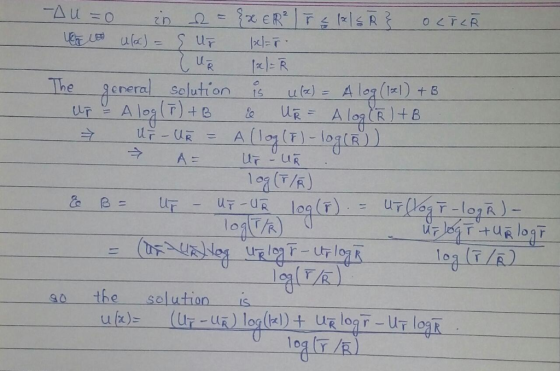
Can anyone help with this question please? Consider the problem-Δu = 0 in the annulus 2- E R R where 0<F< R with...
Question: In the annulus the functions ,z , log l2l,1 (where k EN and any convergent series in these are harmonic....
 Question: In the annulus the functions ,z , log l2l,1 (where k EN and any convergent series in these are harmonic. Find a harmonic function in which takes value 1 on the inner boundary (circle of radius 1/2) and value 2 on the outer boundary (unit circle). If u is the solution you just found, what problem is solved by (E lu
Question: In the annulus the functions ,z , log l2l,1 (where k EN and any convergent series in...
Question: In the annulus the functions ,z , log l2l,1 (where k EN and any convergent series in these are harmonic. Find a harmonic function in which takes value 1 on the inner boundary (circle of radius 1/2) and value 2 on the outer boundary (unit circle). If u is the solution you just found, what problem is solved by (E lu
Question: In the annulus the functions ,z , log l2l,1 (where k EN and any convergent series in...
2. Show that the Dirichlet problem for the disc t(z,y): +y S R2), where f(0) is the boundary func...
 use the hint please
2. Show that the Dirichlet problem for the disc t(z,y): +y S R2), where f(0) is the boundary function, has the solution 0o aj COS 1 sin j 3-1 where a, and b, are the Fourier coefficients of f. Show also that the Poisson integral formula for this more general disc setting is R22 (Hint: Do not solve this problem from first principles. Rather, do a change of variables to reduce this new problem to the...
use the hint please
2. Show that the Dirichlet problem for the disc t(z,y): +y S R2), where f(0) is the boundary function, has the solution 0o aj COS 1 sin j 3-1 where a, and b, are the Fourier coefficients of f. Show also that the Poisson integral formula for this more general disc setting is R22 (Hint: Do not solve this problem from first principles. Rather, do a change of variables to reduce this new problem to the...
4. Consider the boundary-value problem on the region given by {(r, 0, 6)|1 < r < 2}: vu= 0, 1 <r< 2, u(r =...
 4. Consider the boundary-value problem on the region given by {(r, 0, 6)|1 < r < 2}: vu= 0, 1 <r< 2, u(r = 1)= 1, ur(r = 2) = -u(r = 2). Using our work with the Laplace equation in class, find the solution to this problem. [Hint: it depends only on r, not on 0 or ø.
4. Consider the boundary-value problem on the region given by {(r, 0, 6)|1
4. Consider the boundary-value problem on the region given by {(r, 0, 6)|1 < r < 2}: vu= 0, 1 <r< 2, u(r = 1)= 1, ur(r = 2) = -u(r = 2). Using our work with the Laplace equation in class, find the solution to this problem. [Hint: it depends only on r, not on 0 or ø.
4. Consider the boundary-value problem on the region given by {(r, 0, 6)|1
1. Wave equation. Consider the wave equation on the finite interval (0, L) PDE BC where Neumann b...
 1. Wave equation. Consider the wave equation on the finite interval (0, L) PDE BC where Neumann boundary conditions are specified Physically, with Neumann boundary conditions, u(r, t) could represent the height of a fluid that sloshes between two walls. (a) Find the general Fourier series solution by repeating the derivation from class now considering Neumann instead of Dirichlet boundary conditions. Your final solution should be (b) Consider the following general initial conditions u(x, 0)x) IC IC Derive formulas that...
Can anyone help with this question please? Given a domain Ω c R2 and a smooth function f,uo : Ω-+ R consider the proble...
 Can anyone help with this question please?
Given a domain Ω c R2 and a smooth function f,uo : Ω-+ R consider the problem Uz (x, t)-Au (x, t) + u(x, t) u(x, t = f(x) Y(x, t) E Ω × (0, oo), V(x, t) E 2 x (0, 00), Assume that u(z, t) is a smooth solution and that v(x) is a smooth stationary (i.e., time-independent) solution. Derive a PDE problem for the difference w(x, t)u(x, t)(x) By multiplying...
Can anyone help with this question please?
Given a domain Ω c R2 and a smooth function f,uo : Ω-+ R consider the problem Uz (x, t)-Au (x, t) + u(x, t) u(x, t = f(x) Y(x, t) E Ω × (0, oo), V(x, t) E 2 x (0, 00), Assume that u(z, t) is a smooth solution and that v(x) is a smooth stationary (i.e., time-independent) solution. Derive a PDE problem for the difference w(x, t)u(x, t)(x) By multiplying...
Can anyone help with this question please? Any help will be appreciated!!! Consider a general first order equation of t...
 Can anyone help with this question please? Any help will be
appreciated!!!
Consider a general first order equation of the form where q(u) is a smooth function and assume that u(x, t) is a smooth solution. Given any smooth function u(x, t) whose support is a subset of [-R, R] × [0, T] for some R, T> 0 show that
Consider a general first order equation of the form where q(u) is a smooth function and assume that u(x, t)...
Can anyone help with this question please? Any help will be
appreciated!!!
Consider a general first order equation of the form where q(u) is a smooth function and assume that u(x, t) is a smooth solution. Given any smooth function u(x, t) whose support is a subset of [-R, R] × [0, T] for some R, T> 0 show that
Consider a general first order equation of the form where q(u) is a smooth function and assume that u(x, t)...
Using Laplace Equation PDE 42.(a) Solve for u(r, e): That is, the region is an annulus betweenr 1 andr 2. HINT: First draw a picture of it, to get a look at the problem. Now, you should be able to re...
 Using Laplace Equation PDE
42.(a) Solve for u(r, e): That is, the region is an annulus betweenr 1 andr 2. HINT: First draw a picture of it, to get a look at the problem. Now, you should be able to readily get Then, see that you have 27-periodicity, so K n (n-1, 2, ) and D-0, so u (r, θ) A' + B' In r + an infinite series with r's and θ's in it. But look at your picture:...
Using Laplace Equation PDE
42.(a) Solve for u(r, e): That is, the region is an annulus betweenr 1 andr 2. HINT: First draw a picture of it, to get a look at the problem. Now, you should be able to readily get Then, see that you have 27-periodicity, so K n (n-1, 2, ) and D-0, so u (r, θ) A' + B' In r + an infinite series with r's and θ's in it. But look at your picture:...
Q2 Given the following heat conduction initial-boundary value problem of a thin homogeneous rod, where ?(?,?)...
 Q2 Given the following heat conduction initial-boundary value
problem of a thin homogeneous rod, where ?(?,?) represents the
temperature. 9??? = ?? ; 0 < ? < 6; ? > 0; B. C. : ??
(0,?) = 0; ?? (6,?) = 0; ? > 0; I. C. : ?(?, 0) = 12 + 5??? ( ?
6 ?) − 4???(2??); 0 < ? < 6 (a) When ? = 0, what would be the
temperature at ? = 3? (Use...
Q2 Given the following heat conduction initial-boundary value
problem of a thin homogeneous rod, where ?(?,?) represents the
temperature. 9??? = ?? ; 0 < ? < 6; ? > 0; B. C. : ??
(0,?) = 0; ?? (6,?) = 0; ? > 0; I. C. : ?(?, 0) = 12 + 5??? ( ?
6 ?) − 4???(2??); 0 < ? < 6 (a) When ? = 0, what would be the
temperature at ? = 3? (Use...
Can anyone help with this question please? The initial boundary condition is trivial, I struggled to show the first cond...
 Can anyone help with this question please? The initial boundary
condition is trivial, I struggled to show the first condition.
Any help will be appreciated!!!
Let now Ω c Rd be an open and bounded set with a smooth boundary on and outer unit normal n. Furthermore, let f : Ω → R be a continuous function. Define the functional where weg-(u E C10) |v = 0 and ▽u . n = 0 in 201. Show that a minimiser u...
Can anyone help with this question please? The initial boundary
condition is trivial, I struggled to show the first condition.
Any help will be appreciated!!!
Let now Ω c Rd be an open and bounded set with a smooth boundary on and outer unit normal n. Furthermore, let f : Ω → R be a continuous function. Define the functional where weg-(u E C10) |v = 0 and ▽u . n = 0 in 201. Show that a minimiser u...
3. In class we discussed the heat conduction problem with the boundary conditions a(0, t) 0, t4(1...
 3. In class we discussed the heat conduction problem with the boundary conditions a(0, t) 0, t4(1,t)-0, t > 0 and the initial condition u(r,0) f(a) We found the solution to be of the form where (2n-1)n 1,2,3,. TL 20 Now consider the heat conduction problem with the boundary conditions u(0, t) 1,u(T, t)0, t>0 and the initial condition ur,0) 0. Find u(r,t). Hint: First you must find the steady state.
3. In class we discussed the heat conduction problem...
3. In class we discussed the heat conduction problem with the boundary conditions a(0, t) 0, t4(1,t)-0, t > 0 and the initial condition u(r,0) f(a) We found the solution to be of the form where (2n-1)n 1,2,3,. TL 20 Now consider the heat conduction problem with the boundary conditions u(0, t) 1,u(T, t)0, t>0 and the initial condition ur,0) 0. Find u(r,t). Hint: First you must find the steady state.
3. In class we discussed the heat conduction problem...
 Question: In the annulus the functions ,z , log l2l,1 (where k EN and any convergent series in these are harmonic. Find a harmonic function in which takes value 1 on the inner boundary (circle of radius 1/2) and value 2 on the outer boundary (unit circle). If u is the solution you just found, what problem is solved by (E lu
Question: In the annulus the functions ,z , log l2l,1 (where k EN and any convergent series in...
Question: In the annulus the functions ,z , log l2l,1 (where k EN and any convergent series in these are harmonic. Find a harmonic function in which takes value 1 on the inner boundary (circle of radius 1/2) and value 2 on the outer boundary (unit circle). If u is the solution you just found, what problem is solved by (E lu
Question: In the annulus the functions ,z , log l2l,1 (where k EN and any convergent series in...
 use the hint please
2. Show that the Dirichlet problem for the disc t(z,y): +y S R2), where f(0) is the boundary function, has the solution 0o aj COS 1 sin j 3-1 where a, and b, are the Fourier coefficients of f. Show also that the Poisson integral formula for this more general disc setting is R22 (Hint: Do not solve this problem from first principles. Rather, do a change of variables to reduce this new problem to the...
use the hint please
2. Show that the Dirichlet problem for the disc t(z,y): +y S R2), where f(0) is the boundary function, has the solution 0o aj COS 1 sin j 3-1 where a, and b, are the Fourier coefficients of f. Show also that the Poisson integral formula for this more general disc setting is R22 (Hint: Do not solve this problem from first principles. Rather, do a change of variables to reduce this new problem to the...
 4. Consider the boundary-value problem on the region given by {(r, 0, 6)|1 < r < 2}: vu= 0, 1 <r< 2, u(r = 1)= 1, ur(r = 2) = -u(r = 2). Using our work with the Laplace equation in class, find the solution to this problem. [Hint: it depends only on r, not on 0 or ø.
4. Consider the boundary-value problem on the region given by {(r, 0, 6)|1
4. Consider the boundary-value problem on the region given by {(r, 0, 6)|1 < r < 2}: vu= 0, 1 <r< 2, u(r = 1)= 1, ur(r = 2) = -u(r = 2). Using our work with the Laplace equation in class, find the solution to this problem. [Hint: it depends only on r, not on 0 or ø.
4. Consider the boundary-value problem on the region given by {(r, 0, 6)|1
 1. Wave equation. Consider the wave equation on the finite interval (0, L) PDE BC where Neumann boundary conditions are specified Physically, with Neumann boundary conditions, u(r, t) could represent the height of a fluid that sloshes between two walls. (a) Find the general Fourier series solution by repeating the derivation from class now considering Neumann instead of Dirichlet boundary conditions. Your final solution should be (b) Consider the following general initial conditions u(x, 0)x) IC IC Derive formulas that...
 Can anyone help with this question please?
Given a domain Ω c R2 and a smooth function f,uo : Ω-+ R consider the problem Uz (x, t)-Au (x, t) + u(x, t) u(x, t = f(x) Y(x, t) E Ω × (0, oo), V(x, t) E 2 x (0, 00), Assume that u(z, t) is a smooth solution and that v(x) is a smooth stationary (i.e., time-independent) solution. Derive a PDE problem for the difference w(x, t)u(x, t)(x) By multiplying...
Can anyone help with this question please?
Given a domain Ω c R2 and a smooth function f,uo : Ω-+ R consider the problem Uz (x, t)-Au (x, t) + u(x, t) u(x, t = f(x) Y(x, t) E Ω × (0, oo), V(x, t) E 2 x (0, 00), Assume that u(z, t) is a smooth solution and that v(x) is a smooth stationary (i.e., time-independent) solution. Derive a PDE problem for the difference w(x, t)u(x, t)(x) By multiplying...
 Can anyone help with this question please? Any help will be
appreciated!!!
Consider a general first order equation of the form where q(u) is a smooth function and assume that u(x, t) is a smooth solution. Given any smooth function u(x, t) whose support is a subset of [-R, R] × [0, T] for some R, T> 0 show that
Consider a general first order equation of the form where q(u) is a smooth function and assume that u(x, t)...
Can anyone help with this question please? Any help will be
appreciated!!!
Consider a general first order equation of the form where q(u) is a smooth function and assume that u(x, t) is a smooth solution. Given any smooth function u(x, t) whose support is a subset of [-R, R] × [0, T] for some R, T> 0 show that
Consider a general first order equation of the form where q(u) is a smooth function and assume that u(x, t)...
 Using Laplace Equation PDE
42.(a) Solve for u(r, e): That is, the region is an annulus betweenr 1 andr 2. HINT: First draw a picture of it, to get a look at the problem. Now, you should be able to readily get Then, see that you have 27-periodicity, so K n (n-1, 2, ) and D-0, so u (r, θ) A' + B' In r + an infinite series with r's and θ's in it. But look at your picture:...
Using Laplace Equation PDE
42.(a) Solve for u(r, e): That is, the region is an annulus betweenr 1 andr 2. HINT: First draw a picture of it, to get a look at the problem. Now, you should be able to readily get Then, see that you have 27-periodicity, so K n (n-1, 2, ) and D-0, so u (r, θ) A' + B' In r + an infinite series with r's and θ's in it. But look at your picture:...
 Q2 Given the following heat conduction initial-boundary value
problem of a thin homogeneous rod, where ?(?,?) represents the
temperature. 9??? = ?? ; 0 < ? < 6; ? > 0; B. C. : ??
(0,?) = 0; ?? (6,?) = 0; ? > 0; I. C. : ?(?, 0) = 12 + 5??? ( ?
6 ?) − 4???(2??); 0 < ? < 6 (a) When ? = 0, what would be the
temperature at ? = 3? (Use...
Q2 Given the following heat conduction initial-boundary value
problem of a thin homogeneous rod, where ?(?,?) represents the
temperature. 9??? = ?? ; 0 < ? < 6; ? > 0; B. C. : ??
(0,?) = 0; ?? (6,?) = 0; ? > 0; I. C. : ?(?, 0) = 12 + 5??? ( ?
6 ?) − 4???(2??); 0 < ? < 6 (a) When ? = 0, what would be the
temperature at ? = 3? (Use...
 Can anyone help with this question please? The initial boundary
condition is trivial, I struggled to show the first condition.
Any help will be appreciated!!!
Let now Ω c Rd be an open and bounded set with a smooth boundary on and outer unit normal n. Furthermore, let f : Ω → R be a continuous function. Define the functional where weg-(u E C10) |v = 0 and ▽u . n = 0 in 201. Show that a minimiser u...
Can anyone help with this question please? The initial boundary
condition is trivial, I struggled to show the first condition.
Any help will be appreciated!!!
Let now Ω c Rd be an open and bounded set with a smooth boundary on and outer unit normal n. Furthermore, let f : Ω → R be a continuous function. Define the functional where weg-(u E C10) |v = 0 and ▽u . n = 0 in 201. Show that a minimiser u...
 3. In class we discussed the heat conduction problem with the boundary conditions a(0, t) 0, t4(1,t)-0, t > 0 and the initial condition u(r,0) f(a) We found the solution to be of the form where (2n-1)n 1,2,3,. TL 20 Now consider the heat conduction problem with the boundary conditions u(0, t) 1,u(T, t)0, t>0 and the initial condition ur,0) 0. Find u(r,t). Hint: First you must find the steady state.
3. In class we discussed the heat conduction problem...
3. In class we discussed the heat conduction problem with the boundary conditions a(0, t) 0, t4(1,t)-0, t > 0 and the initial condition u(r,0) f(a) We found the solution to be of the form where (2n-1)n 1,2,3,. TL 20 Now consider the heat conduction problem with the boundary conditions u(0, t) 1,u(T, t)0, t>0 and the initial condition ur,0) 0. Find u(r,t). Hint: First you must find the steady state.
3. In class we discussed the heat conduction problem...
Most questions answered within 3 hours.
-
Where is the error in this code sequence?
String s1 = "Hello";
String s2 = "ello";...
asked 10 months ago -
Financial data for Joel de Paris, Inc., for last year
follow:
Joel de Paris, Inc.
Balance...
asked 10 months ago -
Consider this reaction:
Al2(SO4)3 (aq)+ BaCl3
(aq) Al2Cl6 (aq)- +
3BaSO4(s) . What is the...
asked 10 months ago -
Suppose that Savneet is considering increasing her
recent random sample from 20 car rentals to 40...
asked 10 months ago -
Trucks arrive at an unloading terminal at an average rate of 120
per hour.
Trucks arrive...
asked 10 months ago -
Why are methanol and ethanol completely soluble in water while
octanol is not very little soluble....
asked 10 months ago -
A facilities manager at a university reads in a research report
that the mean amount of...
asked 10 months ago -
When the CuSO4 is rehydrated by adding water to the anhydrous
compound, is this an endothermic...
asked 10 months ago -
A ray of sunlight is passing from diamond into crown glass; the
angle of incidence is...
asked 10 months ago -
A block of mass 0.249 kg is placed on top of a light, vertical
spring of...
asked 10 months ago -
how do the kidneys compensate in the presences of acidosis
a) trigger hyperventilate
b) reserve acid...
asked 10 months ago -
Question 501 pts
The rental rate of capital to the firm increases. Which of the
following...
asked 10 months ago