

Homework Answers
Add Answer to:
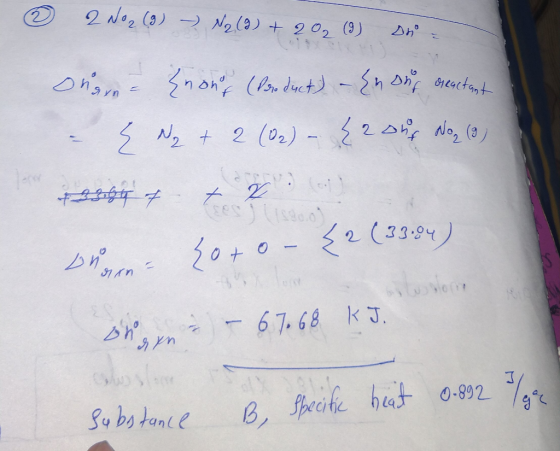
Which of the following 10.0 gram substances will increase in temperature by the greatest amount when 100 J of hea...
Calculate the amount of heat in J required to increase the temperature of 25.0 grams of...
 Calculate the amount of heat in J required to increase the temperature of 25.0 grams of water from 25. °C to 50.0 °C. ice Specific Heats of Common Substances at 25 °C and 1 bar Substance Symbol Specific Heat (J/g (state) °C) helium He(s) 5.193 water H2O(1) 4.184 ethanol C2H60(1) 2.376 H2O(s) 2.093 (at -10 °C) water vapor H2O(g) 1.864 nitrogen N2(8) 1.040 air 1.007 oxygen O2(8) 0.918 aluminum Al(s) 0.897 carbon CO2(8) 0.853 dioxide argon Ar(s) 0.522 iron Fe(s)...
Styrene, CgHg, is one of the substances used in the production of synthetic rubber. When styrene...
 Styrene, CgHg, is one of the substances used in the production of synthetic rubber. When styrene burns in oxygen to form carbon dioxide and liquid water under standard-state conditions at 25°C, 42.15 kJ are released per gram of styrene. Find the standard enthalpy of formation of styrene at 25°C, AH" (C02(9)) = -393.5 kJ/mol, AH®:(H,0(I) = -285.8 kJ/mol Select one: a. - 4390 kJ/mol b.-1044 kJ/mol c. -8681 kJ/mol d. +99 kJ/mol O e. +637 kJ/mol The heat of solution...
Which substance in the table below undergoes the greatest temperature change when the same mass of...
Which substance in the table below undergoes the greatest temperature change when the same mass of each substance absorbs the same amount of heat? substance specific / heat (J/(g⋅0C) N2 (g) / 1.04 C2H5OH (l) / 2.42 H2O (l) / 4.18 CH4 (g) / 2.20
13. How many kJ of heat are required when 128.0 grams of O, is formed as...
 13. How many kJ of heat are required when 128.0 grams of O, is formed as shown in the equation 2H2O(g) 2H2 (s) + O, (e) AH = +483.6 kJ 19344 9672 -1934.4 4336 D Question 14 1 pts 14. How much heat is required to raise the temperature of 31.2 g of bromine from 25.00 C to 27.30 "C? The specific heat of liquid bromine is 0.226 °C 16.23 300.02) 73.05 ) 5.203 Question 15 MacBook Pro DFGHJ 1...
Which of the following substances (with specific heat capacity provided) would show the greatest temperature change...
Which of the following substances (with specific heat capacity provided) would show the greatest temperature change upon absorbing 100.0 J of heat? a. 100 g Ag, CAg= O.235 J/g*C b. 10.0 g H2O, CH2O= 4.18 J/g*C c. 1.00 g ethanol, Cethanol= 2.42 J/g*C d. 50.0 g Fe, CFe=0.449 J/g*C Given the equations to use ΔT=ΔH/MCs
15.2 J of heat is applied to 8.0 g samples of each of the following substances:...
 15.2 J of heat is applied to 8.0 g samples of each of the following substances: water (s), water (g), mercury (1), and gold (s). Which substance's temperature will increase the most? The Specific Heat Capacities of Some Common Substances Substance Specific Heat Capacity (J/g °C) water (()* (liquid) 4.184 water(s) (ice) 2.03 water (8) (steam) 2.0 aluminum (s) 0.89 iron (s) 0.45 mercury (1) 0.14 0.71 silver (S) 0.24 gold (s) 0.13 *The symbols (s), (), and (g) indicate...
Heat Capacity The temperature of an object increases by 29.0 °C when it absorbs 3693 J...
 Heat Capacity The temperature of an object increases by 29.0 °C when it absorbs 3693 J of heat. Calculate the heat capacity of the object. What is the formula for heat (9) that does not contain a variable for mass? Solve: Calculate the specific heat capacity of the object if the object weighs 331 grams. What is the formula for heat (g) that contains a specific heat capacity term? Solve: Calorimetry A researcher studying the nutritional value of a new...
Assume that you have 10.0 g of each of the following substances. To which substance would...
Assume that you have 10.0 g of each of the following substances. To which substance would you have to add the smallest amount of energy to change the temperature by the same amount? a. Copper (specific heat capacity = 0.387 J/g°C) b. Lead (specific heat capacity = 0.128 J/g°C) c. Gold (specific heat capacity = 0.129 J/g°C) d. Iron (specific heat capacity = 0.4998 J/g°C) e. Silver (specific heat capacity = 0.235 J/g°C)
A piece of unknown substance weighs 57.2 g and requires 3210 ) to increase its temperature...
 A piece of unknown substance weighs 57.2 g and requires 3210 ) to increase its temperature from 22.6°C to 89.2°C. (a) What is the specific heat (in J/g.°C) of the substance? 493 /9-°C (6) If it is one of the substances found in the table below, what is its likely identity? Specific Heats of Common Substances at 25°C and 1 bar Substance Symbol (state) Specific Heat (1/g.c) gold Au(s) 0.129 copper Cu(s) 0.384 iron Fe(s) 0.449 argon Arg) 0.521 silicon...
Which one of the following statements is true? O H is the value of a measured...
 Which one of the following statements is true? O H is the value of a measured under conditions of constant volume. The enthalpy change for a reaction is independent of the state of the reactants and products. Enthalpy is a state function. O Enthalpy is an intensive property. The enthalpy change of a reaction is the reciprocal of the AH of the reverse reaction. QUESTION 2 0.5 points Save Answer Given the following reactions N2 (g) + 2O2 (g) +...
 Calculate the amount of heat in J required to increase the temperature of 25.0 grams of water from 25. °C to 50.0 °C. ice Specific Heats of Common Substances at 25 °C and 1 bar Substance Symbol Specific Heat (J/g (state) °C) helium He(s) 5.193 water H2O(1) 4.184 ethanol C2H60(1) 2.376 H2O(s) 2.093 (at -10 °C) water vapor H2O(g) 1.864 nitrogen N2(8) 1.040 air 1.007 oxygen O2(8) 0.918 aluminum Al(s) 0.897 carbon CO2(8) 0.853 dioxide argon Ar(s) 0.522 iron Fe(s)...
 Styrene, CgHg, is one of the substances used in the production of synthetic rubber. When styrene burns in oxygen to form carbon dioxide and liquid water under standard-state conditions at 25°C, 42.15 kJ are released per gram of styrene. Find the standard enthalpy of formation of styrene at 25°C, AH" (C02(9)) = -393.5 kJ/mol, AH®:(H,0(I) = -285.8 kJ/mol Select one: a. - 4390 kJ/mol b.-1044 kJ/mol c. -8681 kJ/mol d. +99 kJ/mol O e. +637 kJ/mol The heat of solution...
 13. How many kJ of heat are required when 128.0 grams of O, is formed as shown in the equation 2H2O(g) 2H2 (s) + O, (e) AH = +483.6 kJ 19344 9672 -1934.4 4336 D Question 14 1 pts 14. How much heat is required to raise the temperature of 31.2 g of bromine from 25.00 C to 27.30 "C? The specific heat of liquid bromine is 0.226 °C 16.23 300.02) 73.05 ) 5.203 Question 15 MacBook Pro DFGHJ 1...
 15.2 J of heat is applied to 8.0 g samples of each of the following substances: water (s), water (g), mercury (1), and gold (s). Which substance's temperature will increase the most? The Specific Heat Capacities of Some Common Substances Substance Specific Heat Capacity (J/g °C) water (()* (liquid) 4.184 water(s) (ice) 2.03 water (8) (steam) 2.0 aluminum (s) 0.89 iron (s) 0.45 mercury (1) 0.14 0.71 silver (S) 0.24 gold (s) 0.13 *The symbols (s), (), and (g) indicate...
 Heat Capacity The temperature of an object increases by 29.0 °C when it absorbs 3693 J of heat. Calculate the heat capacity of the object. What is the formula for heat (9) that does not contain a variable for mass? Solve: Calculate the specific heat capacity of the object if the object weighs 331 grams. What is the formula for heat (g) that contains a specific heat capacity term? Solve: Calorimetry A researcher studying the nutritional value of a new...
 A piece of unknown substance weighs 57.2 g and requires 3210 ) to increase its temperature from 22.6°C to 89.2°C. (a) What is the specific heat (in J/g.°C) of the substance? 493 /9-°C (6) If it is one of the substances found in the table below, what is its likely identity? Specific Heats of Common Substances at 25°C and 1 bar Substance Symbol (state) Specific Heat (1/g.c) gold Au(s) 0.129 copper Cu(s) 0.384 iron Fe(s) 0.449 argon Arg) 0.521 silicon...
 Which one of the following statements is true? O H is the value of a measured under conditions of constant volume. The enthalpy change for a reaction is independent of the state of the reactants and products. Enthalpy is a state function. O Enthalpy is an intensive property. The enthalpy change of a reaction is the reciprocal of the AH of the reverse reaction. QUESTION 2 0.5 points Save Answer Given the following reactions N2 (g) + 2O2 (g) +...
Most questions answered within 3 hours.
-
Where is the error in this code sequence?
String s1 = "Hello";
String s2 = "ello";...
asked 11 months ago -
Financial data for Joel de Paris, Inc., for last year
follow:
Joel de Paris, Inc.
Balance...
asked 11 months ago -
Consider this reaction:
Al2(SO4)3 (aq)+ BaCl3
(aq) Al2Cl6 (aq)- +
3BaSO4(s) . What is the...
asked 11 months ago -
Suppose that Savneet is considering increasing her
recent random sample from 20 car rentals to 40...
asked 11 months ago -
Trucks arrive at an unloading terminal at an average rate of 120
per hour.
Trucks arrive...
asked 11 months ago -
Why are methanol and ethanol completely soluble in water while
octanol is not very little soluble....
asked 11 months ago -
A facilities manager at a university reads in a research report
that the mean amount of...
asked 11 months ago -
When the CuSO4 is rehydrated by adding water to the anhydrous
compound, is this an endothermic...
asked 11 months ago -
A ray of sunlight is passing from diamond into crown glass; the
angle of incidence is...
asked 11 months ago -
A block of mass 0.249 kg is placed on top of a light, vertical
spring of...
asked 11 months ago -
how do the kidneys compensate in the presences of acidosis
a) trigger hyperventilate
b) reserve acid...
asked 11 months ago -
Question 501 pts
The rental rate of capital to the firm increases. Which of the
following...
asked 11 months ago