
Homework Answers
Add Answer to:
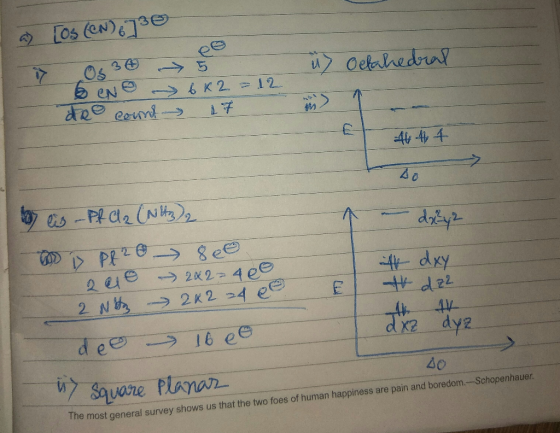
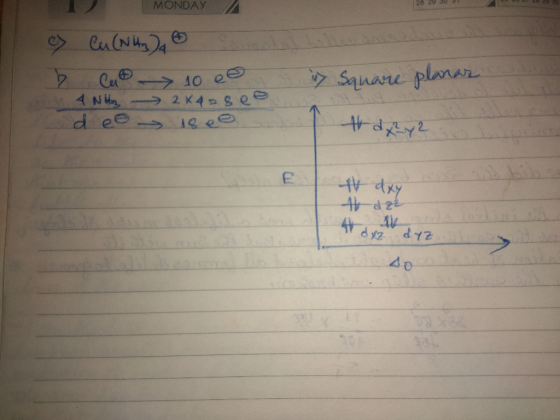
5. For each of the following transition metal complexes, give (i) the d-electron count, (ii) the approximate shape of t...
The transition metal ion, Fe(III), can form octahedral or tetrahedral complexes depending on the ligand it...
 The transition metal ion, Fe(III), can form octahedral or tetrahedral complexes depending on the ligand it binds to. (a) (i) [Fe(CN)6]3- is a strong field octahedral complex of Fe(III). Draw a labelled orbital energy level diagram that shows both the splitting of the d-orbitals and their electron occupancy in [Fe(CN)6]. (3 marks) (ii) Fe(III) can also form tetrahedral complexes, most of which are weak field. Draw a labelled orbital energy level diagram that shows both the splitting of the d-orbitals...
1. For each of the following complexes, give the electron configurations of the d-type M Os,...
 1. For each of the following complexes, give the electron configurations of the d-type M Os, for tetrahedral complexes. Also ie ) (e) for octahedral complexes and (e( ch complex in units of the Bohr , Fe(CN) 3, CoCl , Ni(CO)4, Ti(H2O) +, magnet n f.в Co ( NH3) 3+, Co(FLO)r", Fe(CN) V Fa". Cu(H2O) г., CuCl? , V(CO), Cr(CO) each octahedral complex is high-spi the ligand field theory notes). ust use your judgment as to whether n or low-spin...
1. Name the following transition metal complexes AND give the coordination number for each metal in the complex ion...
 1. Name the following transition metal complexes AND give the coordination number for each metal in the complex ion: Name Coordination # (a) K[Fe(CN).] (b)Ks[Fe(ox).] (c) Cr(en).]C13 (d) (Cr(NH3):(HO)](NO3) (e)ky [Cr(NH3),Cla]
For each of the following complexes, give an energy level diagram of the split d orbitals,...
For each of the following complexes, give an energy level diagram of the split d orbitals, fill the orbitals with electrons appropriately, and indicate the number of unpaired electrons (spins). In addition, calculate the LFSE for (a)–(f). (a) [Co(NH3)4(CN)2] (b) [Cr(CN)6]3– (c) [FeF6]3– (d) MnO4– (tetrahedral) (e) [Cu(H2O)6]2+ (f) [Cd(CN)4]2– (g) [Ni(CN)4]2
(b) Determine the oxidation state of the metal, the d electron configuration, the number of unpaired electrons and the ligand field stabilisation energy for the following complexes: (i) [Co(NH3)5Br]2+...
(b) Determine the oxidation state of the metal, the d electron configuration, the number of unpaired electrons and the ligand field stabilisation energy for the following complexes: (i) [Co(NH3)5Br]2+ (ii) [MnO4]- (iii) [Fe(CN)6]3- (iv) [Cu(H2O)6]2+
(i) Draw the electron distribution in the d orbitals of an octahedral Cu(II) complex and show...
(i) Draw the electron distribution in the d orbitals of an octahedral Cu(II) complex and show the electronic transition responsible for the absorptions observed. (ii) Assign the transition you observe for each complex and give the value of (in cm-1 ) (ii) is based on the complexes from (i)
2. For each of the complexes: [Co(H2O)6]Cl3 and [Co(NH3)6]Cl3 Give the oxidation state and the electron...
2. For each of the complexes: [Co(H2O)6]Cl3 and [Co(NH3)6]Cl3 Give the oxidation state and the electron configuration of the transition element as it is in the complex. Say whether the complex is low - spin or high - spin giving a reason for your choice. Draw the d level splitting diagram including the electrons.
Electronic absorption spectrum of copper ammine complexes (i) Draw the electron distribution in the d orbitals of an octahedral Cu(II) complex and show the electronic transition responsible for the...
 Electronic absorption spectrum of copper ammine complexes
(i) Draw the electron distribution in the d orbitals of an
octahedral Cu(II) complex and show the electronic transition
responsible for the absorptions observed.
(ii) Assign the transition you observe for each complex and give
the value of Δ (in cm-1).
Visible absorption spectra of Cu(ll) complexes 1.2 Cu (H20)2(NH3)4 Cu (H2O)6 Cu (H20)3(NH3)3 0.8 0.6 Cu (H20)s(NH3) Cu (H20)4(NH3)2 0.4 0.2 850 500 550 600 650 700 750 800 900 450 nm...
Electronic absorption spectrum of copper ammine complexes
(i) Draw the electron distribution in the d orbitals of an
octahedral Cu(II) complex and show the electronic transition
responsible for the absorptions observed.
(ii) Assign the transition you observe for each complex and give
the value of Δ (in cm-1).
Visible absorption spectra of Cu(ll) complexes 1.2 Cu (H20)2(NH3)4 Cu (H2O)6 Cu (H20)3(NH3)3 0.8 0.6 Cu (H20)s(NH3) Cu (H20)4(NH3)2 0.4 0.2 850 500 550 600 650 700 750 800 900 450 nm...
2. Indicate i. the metal oxidation state, ii. d-electron count, and iii. coordination number (CN) for...
 2. Indicate i. the metal oxidation state, ii. d-electron count, and iii. coordination number (CN) for the following complex (12 Points). a. Anti-cancer drug b. [Fe S4(SR)] SR Fe COS i. ii. ii. iii. iii. 3. Draw the metal coordination structure of carbonic anhydrase enzyme. Clearly show the 3-D geometry round the metal center. (6 Points)
We discussed in class how ligands can affect the A. energy splitting. a. Categorize these complexes...
 We discussed in class how ligands can affect the A. energy splitting. a. Categorize these complexes by whether their ligands are mainly i acceptors, i donors, or o donors. [Cr(CN)6]4-, [Fe(H20)6]2+, [CO(NH3)6]2+, [Cu(H20).]2+ b. Draw the tag-eg splitting and show the electron count for each complex from part a. Categorize each as high or low spin or write neither if both electron filling methods give the same result. Assume all o and i donors given here are weak-field ligands.
 The transition metal ion, Fe(III), can form octahedral or tetrahedral complexes depending on the ligand it binds to. (a) (i) [Fe(CN)6]3- is a strong field octahedral complex of Fe(III). Draw a labelled orbital energy level diagram that shows both the splitting of the d-orbitals and their electron occupancy in [Fe(CN)6]. (3 marks) (ii) Fe(III) can also form tetrahedral complexes, most of which are weak field. Draw a labelled orbital energy level diagram that shows both the splitting of the d-orbitals...
 1. For each of the following complexes, give the electron configurations of the d-type M Os, for tetrahedral complexes. Also ie ) (e) for octahedral complexes and (e( ch complex in units of the Bohr , Fe(CN) 3, CoCl , Ni(CO)4, Ti(H2O) +, magnet n f.в Co ( NH3) 3+, Co(FLO)r", Fe(CN) V Fa". Cu(H2O) г., CuCl? , V(CO), Cr(CO) each octahedral complex is high-spi the ligand field theory notes). ust use your judgment as to whether n or low-spin...
 1. Name the following transition metal complexes AND give the coordination number for each metal in the complex ion: Name Coordination # (a) K[Fe(CN).] (b)Ks[Fe(ox).] (c) Cr(en).]C13 (d) (Cr(NH3):(HO)](NO3) (e)ky [Cr(NH3),Cla]
 Electronic absorption spectrum of copper ammine complexes
(i) Draw the electron distribution in the d orbitals of an
octahedral Cu(II) complex and show the electronic transition
responsible for the absorptions observed.
(ii) Assign the transition you observe for each complex and give
the value of Δ (in cm-1).
Visible absorption spectra of Cu(ll) complexes 1.2 Cu (H20)2(NH3)4 Cu (H2O)6 Cu (H20)3(NH3)3 0.8 0.6 Cu (H20)s(NH3) Cu (H20)4(NH3)2 0.4 0.2 850 500 550 600 650 700 750 800 900 450 nm...
Electronic absorption spectrum of copper ammine complexes
(i) Draw the electron distribution in the d orbitals of an
octahedral Cu(II) complex and show the electronic transition
responsible for the absorptions observed.
(ii) Assign the transition you observe for each complex and give
the value of Δ (in cm-1).
Visible absorption spectra of Cu(ll) complexes 1.2 Cu (H20)2(NH3)4 Cu (H2O)6 Cu (H20)3(NH3)3 0.8 0.6 Cu (H20)s(NH3) Cu (H20)4(NH3)2 0.4 0.2 850 500 550 600 650 700 750 800 900 450 nm...
 2. Indicate i. the metal oxidation state, ii. d-electron count, and iii. coordination number (CN) for the following complex (12 Points). a. Anti-cancer drug b. [Fe S4(SR)] SR Fe COS i. ii. ii. iii. iii. 3. Draw the metal coordination structure of carbonic anhydrase enzyme. Clearly show the 3-D geometry round the metal center. (6 Points)
 We discussed in class how ligands can affect the A. energy splitting. a. Categorize these complexes by whether their ligands are mainly i acceptors, i donors, or o donors. [Cr(CN)6]4-, [Fe(H20)6]2+, [CO(NH3)6]2+, [Cu(H20).]2+ b. Draw the tag-eg splitting and show the electron count for each complex from part a. Categorize each as high or low spin or write neither if both electron filling methods give the same result. Assume all o and i donors given here are weak-field ligands.
Most questions answered within 3 hours.
-
Where is the error in this code sequence?
String s1 = "Hello";
String s2 = "ello";...
asked 11 months ago -
Financial data for Joel de Paris, Inc., for last year
follow:
Joel de Paris, Inc.
Balance...
asked 11 months ago -
Consider this reaction:
Al2(SO4)3 (aq)+ BaCl3
(aq) Al2Cl6 (aq)- +
3BaSO4(s) . What is the...
asked 11 months ago -
Suppose that Savneet is considering increasing her
recent random sample from 20 car rentals to 40...
asked 11 months ago -
Trucks arrive at an unloading terminal at an average rate of 120
per hour.
Trucks arrive...
asked 11 months ago -
Why are methanol and ethanol completely soluble in water while
octanol is not very little soluble....
asked 11 months ago -
A facilities manager at a university reads in a research report
that the mean amount of...
asked 11 months ago -
When the CuSO4 is rehydrated by adding water to the anhydrous
compound, is this an endothermic...
asked 11 months ago -
A ray of sunlight is passing from diamond into crown glass; the
angle of incidence is...
asked 11 months ago -
A block of mass 0.249 kg is placed on top of a light, vertical
spring of...
asked 11 months ago -
how do the kidneys compensate in the presences of acidosis
a) trigger hyperventilate
b) reserve acid...
asked 11 months ago -
Question 501 pts
The rental rate of capital to the firm increases. Which of the
following...
asked 11 months ago