Write the NIE and FUE for the addition of Ba(NO3)2, NaNO3, NaOH.
Homework Answers
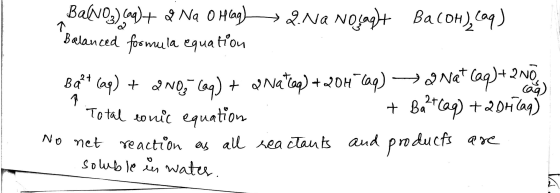
(6)- Write the NIE and FUE for the addition of Ba(NO3)2, NaNO3, NaOH
 (6)- Write the NIE and FUE for the addition of Ba(NO3)2, NaNO3, NaOH
Needing help with chemistry net ionic equations. NazSO4 (aq) + 8) HCI (aq) NIE Ba(NO3)2 (aq)...
 Needing help with chemistry net ionic equations.
NazSO4 (aq) + 8) HCI (aq) NIE Ba(NO3)2 (aq) + 9) HCI (aq) NIE = NaNO3 (aq)- 10) Na2CO3 (aq) + NIE Na2SO4 (aq) 11) Na2CO3 (aq) + NIE = Ba(NO3)2 (aq) 12) Na2CO3 (aq) NIE Na2SO4 (aq) 13) NaNO3 (aq) + NIE NANO3 (aq) Ba(NO32 (aq) 14) NIE 15) Na2SO4 (aq) + Ba(NO3)2 (aq) NIE
Needing help with chemistry net ionic equations.
NazSO4 (aq) + 8) HCI (aq) NIE Ba(NO3)2 (aq) + 9) HCI (aq) NIE = NaNO3 (aq)- 10) Na2CO3 (aq) + NIE Na2SO4 (aq) 11) Na2CO3 (aq) + NIE = Ba(NO3)2 (aq) 12) Na2CO3 (aq) NIE Na2SO4 (aq) 13) NaNO3 (aq) + NIE NANO3 (aq) Ba(NO32 (aq) 14) NIE 15) Na2SO4 (aq) + Ba(NO3)2 (aq) NIE
notes. 1) AgNO3 (aq) HCI (aq) 2) AgNO3 (aq) Na2CO3 (aq) NIE 3) AgNO3 (aq) NaNO3...
 notes. 1) AgNO3 (aq) HCI (aq) 2) AgNO3 (aq) Na2CO3 (aq) NIE 3) AgNO3 (aq) NaNO3 (aq) 4) AgNO3 (aq) Na2SO4 (aq) Ba (NO3)2 5) AgNO3 (aq) NIE 6) HCI (aq) Na2CO3 (aq) NIE NaNO3 (aq) 7) HCI (aq) NIE
The following combination of solutions will be added to a medium test tube and observations will...
 The following combination of solutions will be added to a medium test tube and observations will be recorded. For each precipitation provide the NET IONIC EQUATION and the FORMULA UNIT EQUATION. If no reaction occurs, write NR (No Reaction). Obtain three medium test tubes and add roughly 5 mL of 0.100 M Cu(NO3). Use (i) as your guide. The exact volume is not important. Then add dropwise each of the following: 1) 0.100 M Na co Write the NIE and...
1) If the equation Ba(NO3)2 + Na2SO4 → BaSO4 + NaNO3 is balanced, what coefficient must...
1) If the equation Ba(NO3)2 + Na2SO4 → BaSO4 + NaNO3 is balanced, what coefficient must be placed in front of the NaNO3? Group of answer choices: 3 4 2 1 2) If the equation H3PO4 + NaOH → Na3PO4 + H2O is balanced, what coefficient must be placed in front of the NaOH? Group of answer choices: 3 6 2 1
Write out the Balanced Chemical Equation (BCE), Complete Ionic Equation (CIE) and Net inoic Equation (NIE) of the follo...
Write out the Balanced Chemical Equation (BCE), Complete Ionic Equation (CIE) and Net inoic Equation (NIE) of the following: 1) HCl+ MnSO4 2) HC2H3O2+ NaOH 3) HCl+ NaHCO3 4) Na3PO4+Ba(NO3)2 5) H2SO4+Ba(NO3)2 6) NaCO3+HCl 7)Fe(NO3)3+NaCl 8) Cu(NO3)2+ NH3 9) Cu+HCl 10) Mg+HCl
Cu(OH)2 can be obtained from the addition of excess NaOH solution to a solution of Cu(NO3)2 as shown in the figur...
 Cu(OH)2 can be obtained from the addition of excess NaOH solution to a solution of Cu(NO3)2 as shown in the figure. If the NaOH is added to 35.0 mL of 0.167 M Cu(NO3)2 and the precipitate isolated by filtration, what is the theoretical yield of Cu(OH)2? Cu(NO3)2 (aq) + 2 NaOH (aq) → Cu(OH)2 (s) + 2 NaNO3(aq) 0.4718 5858 1.10 g 0.570 g 1.14g
Please write NIE for a reaction of Pb2O(NO3)2 and HCl to form PbCl2 and for a...
Please write NIE for a reaction of Pb2O(NO3)2 and HCl to form PbCl2 and for a reaction of Pb(C2H3O2)2 and H2SO4 to form PbSO4.
Balance each of the following chemical equations. a) Ba(NO3)2(aq) + Na2CrO4(aq) —> BaCrO4(s) + NaNO3(aq) b)...
Balance each of the following chemical equations. a) Ba(NO3)2(aq) + Na2CrO4(aq) —> BaCrO4(s) + NaNO3(aq) b) C2H5OH(l) + O2(g) —> CO2(g) + H2O(l) c) Sr(s) + HNO3(aq)—> Sr(NO3)2(aq) + H2(g) d) CuSO4(aq) + KI(s)—> CuI(s) + I2(s) + K2SO4(aq) Show the balancing of equations using the reactants-product table.
Unbalanced Equations AgNO3 + NaCl -- AgCl + NaNO3 Ca(NO3)2 + Na2CO3 -- Caco; +NaNO3 Pb(NO3)2...
 Unbalanced Equations AgNO3 + NaCl -- AgCl + NaNO3 Ca(NO3)2 + Na2CO3 -- Caco; +NaNO3 Pb(NO3)2 +K Cro, PbCrO, KNO, FeCl3 + NaOH -- Fe(OH)3 + NaCl FeCl2 + Nas -- Fes + NaCl Initial Mass of NaCl og 20 g 40 g 60g Add AgNO3 Add 1 g Add 10 8 Total Mass of AgNO3 added: 0g Reset Experiment AgNO; NaCl AgCl NaNO; 0.08 0.0 g 0.0 g 0.0 g Redo the experiment by clicking on Reset Experiment. Add...
 (6)- Write the NIE and FUE for the addition of Ba(NO3)2, NaNO3, NaOH
 Needing help with chemistry net ionic equations.
NazSO4 (aq) + 8) HCI (aq) NIE Ba(NO3)2 (aq) + 9) HCI (aq) NIE = NaNO3 (aq)- 10) Na2CO3 (aq) + NIE Na2SO4 (aq) 11) Na2CO3 (aq) + NIE = Ba(NO3)2 (aq) 12) Na2CO3 (aq) NIE Na2SO4 (aq) 13) NaNO3 (aq) + NIE NANO3 (aq) Ba(NO32 (aq) 14) NIE 15) Na2SO4 (aq) + Ba(NO3)2 (aq) NIE
Needing help with chemistry net ionic equations.
NazSO4 (aq) + 8) HCI (aq) NIE Ba(NO3)2 (aq) + 9) HCI (aq) NIE = NaNO3 (aq)- 10) Na2CO3 (aq) + NIE Na2SO4 (aq) 11) Na2CO3 (aq) + NIE = Ba(NO3)2 (aq) 12) Na2CO3 (aq) NIE Na2SO4 (aq) 13) NaNO3 (aq) + NIE NANO3 (aq) Ba(NO32 (aq) 14) NIE 15) Na2SO4 (aq) + Ba(NO3)2 (aq) NIE
 notes. 1) AgNO3 (aq) HCI (aq) 2) AgNO3 (aq) Na2CO3 (aq) NIE 3) AgNO3 (aq) NaNO3 (aq) 4) AgNO3 (aq) Na2SO4 (aq) Ba (NO3)2 5) AgNO3 (aq) NIE 6) HCI (aq) Na2CO3 (aq) NIE NaNO3 (aq) 7) HCI (aq) NIE
 The following combination of solutions will be added to a medium test tube and observations will be recorded. For each precipitation provide the NET IONIC EQUATION and the FORMULA UNIT EQUATION. If no reaction occurs, write NR (No Reaction). Obtain three medium test tubes and add roughly 5 mL of 0.100 M Cu(NO3). Use (i) as your guide. The exact volume is not important. Then add dropwise each of the following: 1) 0.100 M Na co Write the NIE and...
 Cu(OH)2 can be obtained from the addition of excess NaOH solution to a solution of Cu(NO3)2 as shown in the figure. If the NaOH is added to 35.0 mL of 0.167 M Cu(NO3)2 and the precipitate isolated by filtration, what is the theoretical yield of Cu(OH)2? Cu(NO3)2 (aq) + 2 NaOH (aq) → Cu(OH)2 (s) + 2 NaNO3(aq) 0.4718 5858 1.10 g 0.570 g 1.14g
 Unbalanced Equations AgNO3 + NaCl -- AgCl + NaNO3 Ca(NO3)2 + Na2CO3 -- Caco; +NaNO3 Pb(NO3)2 +K Cro, PbCrO, KNO, FeCl3 + NaOH -- Fe(OH)3 + NaCl FeCl2 + Nas -- Fes + NaCl Initial Mass of NaCl og 20 g 40 g 60g Add AgNO3 Add 1 g Add 10 8 Total Mass of AgNO3 added: 0g Reset Experiment AgNO; NaCl AgCl NaNO; 0.08 0.0 g 0.0 g 0.0 g Redo the experiment by clicking on Reset Experiment. Add...
Most questions answered within 3 hours.
-
Where is the error in this code sequence?
String s1 = "Hello";
String s2 = "ello";...
asked 11 months ago -
Financial data for Joel de Paris, Inc., for last year
follow:
Joel de Paris, Inc.
Balance...
asked 11 months ago -
Consider this reaction:
Al2(SO4)3 (aq)+ BaCl3
(aq) Al2Cl6 (aq)- +
3BaSO4(s) . What is the...
asked 11 months ago -
Suppose that Savneet is considering increasing her
recent random sample from 20 car rentals to 40...
asked 11 months ago -
Trucks arrive at an unloading terminal at an average rate of 120
per hour.
Trucks arrive...
asked 11 months ago -
Why are methanol and ethanol completely soluble in water while
octanol is not very little soluble....
asked 11 months ago -
A facilities manager at a university reads in a research report
that the mean amount of...
asked 11 months ago -
When the CuSO4 is rehydrated by adding water to the anhydrous
compound, is this an endothermic...
asked 11 months ago -
A ray of sunlight is passing from diamond into crown glass; the
angle of incidence is...
asked 11 months ago -
A block of mass 0.249 kg is placed on top of a light, vertical
spring of...
asked 11 months ago -
how do the kidneys compensate in the presences of acidosis
a) trigger hyperventilate
b) reserve acid...
asked 11 months ago -
Question 501 pts
The rental rate of capital to the firm increases. Which of the
following...
asked 11 months ago