
Homework Answers
Solution:
- Basic liquid (amine !) : B.P. 135 C (is shows strong molecular interaction).
- Neutral group reacts with Acetic anhydride : it indicates presence of -OH functional group.
- UV : Transparent : absence of conjugation or unsaturation.
- Mass spectra : - MM : 89 indicates presence of Nitrogen atom (odd mass rule) - M+1 : due 13C (1.1 % of M )and 15N (0.38 %), we can deduce no. of cabon atoms using this : - no. of Carbon atoms : (0.37-0.03 (N))/7.42 * 100/1.1 = 4 - M+2 : due to 18O : 0.2 % of M
- Molecular formula = C4H11NO : base peak at m/z = 58 (M-31) probably : M- (-CH2OH)
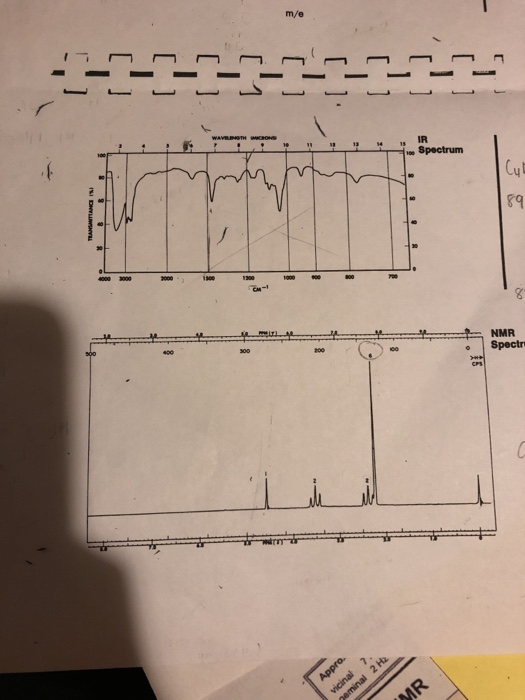
- IR spectra : broad , strong peak 3100-3500 cm-1 indicates presence of -OH functional group ; 2800-3000 cm-1 ( sp3 C-H stretching) : 1100 cm-1 : C-O stretching.
- 1H-NMR : - 6H (2.2 ppm ; S) : due to two -CH3 group , probably attached to N. - 2H ((2.3 ppm ; t) : -CH2-N- group , attached to another -CH2- . - -2H ((3.5 ppm ; t) : -CH2-O- group , attached to another -CH2- . - 1H (4.5 ppm ; s ) : proton of -OH group (not coupling due to rapid exchange).
Most probable structure of this compound is : HO-CH2-CH2-N-( -CH3)2
Add Answer to:
find the molecular structure of the unknown Compound 18 is a basic liquid (b.p. 135') which has two functional grou...
5. Identify the base peak in your mass spectrum. 6. Are there other significant isotope patterns...
 5. Identify the base peak in your mass spectrum. 6. Are there other significant isotope patterns in your mass spectrum? If so, what do they indicate? 7. Provide at least one fragment (not the parent ion) that was useful in determining (or confirming) the structure of the unknown and briefly explain how it was useful. Compound 14 is a liquid (b.p. 85") which finds its greatest application as an aprotic solvent UV-transparent; IR-liquid fim. MASS SPECTRAL DATA 99 100 Mass...
8. Give several pieces of data you gathered from the IR spectrum that aided in determining...
 8. Give several pieces of data you gathered from the IR spectrum that aided in determining (or confirming) the structure of your unknown. For example, you might mention the presence (or absence) of certain definitive peaks (include wavenumbers). Do NOT use anything from the fingerprint region. 9. Fill in the table below with the information on each unique 1H-NMR signal. You may treat all aromatic protons as a single signal if that helps. Peak Chemical Shift (8) # of *10...
Please include the following information allow with the molecular structure of the unknown compound: 1. IR-Include...
 Please include the following information allow with the
molecular structure of the unknown compound:
1. IR-Include the major peaks and indicate the stretch
wavenumber and what bond it is.
2. UV-VIs- If there is a lambda max given, please briefly
indicate what structural element is contributing to it.
3. HNMR-Include proton label, chemical shift, multiplicity, and
integration.
4. CNMR- include the carbon label and the chemical shift.
Some additional information about the unknown compound:
Iodoform Test: Clear solution
Chromic Acid...
Please include the following information allow with the
molecular structure of the unknown compound:
1. IR-Include the major peaks and indicate the stretch
wavenumber and what bond it is.
2. UV-VIs- If there is a lambda max given, please briefly
indicate what structural element is contributing to it.
3. HNMR-Include proton label, chemical shift, multiplicity, and
integration.
4. CNMR- include the carbon label and the chemical shift.
Some additional information about the unknown compound:
Iodoform Test: Clear solution
Chromic Acid...
 5. Identify the base peak in your mass spectrum. 6. Are there other significant isotope patterns in your mass spectrum? If so, what do they indicate? 7. Provide at least one fragment (not the parent ion) that was useful in determining (or confirming) the structure of the unknown and briefly explain how it was useful. Compound 14 is a liquid (b.p. 85") which finds its greatest application as an aprotic solvent UV-transparent; IR-liquid fim. MASS SPECTRAL DATA 99 100 Mass...
 8. Give several pieces of data you gathered from the IR spectrum that aided in determining (or confirming) the structure of your unknown. For example, you might mention the presence (or absence) of certain definitive peaks (include wavenumbers). Do NOT use anything from the fingerprint region. 9. Fill in the table below with the information on each unique 1H-NMR signal. You may treat all aromatic protons as a single signal if that helps. Peak Chemical Shift (8) # of *10...
 Please include the following information allow with the
molecular structure of the unknown compound:
1. IR-Include the major peaks and indicate the stretch
wavenumber and what bond it is.
2. UV-VIs- If there is a lambda max given, please briefly
indicate what structural element is contributing to it.
3. HNMR-Include proton label, chemical shift, multiplicity, and
integration.
4. CNMR- include the carbon label and the chemical shift.
Some additional information about the unknown compound:
Iodoform Test: Clear solution
Chromic Acid...
Please include the following information allow with the
molecular structure of the unknown compound:
1. IR-Include the major peaks and indicate the stretch
wavenumber and what bond it is.
2. UV-VIs- If there is a lambda max given, please briefly
indicate what structural element is contributing to it.
3. HNMR-Include proton label, chemical shift, multiplicity, and
integration.
4. CNMR- include the carbon label and the chemical shift.
Some additional information about the unknown compound:
Iodoform Test: Clear solution
Chromic Acid...
Most questions answered within 3 hours.
-
Where is the error in this code sequence?
String s1 = "Hello";
String s2 = "ello";...
asked 10 months ago -
Financial data for Joel de Paris, Inc., for last year
follow:
Joel de Paris, Inc.
Balance...
asked 10 months ago -
Consider this reaction:
Al2(SO4)3 (aq)+ BaCl3
(aq) Al2Cl6 (aq)- +
3BaSO4(s) . What is the...
asked 10 months ago -
Suppose that Savneet is considering increasing her
recent random sample from 20 car rentals to 40...
asked 10 months ago -
Trucks arrive at an unloading terminal at an average rate of 120
per hour.
Trucks arrive...
asked 10 months ago -
Why are methanol and ethanol completely soluble in water while
octanol is not very little soluble....
asked 10 months ago -
A facilities manager at a university reads in a research report
that the mean amount of...
asked 10 months ago -
When the CuSO4 is rehydrated by adding water to the anhydrous
compound, is this an endothermic...
asked 10 months ago -
A ray of sunlight is passing from diamond into crown glass; the
angle of incidence is...
asked 10 months ago -
A block of mass 0.249 kg is placed on top of a light, vertical
spring of...
asked 10 months ago -
how do the kidneys compensate in the presences of acidosis
a) trigger hyperventilate
b) reserve acid...
asked 10 months ago -
Question 501 pts
The rental rate of capital to the firm increases. Which of the
following...
asked 10 months ago