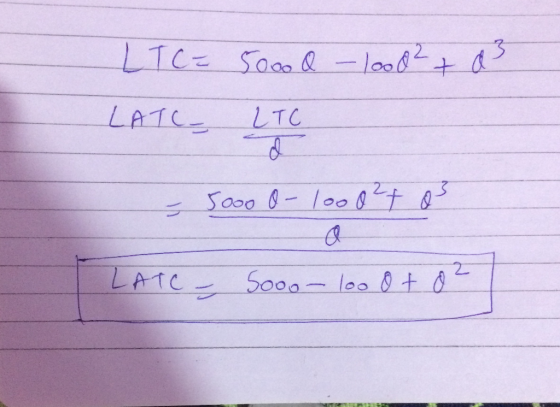
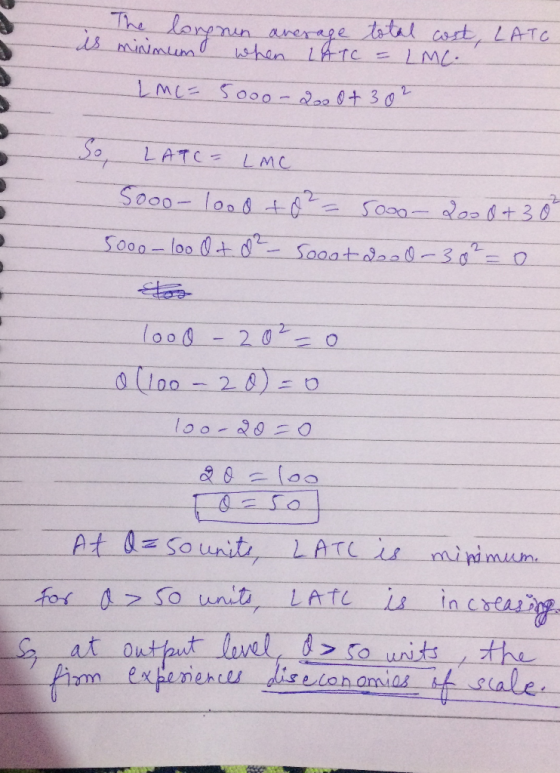
The firm's long-run total cost is given by LTC = 5,000Q - 100Q^2 + Q^3 and its long-run marginal cost is given by LMC =...
The firm's long-run total cost is given by LTC = 5,000Q - 100Q^2 + Q^3 and its long-run marginal cost is given by LMC = 5,000 - 200Q + 3Q^2. At what output level does the firm experience diseconomies of scale?
I don't understand how it goes from this " 5000 - 100Q + Q2 " to this equation "-100 + 2Q = 0"
Homework Answers
Add Answer to:
The firm's long-run total cost is given by LTC = 5,000Q - 100Q^2 + Q^3 and its long-run marginal cost is given by LMC =...
7. A bicycle company has the following long run total cost function: LTC(Q) = 40,000Q –...
 7. A bicycle company has the following long run total cost function: LTC(Q) = 40,000Q – 400Q2 + 203 where Q is the number of bikes produced. a. Compute the company's LMC and LAC as a function of Q b. Assume that that there is perfect competition. How many bikes would the bicycle company produce in the long run? c. Over what range of output does the company experience economies of scale? Over what range of output does it experience...
Costs — End of Chapter Problem Peter's Pipers produces plumbing pipe. The long-run total cost of...
 Costs — End of Chapter Problem Peter's Pipers produces plumbing pipe. The long-run total cost of Peter's pipes is LTC = 20,000Q – 200Q2 +Q3 where Q is measured as thousands of feet of piping. The long-run marginal cost of Peter's pipes is LMC = 20,000 – 400Q +3Q? a. Divide total cost by Q to obtain Peter's long-run average cost of producing pipe. Average cost = $ b. Exploit the relationship between LMC and LAC to find the quantity...
Question 18 Suppose that a firm's long-run total cost curve can be expressed as C(Q) 100Q...
 Question 18 Suppose that a firm's long-run total cost curve can be expressed as C(Q) 100Q Based on this information, the firm's long-run marginal cost is given as: a MC 100 Ob MC 10 MC = 100Q' OdMC = 100Q
For each of the long-run total cost functions given below, determine the average cost function and...
For each of the long-run total cost functions given below, determine the average cost function and state what type of returns to scale the firm experiences: a. ?RTC = 100Q b. ?RTC=3Q2+Q c. LRTC=200Q−Q2
100 1. LAC is given as Q LMC is given as 2Q (a) Find individual firm's...
 100 1. LAC is given as Q LMC is given as 2Q (a) Find individual firm's production when it is long term equilibrium (b) When market demand is Q 5000 100P, find market equilibrium quantity and number of firms
100 1. LAC is given as Q LMC is given as 2Q (a) Find individual firm's production when it is long term equilibrium (b) When market demand is Q 5000 100P, find market equilibrium quantity and number of firms
100 1. LAC is given as Q LMC is given as 2Q (a) Find individual firm's production when it is long term equilibrium (b) When market demand is Q 5000 100P, find market equilibrium quantity and number of firms
e) Suppose that a competitive firm's marginal cost of producing output q is given by MC(q)...
 e) Suppose that a competitive firm's marginal cost of producing output q is given by MC(q) -3+2q. Assume that the market price of the firm's product is $9. i) What level of output will the firm produce? (2p) ii) What is the firm's producer surplus? (4p) ii) Suppose that the average variable cost of the firm is given by AVC(g)-3+q. Suppose that the firm's fixed costs are known to be $3. Will the firm be earning a positive, negative, or...
If a firm's long-run average cost goes from $3 to $2.5 when output increases, the firm...
If a firm's long-run average cost goes from $3 to $2.5 when output increases, the firm is experiencing ________. economies of scale constant returns to scale diseconomies of scale a shift in its long-run average cost curve
Each firm in a perfectly competitive market has long run average cost represented as AC(q) =...
Each firm in a perfectly competitive market has long run average cost represented as AC(q) = 100q- 10+100/q. Long run marginal cost is MC=200q-10. The market demand is Qd = 2150-5P. Find the long run equilibrium output per firm, q*, the long run equilibrium price, P*, and the number of firms in the industry, n*. P = 190; Q = 1200; q =1 , n = 1200
5. Suppose that a competitive firm's marginal cost of pro- ducing output q is given by...
 5. Suppose that a competitive firm's marginal cost of pro- ducing output q is given by MC(q) = 3 + 2q. Assume that the market price of the firm's product is $9. a. What level of output will the firm produce? b. What is the firm's producer surplus? c. Suppose that the average variable cost of the firm is given by AVC(q) = 3 + q. Suppose that the firm's fixed costs are known to be $3. Will the firm...
Suppose that a competitive firm's marginal cost of producing output q (MC) is given by MC(q)...
 Suppose that a competitive firm's marginal cost of producing output q (MC) is given by MC(q) = 3 + 2q. Assume that the market price (P) of the firm's product is $15. What level of output (q) will the firm produce? The firm will produce units of output. (Enter your response rounded to two decimal places.) What is the firm's producer surplus? Producer surplus (PS) is $ . (Enter your response rounded to two decimal places.) Suppose that the average...
 7. A bicycle company has the following long run total cost function: LTC(Q) = 40,000Q – 400Q2 + 203 where Q is the number of bikes produced. a. Compute the company's LMC and LAC as a function of Q b. Assume that that there is perfect competition. How many bikes would the bicycle company produce in the long run? c. Over what range of output does the company experience economies of scale? Over what range of output does it experience...
 Costs — End of Chapter Problem Peter's Pipers produces plumbing pipe. The long-run total cost of Peter's pipes is LTC = 20,000Q – 200Q2 +Q3 where Q is measured as thousands of feet of piping. The long-run marginal cost of Peter's pipes is LMC = 20,000 – 400Q +3Q? a. Divide total cost by Q to obtain Peter's long-run average cost of producing pipe. Average cost = $ b. Exploit the relationship between LMC and LAC to find the quantity...
 Question 18 Suppose that a firm's long-run total cost curve can be expressed as C(Q) 100Q Based on this information, the firm's long-run marginal cost is given as: a MC 100 Ob MC 10 MC = 100Q' OdMC = 100Q
 100 1. LAC is given as Q LMC is given as 2Q (a) Find individual firm's production when it is long term equilibrium (b) When market demand is Q 5000 100P, find market equilibrium quantity and number of firms
100 1. LAC is given as Q LMC is given as 2Q (a) Find individual firm's production when it is long term equilibrium (b) When market demand is Q 5000 100P, find market equilibrium quantity and number of firms
100 1. LAC is given as Q LMC is given as 2Q (a) Find individual firm's production when it is long term equilibrium (b) When market demand is Q 5000 100P, find market equilibrium quantity and number of firms
 e) Suppose that a competitive firm's marginal cost of producing output q is given by MC(q) -3+2q. Assume that the market price of the firm's product is $9. i) What level of output will the firm produce? (2p) ii) What is the firm's producer surplus? (4p) ii) Suppose that the average variable cost of the firm is given by AVC(g)-3+q. Suppose that the firm's fixed costs are known to be $3. Will the firm be earning a positive, negative, or...
 5. Suppose that a competitive firm's marginal cost of pro- ducing output q is given by MC(q) = 3 + 2q. Assume that the market price of the firm's product is $9. a. What level of output will the firm produce? b. What is the firm's producer surplus? c. Suppose that the average variable cost of the firm is given by AVC(q) = 3 + q. Suppose that the firm's fixed costs are known to be $3. Will the firm...
 Suppose that a competitive firm's marginal cost of producing output q (MC) is given by MC(q) = 3 + 2q. Assume that the market price (P) of the firm's product is $15. What level of output (q) will the firm produce? The firm will produce units of output. (Enter your response rounded to two decimal places.) What is the firm's producer surplus? Producer surplus (PS) is $ . (Enter your response rounded to two decimal places.) Suppose that the average...
Most questions answered within 3 hours.
-
Where is the error in this code sequence?
String s1 = "Hello";
String s2 = "ello";...
asked 11 months ago -
Financial data for Joel de Paris, Inc., for last year
follow:
Joel de Paris, Inc.
Balance...
asked 11 months ago -
Consider this reaction:
Al2(SO4)3 (aq)+ BaCl3
(aq) Al2Cl6 (aq)- +
3BaSO4(s) . What is the...
asked 11 months ago -
Suppose that Savneet is considering increasing her
recent random sample from 20 car rentals to 40...
asked 11 months ago -
Trucks arrive at an unloading terminal at an average rate of 120
per hour.
Trucks arrive...
asked 11 months ago -
Why are methanol and ethanol completely soluble in water while
octanol is not very little soluble....
asked 11 months ago -
A facilities manager at a university reads in a research report
that the mean amount of...
asked 11 months ago -
When the CuSO4 is rehydrated by adding water to the anhydrous
compound, is this an endothermic...
asked 11 months ago -
A ray of sunlight is passing from diamond into crown glass; the
angle of incidence is...
asked 11 months ago -
A block of mass 0.249 kg is placed on top of a light, vertical
spring of...
asked 11 months ago -
how do the kidneys compensate in the presences of acidosis
a) trigger hyperventilate
b) reserve acid...
asked 11 months ago -
Question 501 pts
The rental rate of capital to the firm increases. Which of the
following...
asked 11 months ago