
Homework Answers
Add Answer to:
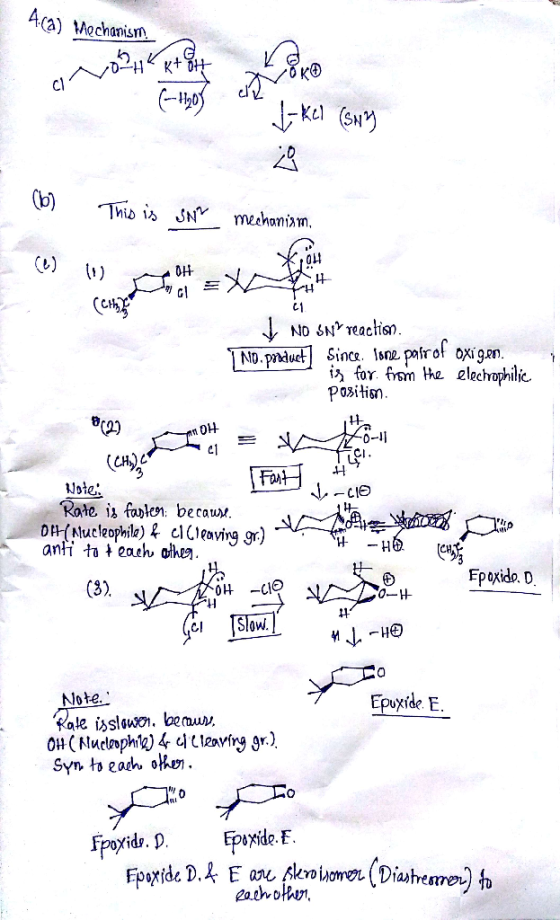
4. It is known that an epoxide can be made in the following way: олон кон anok - epoxide a. Propose a mechanism, us...
Use curved arrows to propose mechanisms for the following reaction (a)Propene with HCl (b)tert-butylbromide with methanol(c)3-methyl-2-pentene...
Use curved arrows to propose mechanisms for the following reaction (a)Propene with HCl (b)tert-butylbromide with methanol(c)3-methyl-2-pentene with chlorine (d)3-methyl-1-butene with sulphiric acid(e)Propyne with excess HBr (f)2-Pentyne with water in the presence of a mineral acid.
Thank you so much! (2 pts) Draw the major elimination products and Identify the mechanism responsible...
 Thank you so much!
(2 pts) Draw the major elimination products and Identify the mechanism responsible (E1 or E2). If both E and Z isomers form, only draw the E alkene. If only one isomer forms, label the alkene "E,""Z," or neither 1. NaOCH3 а. Br НОСHЗ b. НОСНЗ C. CI NaOCH3 d. (6 pts) Draw the substitution and/or elimination product(s) for the following reactions and identify 2. the mechanism responsible (SN1, SN2, E1, or E2) for each product drawn....
Thank you so much!
(2 pts) Draw the major elimination products and Identify the mechanism responsible (E1 or E2). If both E and Z isomers form, only draw the E alkene. If only one isomer forms, label the alkene "E,""Z," or neither 1. NaOCH3 а. Br НОСHЗ b. НОСНЗ C. CI NaOCH3 d. (6 pts) Draw the substitution and/or elimination product(s) for the following reactions and identify 2. the mechanism responsible (SN1, SN2, E1, or E2) for each product drawn....
Question 17 For the following reaction, which of the following is the mechanism? HBr OH A....
 Question 17 For the following reaction, which of the following is the mechanism? HBr OH A. SN1 B. SN2 C. E1 D. E2 Question 18 What is the product of the following reaction. som trosos molt sisada gniotetor H2O GA I. AG A) I B) II C) III al D) I+II istuiwell todo E) I+III HO Question 19 What reaction mechanism is most likely for substitution on the following compound? 2 Dub T o wable oil A. SN1 B. SN2...
4. [12 pts] Propose mechanisms for the formation of all 3 products shown in the reaction...
 4. [12 pts] Propose mechanisms for the formation of all 3 products shown in the reaction below: (draw curved arrows, intermediates, and resonance structures if necessary. NO NEED FOR TRANSITION STATES! CH CH CH CH Br Heat CH,CH,OH OCH.CH Mechanism.14 points) Mechanism 2 points) Mechanism.3 14 points) 5. [14 pts] Provide the major products of reacting the alkene shown in the middle of the scheme below with all the reagents independently. Draw the products' structures in the corresponding table below...
CH3 (4) 1. Which of the following alkyl halides would you expect to be most reactive...
 CH3 (4) 1. Which of the following alkyl halides would you expect to be most reactive in a unimolecular reaction? a) C&H, CH, CH, CH, BY b) CH 1 CH CH Br C) CH11CCH, Br d) C6H CH2 CH CHỊ CHỊ CH3 CHỊ e) C&H, CCH Br CHE (4) 2. What would you expect to be the chief organic product(s) when tert-butyl bromide reacts with sodium acetylide, i.e., CH3 + - CH2-C-Br + Na :CECH — ? CH a) I...
1. (18 points; 3 points each] Multiple Choice: Circle the best answer i. Consider the following...
 1. (18 points; 3 points each] Multiple Choice: Circle the best answer i. Consider the following reaction: Xooot THF, A If there are no other changes, what is the effect of doubling the concentration of the starting alcohol on the rate of this reaction? a. No change b. Doubles the rate C. Triples the rate d. Quadruples the rate ii. Which nitrogen compound below would react fastest as a nucleophile in an 5, 2 reaction? NH NH N d. "NH2...
Question 1(Soalan 1) An alkyne A, 4-methyl-2-pentyne can be prepared via dehydrohalogenation of compound B in...
 Question 1(Soalan 1) An alkyne A, 4-methyl-2-pentyne can be prepared via dehydrohalogenation of compound B in the presence of KOH. Hydroboration of alkyne A produces a mixture of ketones, Dand E Alkuna A, 4-me til-2-pentuna boleh disediakan melalui tindak balas pendehidrohalogenan sebatian B dalam kehadiran KOH. Penghidroboratan alkuna A menghasilkan campuran keton, D dan E a) Draw the structures of B, D and E. Lukis struktur bagi B, D dan E. b) Give the reagent/condition for the hydroboration reaction. Berikan...
For letters h & i : For each of the following reactions, predict the major mechanistic pathway (SN1/SN2/E1/E2...
 For
letters h & i :
For each of the following reactions, predict the major
mechanistic pathway (SN1/SN2/E1/E2) and the major organic
products
1. (cont.) (h) НСОН CHB -CHBr HCOH - (0) CH,CH,CH,CH,Br- NH 2. For each of the following indicate which reaction will occur faster. Explain your reasoning. (No credit will be given for guesses) (a) The reaction of (CH),CBr with 0.001M aqueous NaOH or 0.10M aqueous NaOH (b) The reaction of 2-bromobutane with NaOH in DMSO or NaSH...
For
letters h & i :
For each of the following reactions, predict the major
mechanistic pathway (SN1/SN2/E1/E2) and the major organic
products
1. (cont.) (h) НСОН CHB -CHBr HCOH - (0) CH,CH,CH,CH,Br- NH 2. For each of the following indicate which reaction will occur faster. Explain your reasoning. (No credit will be given for guesses) (a) The reaction of (CH),CBr with 0.001M aqueous NaOH or 0.10M aqueous NaOH (b) The reaction of 2-bromobutane with NaOH in DMSO or NaSH...
_1. An alkyl halide which might be expected to undergo rearrangement under Snl or E1 conditions...
 _1. An alkyl halide which might be expected to undergo rearrangement under Snl or E1 conditions is: HZC Br CH3 A. 1 B. | F—CH,BH C. CH3-C-CH-CH, CHz CH3 D. CH3 CH3-C-CH2CH2-Br CH3 E. A Br 2. Your task is to convert 2-chloropentane into 1-pentene. Which reagents would you choose? a) NaOH/H20 b) KOH/CH3OH c) CH3ONa/CH3OH d) CH3CH2ONa/CH3CH2OH e) (CH3)3COK/(CH3)3COH 3. Circle the reaction below which is faster in polar protic solvents. OH,H,O A. CH,CH,CH,Br- CH,CH,CH,OH + Br or SH.RSH...
the first two questions are asking to do acid-catalyzed mechanism. the last one is mutliple choice...
 the
first two questions are asking to do acid-catalyzed mechanism. the
last one is mutliple choice question
yl-Fall 2019 SO. Draw the mechanism for the acid-catalyzed hydration of 3.3-dimethy the final product in the box below In words: protonation water gives a pro rearrangement to a more stable tertiary carbocation. Then (1) capture deprotonation gives the major organic product. Four curved arrows total on of 3,3-dimethylcyclohexene. (Draw the intermediates in the blank bra otonation of the alkene gives a secondary...
the
first two questions are asking to do acid-catalyzed mechanism. the
last one is mutliple choice question
yl-Fall 2019 SO. Draw the mechanism for the acid-catalyzed hydration of 3.3-dimethy the final product in the box below In words: protonation water gives a pro rearrangement to a more stable tertiary carbocation. Then (1) capture deprotonation gives the major organic product. Four curved arrows total on of 3,3-dimethylcyclohexene. (Draw the intermediates in the blank bra otonation of the alkene gives a secondary...
 Thank you so much!
(2 pts) Draw the major elimination products and Identify the mechanism responsible (E1 or E2). If both E and Z isomers form, only draw the E alkene. If only one isomer forms, label the alkene "E,""Z," or neither 1. NaOCH3 а. Br НОСHЗ b. НОСНЗ C. CI NaOCH3 d. (6 pts) Draw the substitution and/or elimination product(s) for the following reactions and identify 2. the mechanism responsible (SN1, SN2, E1, or E2) for each product drawn....
Thank you so much!
(2 pts) Draw the major elimination products and Identify the mechanism responsible (E1 or E2). If both E and Z isomers form, only draw the E alkene. If only one isomer forms, label the alkene "E,""Z," or neither 1. NaOCH3 а. Br НОСHЗ b. НОСНЗ C. CI NaOCH3 d. (6 pts) Draw the substitution and/or elimination product(s) for the following reactions and identify 2. the mechanism responsible (SN1, SN2, E1, or E2) for each product drawn....
 Question 17 For the following reaction, which of the following is the mechanism? HBr OH A. SN1 B. SN2 C. E1 D. E2 Question 18 What is the product of the following reaction. som trosos molt sisada gniotetor H2O GA I. AG A) I B) II C) III al D) I+II istuiwell todo E) I+III HO Question 19 What reaction mechanism is most likely for substitution on the following compound? 2 Dub T o wable oil A. SN1 B. SN2...
 4. [12 pts] Propose mechanisms for the formation of all 3 products shown in the reaction below: (draw curved arrows, intermediates, and resonance structures if necessary. NO NEED FOR TRANSITION STATES! CH CH CH CH Br Heat CH,CH,OH OCH.CH Mechanism.14 points) Mechanism 2 points) Mechanism.3 14 points) 5. [14 pts] Provide the major products of reacting the alkene shown in the middle of the scheme below with all the reagents independently. Draw the products' structures in the corresponding table below...
 CH3 (4) 1. Which of the following alkyl halides would you expect to be most reactive in a unimolecular reaction? a) C&H, CH, CH, CH, BY b) CH 1 CH CH Br C) CH11CCH, Br d) C6H CH2 CH CHỊ CHỊ CH3 CHỊ e) C&H, CCH Br CHE (4) 2. What would you expect to be the chief organic product(s) when tert-butyl bromide reacts with sodium acetylide, i.e., CH3 + - CH2-C-Br + Na :CECH — ? CH a) I...
 1. (18 points; 3 points each] Multiple Choice: Circle the best answer i. Consider the following reaction: Xooot THF, A If there are no other changes, what is the effect of doubling the concentration of the starting alcohol on the rate of this reaction? a. No change b. Doubles the rate C. Triples the rate d. Quadruples the rate ii. Which nitrogen compound below would react fastest as a nucleophile in an 5, 2 reaction? NH NH N d. "NH2...
 Question 1(Soalan 1) An alkyne A, 4-methyl-2-pentyne can be prepared via dehydrohalogenation of compound B in the presence of KOH. Hydroboration of alkyne A produces a mixture of ketones, Dand E Alkuna A, 4-me til-2-pentuna boleh disediakan melalui tindak balas pendehidrohalogenan sebatian B dalam kehadiran KOH. Penghidroboratan alkuna A menghasilkan campuran keton, D dan E a) Draw the structures of B, D and E. Lukis struktur bagi B, D dan E. b) Give the reagent/condition for the hydroboration reaction. Berikan...
 For
letters h & i :
For each of the following reactions, predict the major
mechanistic pathway (SN1/SN2/E1/E2) and the major organic
products
1. (cont.) (h) НСОН CHB -CHBr HCOH - (0) CH,CH,CH,CH,Br- NH 2. For each of the following indicate which reaction will occur faster. Explain your reasoning. (No credit will be given for guesses) (a) The reaction of (CH),CBr with 0.001M aqueous NaOH or 0.10M aqueous NaOH (b) The reaction of 2-bromobutane with NaOH in DMSO or NaSH...
For
letters h & i :
For each of the following reactions, predict the major
mechanistic pathway (SN1/SN2/E1/E2) and the major organic
products
1. (cont.) (h) НСОН CHB -CHBr HCOH - (0) CH,CH,CH,CH,Br- NH 2. For each of the following indicate which reaction will occur faster. Explain your reasoning. (No credit will be given for guesses) (a) The reaction of (CH),CBr with 0.001M aqueous NaOH or 0.10M aqueous NaOH (b) The reaction of 2-bromobutane with NaOH in DMSO or NaSH...
 _1. An alkyl halide which might be expected to undergo rearrangement under Snl or E1 conditions is: HZC Br CH3 A. 1 B. | F—CH,BH C. CH3-C-CH-CH, CHz CH3 D. CH3 CH3-C-CH2CH2-Br CH3 E. A Br 2. Your task is to convert 2-chloropentane into 1-pentene. Which reagents would you choose? a) NaOH/H20 b) KOH/CH3OH c) CH3ONa/CH3OH d) CH3CH2ONa/CH3CH2OH e) (CH3)3COK/(CH3)3COH 3. Circle the reaction below which is faster in polar protic solvents. OH,H,O A. CH,CH,CH,Br- CH,CH,CH,OH + Br or SH.RSH...
 the
first two questions are asking to do acid-catalyzed mechanism. the
last one is mutliple choice question
yl-Fall 2019 SO. Draw the mechanism for the acid-catalyzed hydration of 3.3-dimethy the final product in the box below In words: protonation water gives a pro rearrangement to a more stable tertiary carbocation. Then (1) capture deprotonation gives the major organic product. Four curved arrows total on of 3,3-dimethylcyclohexene. (Draw the intermediates in the blank bra otonation of the alkene gives a secondary...
the
first two questions are asking to do acid-catalyzed mechanism. the
last one is mutliple choice question
yl-Fall 2019 SO. Draw the mechanism for the acid-catalyzed hydration of 3.3-dimethy the final product in the box below In words: protonation water gives a pro rearrangement to a more stable tertiary carbocation. Then (1) capture deprotonation gives the major organic product. Four curved arrows total on of 3,3-dimethylcyclohexene. (Draw the intermediates in the blank bra otonation of the alkene gives a secondary...
Most questions answered within 3 hours.
-
Where is the error in this code sequence?
String s1 = "Hello";
String s2 = "ello";...
asked 11 months ago -
Financial data for Joel de Paris, Inc., for last year
follow:
Joel de Paris, Inc.
Balance...
asked 11 months ago -
Consider this reaction:
Al2(SO4)3 (aq)+ BaCl3
(aq) Al2Cl6 (aq)- +
3BaSO4(s) . What is the...
asked 11 months ago -
Suppose that Savneet is considering increasing her
recent random sample from 20 car rentals to 40...
asked 11 months ago -
Trucks arrive at an unloading terminal at an average rate of 120
per hour.
Trucks arrive...
asked 11 months ago -
Why are methanol and ethanol completely soluble in water while
octanol is not very little soluble....
asked 11 months ago -
A facilities manager at a university reads in a research report
that the mean amount of...
asked 11 months ago -
When the CuSO4 is rehydrated by adding water to the anhydrous
compound, is this an endothermic...
asked 11 months ago -
A ray of sunlight is passing from diamond into crown glass; the
angle of incidence is...
asked 11 months ago -
A block of mass 0.249 kg is placed on top of a light, vertical
spring of...
asked 11 months ago -
how do the kidneys compensate in the presences of acidosis
a) trigger hyperventilate
b) reserve acid...
asked 11 months ago -
Question 501 pts
The rental rate of capital to the firm increases. Which of the
following...
asked 11 months ago