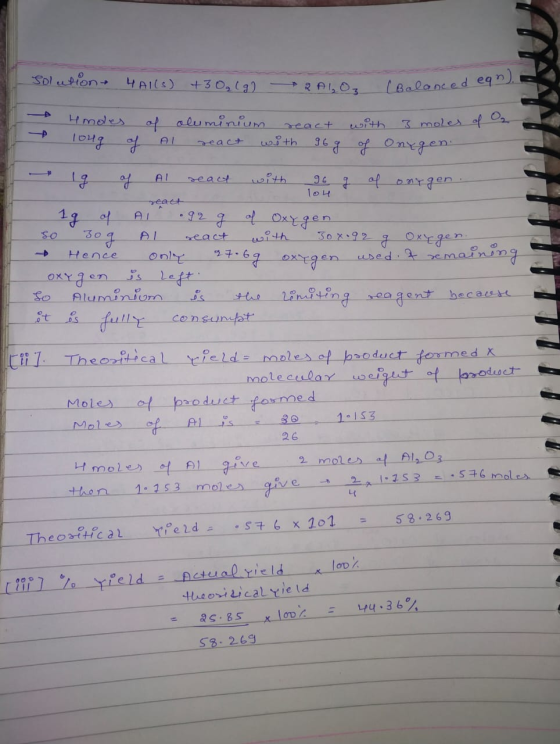
4. Consider the reaction of aluminum and oxygen: Al(s) + O2(g) Al2O3(...
4. Consider the reaction of aluminum and oxygen:
Al(s) + O2(g)
Al2O3(s)
(i). Which is the limiting reactant if we start
with 30.0 g Al and 30.0 g O2?
(ii). What is the Theoretical Yield for the
reaction?
(iii). If 25.85 g of Al2O3 was collected at the
completion of the
reaction (actual yield), what is the % yield for the
reaction?
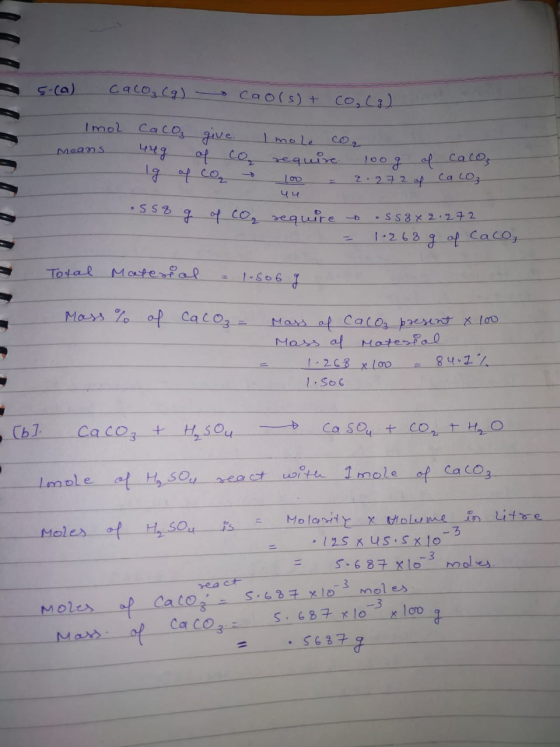
5. (a). A 1.506-g sample of limestone-containing material gave
0.558 g of CO2, in addition to CaO, after being heated at a high
temperature. What was the mass percent of limestone (CaCO3) in the
original sample?
CaCO3(s) → CaO(s) + CO2(g)
5 (b). How many grams of calcium carbonate can be consumed by 45.5
mL of 0.125 M H2SO4 (aq)?
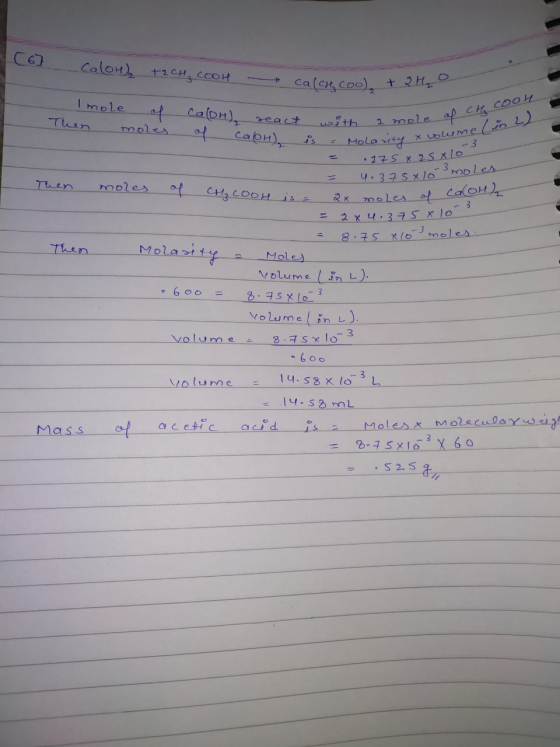
6. What volume of 0.600 M HC2H3O2, acetic acid, is required to
neutralize 25.0 mL of 0.175 M Ca(OH)2?
2 HC2H3O2 + Ca(OH)2 Ca(C2H3O2)2 +
2H2O
What mass of pure acetic acid is required?
Homework Answers
Add Answer to:
4. Consider the reaction of aluminum and oxygen: Al(s) + O2(g) Al2O3(...
Please answer the questions clearly, showing all working. 1(i). Balance the following equations, and then write...
Please answer the questions clearly, showing all working. 1(i). Balance the following equations, and then write the net ionic equation (a) (NH4)2CO3(aq) + Cu(NO3)2(aq) → CuCO3(s) + NH4NO3(aq) (b) Mg(OH)2(s) + HCl(aq) → MgCl2(aq) + H2O(l) (c) BaCO3(s) + HBr(aq) → BaBr2(aq) + H2O(l) + CO2(g) 1(ii). For each reaction equation, identify the driving force of the reaction 2. What is an electrolyte? How can you experimentally differentiate between a weak electrolyte and a strong electrolyte? Name and give the...
please i need help with queation 4,5a,5b, and 6 4. Consider the reaction of aluminum and...
 please i need help with queation 4,5a,5b, and 6
4. Consider the reaction of aluminum and oxygen: Al(s) + O,(g)>Al,0,(s) (i). Which is the limiting reactant if we start with 30.0 g Al and 30.0 g O,? (ii). What is the Theoretical Yield for the reaction? (iii). If 25.85 g of Al,O, was collected at the completion of the reaction (actual yield), what is the % yield for the reaction? 5. (a). A 1.506-g sample of limestone-containing material gave 0.558...
please i need help with queation 4,5a,5b, and 6
4. Consider the reaction of aluminum and oxygen: Al(s) + O,(g)>Al,0,(s) (i). Which is the limiting reactant if we start with 30.0 g Al and 30.0 g O,? (ii). What is the Theoretical Yield for the reaction? (iii). If 25.85 g of Al,O, was collected at the completion of the reaction (actual yield), what is the % yield for the reaction? 5. (a). A 1.506-g sample of limestone-containing material gave 0.558...
The thermochemical equation for the reaction is shown below: 4 Al(s) + 3 O2(g) → 2...
 The thermochemical equation for the reaction is shown below: 4 Al(s) + 3 O2(g) → 2 Al2O3(s) AH = -3352 kJ How much heat is released when 12.1 g of Al react with O2(g) at 25 °C and 1 atm? 0 - 104 kJ 0 -3.59 x 10⁵ kJ -1.50 x 10³ kJ O-376 kJ A 77.0-mL sample of a 0.203 M potassium sulfate solution is mixed with 55.0 mL of a 0.226 M lead(II) nitrate solution and this reaction...
The thermochemical equation for the reaction is shown below: 4 Al(s) + 3 O2(g) → 2...
The thermochemical equation for the reaction is shown below: 4 Al(s) + 3 O2(g) → 2 Al2O3(s) ΔH = -3352 kJ How much heat is released when 8.07 g of Al react with O2(g) at 25 oC and 1 atm? Select the oxidation-reduction reaction(s)? 1. Cl2(g) + ZnBr2(aq) → ZnCl2(aq) + Br2(l) 2. Pb(ClO4)2(aq) + 2 KI(aq) → PbI2(s) + 2 KClO4(aq) 3. CaCO3(s) → CO2(g) + CaO(s) Select the strong acid in aqueous solution from the set below. Group...
Aluminum oxide (Al2O3) is produced according to the following equation. 4 Al(s) + 3 O2(g) →...
Aluminum oxide (Al2O3) is produced according to the following equation. 4 Al(s) + 3 O2(g) → 2 Al2O3(s) If the reaction occurs with an 82.4% yield, what mass of aluminum should be reacted with excess oxygen to produce 45.0 grams of Al2O3? a. 54.6 g Al b. 37.9 g Al c. 35.1 g Al d. 23.8 g Al e. 28.9 g Al How do we solve this problem
The thermochemical equation for the reaction is shown below: 4 Al(s) + 3 O2(g) → 2...
 The thermochemical equation for the reaction is shown below: 4 Al(s) + 3 O2(g) → 2 Al2O3(s) AH - -3352 kJ How much heat is released when 8.07 g of Al react with Oz(g) at 25 °C and 1 atm? -1.68 x 10⁴ kJ 0-104 kJ 0-754 kJ 0-2.50 x 10² kJ Which of the following processes is exothermic? o Water condensing from steam. The vaporization of water The melting of ice. O Heating water to form steam Select the...
Given the unbalanced reaction of Al(s) + O2 (g) ---> Al2O3 (s), determine which reagent, and...
Given the unbalanced reaction of Al(s) + O2 (g) ---> Al2O3 (s), determine which reagent, and how much will be left over after the reaction of 5.0 mol of Al (s) with 4.0 mol of O2 (g).
1. Aluminum reacts with oxygen according to the following reaction: 4 Al(s) + 3 O2(g) ->...
 1. Aluminum reacts with oxygen according to the following reaction: 4 Al(s) + 3 O2(g) -> 2 Al2O3 If 8.00 moles of oxygen are reacted with 8.00 moles of aluminum to completion, which is the excess reactant?
given the following reaction caco3(s)--->cao(s) + co2(g) delta h = 178.1kj C(s,graphite) + O2(g) ---> CO2(g)...
given the following reaction caco3(s)--->cao(s) + co2(g) delta h = 178.1kj C(s,graphite) + O2(g) ---> CO2(g) deltaH=-393.5kj the enthalpy of the reaction CaCO3(s)--->CaO(s) + C(s,graphite) + O2(g) is ________kj.
Calculate DHrxn for the reaction: CaO(s) + CO2(g) à CaCO3(s) given these reactions and their DH’s:...
Calculate DHrxn for the reaction: CaO(s) + CO2(g) à CaCO3(s) given these reactions and their DH’s: 1) Ca(s) + CO2(g) + ½ O2(g) à CaCO3(s) DH = -814.1kJ 2) 2Ca(s) + O2(g) à 2 CaO (s) DH = -1269.8kJ
 please i need help with queation 4,5a,5b, and 6
4. Consider the reaction of aluminum and oxygen: Al(s) + O,(g)>Al,0,(s) (i). Which is the limiting reactant if we start with 30.0 g Al and 30.0 g O,? (ii). What is the Theoretical Yield for the reaction? (iii). If 25.85 g of Al,O, was collected at the completion of the reaction (actual yield), what is the % yield for the reaction? 5. (a). A 1.506-g sample of limestone-containing material gave 0.558...
please i need help with queation 4,5a,5b, and 6
4. Consider the reaction of aluminum and oxygen: Al(s) + O,(g)>Al,0,(s) (i). Which is the limiting reactant if we start with 30.0 g Al and 30.0 g O,? (ii). What is the Theoretical Yield for the reaction? (iii). If 25.85 g of Al,O, was collected at the completion of the reaction (actual yield), what is the % yield for the reaction? 5. (a). A 1.506-g sample of limestone-containing material gave 0.558...
 The thermochemical equation for the reaction is shown below: 4 Al(s) + 3 O2(g) → 2 Al2O3(s) AH = -3352 kJ How much heat is released when 12.1 g of Al react with O2(g) at 25 °C and 1 atm? 0 - 104 kJ 0 -3.59 x 10⁵ kJ -1.50 x 10³ kJ O-376 kJ A 77.0-mL sample of a 0.203 M potassium sulfate solution is mixed with 55.0 mL of a 0.226 M lead(II) nitrate solution and this reaction...
 The thermochemical equation for the reaction is shown below: 4 Al(s) + 3 O2(g) → 2 Al2O3(s) AH - -3352 kJ How much heat is released when 8.07 g of Al react with Oz(g) at 25 °C and 1 atm? -1.68 x 10⁴ kJ 0-104 kJ 0-754 kJ 0-2.50 x 10² kJ Which of the following processes is exothermic? o Water condensing from steam. The vaporization of water The melting of ice. O Heating water to form steam Select the...
 1. Aluminum reacts with oxygen according to the following reaction: 4 Al(s) + 3 O2(g) -> 2 Al2O3 If 8.00 moles of oxygen are reacted with 8.00 moles of aluminum to completion, which is the excess reactant?
Most questions answered within 3 hours.
-
Where is the error in this code sequence?
String s1 = "Hello";
String s2 = "ello";...
asked 11 months ago -
Financial data for Joel de Paris, Inc., for last year
follow:
Joel de Paris, Inc.
Balance...
asked 11 months ago -
Consider this reaction:
Al2(SO4)3 (aq)+ BaCl3
(aq) Al2Cl6 (aq)- +
3BaSO4(s) . What is the...
asked 11 months ago -
Suppose that Savneet is considering increasing her
recent random sample from 20 car rentals to 40...
asked 11 months ago -
Trucks arrive at an unloading terminal at an average rate of 120
per hour.
Trucks arrive...
asked 11 months ago -
Why are methanol and ethanol completely soluble in water while
octanol is not very little soluble....
asked 11 months ago -
A facilities manager at a university reads in a research report
that the mean amount of...
asked 11 months ago -
When the CuSO4 is rehydrated by adding water to the anhydrous
compound, is this an endothermic...
asked 11 months ago -
A ray of sunlight is passing from diamond into crown glass; the
angle of incidence is...
asked 11 months ago -
A block of mass 0.249 kg is placed on top of a light, vertical
spring of...
asked 11 months ago -
how do the kidneys compensate in the presences of acidosis
a) trigger hyperventilate
b) reserve acid...
asked 11 months ago -
Question 501 pts
The rental rate of capital to the firm increases. Which of the
following...
asked 11 months ago