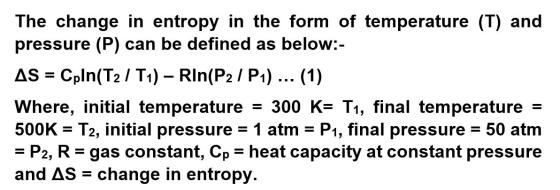
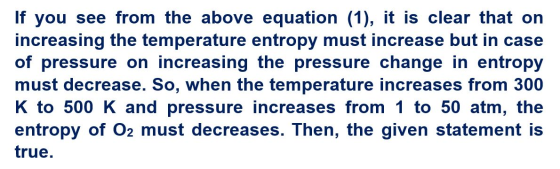
t/f.....When the tempurature increases from 300k to 500k and pressure increases from 1 to 50 atm, the entropy of O2 decr...
t/f.....When the tempurature increases from 300k to 500k and pressure increases from 1 to 50 atm, the entropy of O2 decreases....
running out of time
Homework Answers
Add Answer to:
t/f.....When the tempurature increases from 300k to 500k and pressure increases from 1 to 50 atm, the entropy of O2 decr...
t/f....The Entropy of 1 liter of (liquid) water at 298 k decreases by less than 1...
t/f....The Entropy of 1 liter of (liquid) water at 298 k decreases by less than 1 J/K when the pressure is raised from 1 to 100 atm...
200 moles of an ideal gas at 1 atm pressure and T=300K, compress adiabatically to 2...
200 moles of an ideal gas at 1 atm pressure and T=300K, compress adiabatically to 2 atm, go isochorically back to 1 atm, then isobarically back to the initial conditions, how much work is done by the gas?
When the pressure increases by 105 atm, the molar Gibbs energy of graphite increases. decreases. do...
 When the pressure increases by 105 atm, the molar Gibbs energy of graphite increases. decreases. do not change.
What is the entropy change when the volume of 1.0 g of O2 increases from 2.8...
What is the entropy change when the volume of 1.0 g of O2 increases from 2.8 L to 3.9 L at a constant temperature of 75 ∘C? Assume that O2 behaves as an ideal gas.
When the pressure P is constant at 1 atm, the melting point of Br_2 is T_m...
 When the pressure P is constant at 1 atm, the melting point of Br_2 is T_m = 265.95 K and its boiling point is T_b = 331.85 K. Br_2 is therefore liquid at 298 K and 1 atm but it also has a finite vapor pressure hence the property of both liquid and gas Br_2 can be obtained at at 298 K and 1 atm. Using a DeHoff equation and the thermodynamic table on D2L calculate the absolute molar entropy...
Calculate the entropy change when a system is heated from 10K to 300K. Use the following...
Calculate the entropy change when a system is heated from 10K to 300K. Use the following constants Cp, solid= 2R, Cp, liquid= 2.1R, Cp, gas= 3R fusH = 10 kJ, vapH = 50 kJ Tfus= 100K, Tvap= 200K Invalid Equation Invalid Equation
For the saturated aqueous solution of O2(g) at 20 C and 1 atm with the solubility...
 For the saturated aqueous solution of O2(g) at 20 C and 1 atm
with the solubility increase, decrease or stay no charge when the
indicated change occurs?
For a saturated aqueous solution of O2(3) at 20 °C and 1 atm, will the solubility increase, decrease or stay no change when the indicated change occurs? (1) The solubility of O23) [Select] when pressure increases. (2) The solubility of O2(s) [ Select ] when temperature increases.
For the saturated aqueous solution of O2(g) at 20 C and 1 atm
with the solubility increase, decrease or stay no charge when the
indicated change occurs?
For a saturated aqueous solution of O2(3) at 20 °C and 1 atm, will the solubility increase, decrease or stay no change when the indicated change occurs? (1) The solubility of O23) [Select] when pressure increases. (2) The solubility of O2(s) [ Select ] when temperature increases.
1. When 2 moles of carbon dioxide is heated at a constant pressure of 2 atm,...
 1. When 2 moles of carbon dioxide is heated at a constant pressure of 2 atm, the temperature increases from 300°C to 370°C. (The molar heat capacity of CO2 at constant pressure is a. Find AH. o43.ISk b. Find ΔU 2. 0.01 mole of argon at 5 Cand 1 atm is expanded to 1 L and heated to 75°c. a. Calculate the change in entropy n 12 b. The argon, after expansion, is now gradually taken to a higher elevation...
6. Calculate the entropy change when 2 moles of gaseous water are formed at 100°C and 1 atm from hydrogen and oxygen ga...
 6. Calculate the entropy change when 2 moles of gaseous water are formed at 100°C and 1 atm from hydrogen and oxygen gas at the same temperature. H2(g) = 130.57 J/K Standard molar entropy: H2O(g) = 188.72 J/K O2(g) = 205.04 J/K Constant volume molar heat capacity: H2O(g) = 25.3 J/ K O 2(g) = 21.1 J/K Constant pressure molar heat capacity: H2O(g) = 33.6 J/K O2(g) = 29.4 JK H2(g) = 20.5 JK H2(g) = 28.8 J/K
1. 50 ce/s of O2 at 1 atm is heated from 298 to 3000 K. Calculate the rate of heat transfer. Be sure to account for dissociation 1. 50 ce/s of O2 at 1 atm is heated from 298 to 3000 K. Calcu...
 1. 50 ce/s of O2 at 1 atm is heated from 298 to 3000 K. Calculate the rate of heat transfer. Be sure to account for dissociation
1. 50 ce/s of O2 at 1 atm is heated from 298 to 3000 K. Calculate the rate of heat transfer. Be sure to account for dissociation
1. 50 ce/s of O2 at 1 atm is heated from 298 to 3000 K. Calculate the rate of heat transfer. Be sure to account for dissociation
 When the pressure increases by 105 atm, the molar Gibbs energy of graphite increases. decreases. do not change.
 When the pressure P is constant at 1 atm, the melting point of Br_2 is T_m = 265.95 K and its boiling point is T_b = 331.85 K. Br_2 is therefore liquid at 298 K and 1 atm but it also has a finite vapor pressure hence the property of both liquid and gas Br_2 can be obtained at at 298 K and 1 atm. Using a DeHoff equation and the thermodynamic table on D2L calculate the absolute molar entropy...
 For the saturated aqueous solution of O2(g) at 20 C and 1 atm
with the solubility increase, decrease or stay no charge when the
indicated change occurs?
For a saturated aqueous solution of O2(3) at 20 °C and 1 atm, will the solubility increase, decrease or stay no change when the indicated change occurs? (1) The solubility of O23) [Select] when pressure increases. (2) The solubility of O2(s) [ Select ] when temperature increases.
For the saturated aqueous solution of O2(g) at 20 C and 1 atm
with the solubility increase, decrease or stay no charge when the
indicated change occurs?
For a saturated aqueous solution of O2(3) at 20 °C and 1 atm, will the solubility increase, decrease or stay no change when the indicated change occurs? (1) The solubility of O23) [Select] when pressure increases. (2) The solubility of O2(s) [ Select ] when temperature increases.
 1. When 2 moles of carbon dioxide is heated at a constant pressure of 2 atm, the temperature increases from 300°C to 370°C. (The molar heat capacity of CO2 at constant pressure is a. Find AH. o43.ISk b. Find ΔU 2. 0.01 mole of argon at 5 Cand 1 atm is expanded to 1 L and heated to 75°c. a. Calculate the change in entropy n 12 b. The argon, after expansion, is now gradually taken to a higher elevation...
 6. Calculate the entropy change when 2 moles of gaseous water are formed at 100°C and 1 atm from hydrogen and oxygen gas at the same temperature. H2(g) = 130.57 J/K Standard molar entropy: H2O(g) = 188.72 J/K O2(g) = 205.04 J/K Constant volume molar heat capacity: H2O(g) = 25.3 J/ K O 2(g) = 21.1 J/K Constant pressure molar heat capacity: H2O(g) = 33.6 J/K O2(g) = 29.4 JK H2(g) = 20.5 JK H2(g) = 28.8 J/K
 1. 50 ce/s of O2 at 1 atm is heated from 298 to 3000 K. Calculate the rate of heat transfer. Be sure to account for dissociation
1. 50 ce/s of O2 at 1 atm is heated from 298 to 3000 K. Calculate the rate of heat transfer. Be sure to account for dissociation
1. 50 ce/s of O2 at 1 atm is heated from 298 to 3000 K. Calculate the rate of heat transfer. Be sure to account for dissociation
Most questions answered within 3 hours.
-
Where is the error in this code sequence?
String s1 = "Hello";
String s2 = "ello";...
asked 10 months ago -
Financial data for Joel de Paris, Inc., for last year
follow:
Joel de Paris, Inc.
Balance...
asked 10 months ago -
Consider this reaction:
Al2(SO4)3 (aq)+ BaCl3
(aq) Al2Cl6 (aq)- +
3BaSO4(s) . What is the...
asked 10 months ago -
Suppose that Savneet is considering increasing her
recent random sample from 20 car rentals to 40...
asked 10 months ago -
Trucks arrive at an unloading terminal at an average rate of 120
per hour.
Trucks arrive...
asked 10 months ago -
Why are methanol and ethanol completely soluble in water while
octanol is not very little soluble....
asked 10 months ago -
A facilities manager at a university reads in a research report
that the mean amount of...
asked 10 months ago -
When the CuSO4 is rehydrated by adding water to the anhydrous
compound, is this an endothermic...
asked 10 months ago -
A ray of sunlight is passing from diamond into crown glass; the
angle of incidence is...
asked 10 months ago -
A block of mass 0.249 kg is placed on top of a light, vertical
spring of...
asked 10 months ago -
how do the kidneys compensate in the presences of acidosis
a) trigger hyperventilate
b) reserve acid...
asked 10 months ago -
Question 501 pts
The rental rate of capital to the firm increases. Which of the
following...
asked 10 months ago