
Homework Answers
Add Answer to:
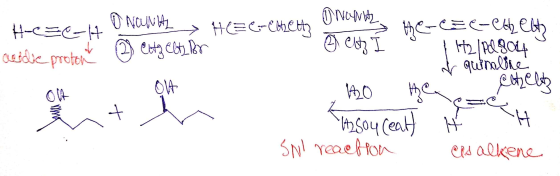
6. (20 pts) Write the structure of the missing starting material, three missing intermediates, and one of the final...
5. (20 pts) For this roadmap synthesis, provide the initial starting material, as well as all...
 5. (20 pts) For this roadmap synthesis, provide the initial starting material, as well as all of the missing reaction products. ? NaH HCI KO EtOH H2SO4 KOtBu SOCI2 pyridine 1. NaH 2 Br 2 Products Needed NaOE heat HBO
(10 pts) Fill in the missing intermediates (two), final product, and reagents (two) in the llowing...
 (10 pts) Fill in the missing intermediates (two), final product, and reagents (two) in the llowing multistep synthesis. Br X OH -- NH 에 CH,Br 6) (5 pts) Write out the 3-step arrow pushing mechanism showing how cyclopentanol is dehydrated to make cyclopentene: он conc. H,SO + HO heat
Draw the missing major organic product(s), starting material(s), or reagents for each of the following reactions...
 Draw the missing major organic product(s), starting
material(s), or reagents for each of the following reactions (DO
NOT WRITE +EN AS A PRODUCT (ie draw everything out!)! And remember
stereo and regiochemistry.) Assume reagents are in excess unless
otherwise indicated. **To make things simple, I indicated what is
needed for each section! Please don't just put the answers, but
explanations as well on why. Thanks!
a) draw the starting material for this reaction.
b) draw the product for this reaction....
Draw the missing major organic product(s), starting
material(s), or reagents for each of the following reactions (DO
NOT WRITE +EN AS A PRODUCT (ie draw everything out!)! And remember
stereo and regiochemistry.) Assume reagents are in excess unless
otherwise indicated. **To make things simple, I indicated what is
needed for each section! Please don't just put the answers, but
explanations as well on why. Thanks!
a) draw the starting material for this reaction.
b) draw the product for this reaction....
1. Provide the missing starting material, reagents, or major organic product for each of the following...
 1. Provide the missing starting material, reagents, or major organic product for each of the following reactions. (No more than two steps are required in any case where we ask you to fill in reagents.) 1. Mgo, Et20 2. H20 a) Cl b) MgBr OH , Et20 2. H* workup c) OH d) NaOH (cat.) e) OH NaBH4, CeCl3, MeOH
1. For each of the following transformations, provide the missing reagents/conditions, starting material, or major organic...
 1. For each of the following transformations, provide the missing reagents/conditions, starting material, or major organic products) as appropriate. You may ignore stereochemistry. All transformations requiring you to fill in reagents can be accomplished in two or fewer steps namorangorang NaOH (cat) moldana 1. Cros, pyridine 2. Hicato c. OYO TA Dono 1. Et Cui 2. H* workup 3. NaBH, MOH modello 1. PhMgBr, E1,0 2 H workup 3. conc. H2SO4 Duplication of this problem ser for any purpose other...
7. Choose your own adventure.Choose one of the starting materials below, then treat ti with three...
 7. Choose your own adventure.Choose one of the starting materials below, then treat ti with three of the reagents listed, showing the expected product after each step. (9 pts) Starting materials Reagents [H+], H2O H+], H20 NaBH4, EtOH 1. LiAlH4 2. H3O+ CH2-PPh3 NaOH(aq), then H30+ SOCl2 DIBAL Br2, hv 1. BH3, THF, 2. H202, NaOH TMSCI, pyridine PBr3 1. NaH 2. CH3CH2Br PCC H2, Pd/C CH3CH2OH Starting material Product 1 Final product Product 2
Propose a synthesis to obtain the indicated product from the starting material (note that this process...
 Propose a synthesis to obtain the indicated product from the starting material (note that this process cannot be done in one step). Br, Br ? НС—СН X CH₃ Н.С The letters below represent many of the reagents you have learned in chapters 6-7. In the space below, enter the letters of the reagents you will use, in the order you will use them. Note: enter only letters, without spaces, commas, or any other separation of the letters (e.g. dna) a....
2. (30 pts) Fill in missing information for each chemical reactions by adding the reactive organic...
 2. (30 pts) Fill in missing information for each chemical reactions by adding the reactive organic compound, all products, and/or the reagents needed to complete the reaction. If there is more than one product, label the major and the minor products. Also, name each organic reactant and each organic product. H,SO 140°C OH + HO + H2O Multi-step reaction: Show all reactants, all reaction conditions and reagents, and all intermediates in order to perform the following reaction. Name each organic...
21. (16 pts) Provide the structure of missing product(s) or reactants. Show the relevant stereochemistry (use...
 21. (16 pts) Provide the structure of missing product(s) or reactants. Show the relevant stereochemistry (use solid or dashed wedge) if necessary. HS 1 product (a) HyC- H.0 S 2 products (2 isomers) (b) HO +NaHa stron base) heat ΕΕ Ο (solvent) (c) = + + NaNH, (a nucleophile is needed here) "SCH CH SCH (An alkyl halide is needed here, can be chloride, bromide or iodide, please show the correct stereochemistry)
The below reaction is accomplished with one reagent. Br The letters below represent all reagents you...
 The below reaction is accomplished with one reagent. Br The letters below represent all reagents you have learned in chapters 6-8. Which of the below reagents would you use to accomplish this process? Enter the ONE correct letter below. • a. H2SO4, H20 b.HBO c. Br2 • d. Br2. H20 e. 1) BH3 (or R2BH), 2) NaOH, H20 • f. 1) OsO4, 2) NaHSO3, H20 g. 1) O3. 2) CH3SCH3 h.mCPBA • i.H2.Pd/C j. NaNH2 k 2 eg NaNH2 ....
 5. (20 pts) For this roadmap synthesis, provide the initial starting material, as well as all of the missing reaction products. ? NaH HCI KO EtOH H2SO4 KOtBu SOCI2 pyridine 1. NaH 2 Br 2 Products Needed NaOE heat HBO
 (10 pts) Fill in the missing intermediates (two), final product, and reagents (two) in the llowing multistep synthesis. Br X OH -- NH 에 CH,Br 6) (5 pts) Write out the 3-step arrow pushing mechanism showing how cyclopentanol is dehydrated to make cyclopentene: он conc. H,SO + HO heat
 Draw the missing major organic product(s), starting
material(s), or reagents for each of the following reactions (DO
NOT WRITE +EN AS A PRODUCT (ie draw everything out!)! And remember
stereo and regiochemistry.) Assume reagents are in excess unless
otherwise indicated. **To make things simple, I indicated what is
needed for each section! Please don't just put the answers, but
explanations as well on why. Thanks!
a) draw the starting material for this reaction.
b) draw the product for this reaction....
Draw the missing major organic product(s), starting
material(s), or reagents for each of the following reactions (DO
NOT WRITE +EN AS A PRODUCT (ie draw everything out!)! And remember
stereo and regiochemistry.) Assume reagents are in excess unless
otherwise indicated. **To make things simple, I indicated what is
needed for each section! Please don't just put the answers, but
explanations as well on why. Thanks!
a) draw the starting material for this reaction.
b) draw the product for this reaction....
 1. Provide the missing starting material, reagents, or major organic product for each of the following reactions. (No more than two steps are required in any case where we ask you to fill in reagents.) 1. Mgo, Et20 2. H20 a) Cl b) MgBr OH , Et20 2. H* workup c) OH d) NaOH (cat.) e) OH NaBH4, CeCl3, MeOH
 1. For each of the following transformations, provide the missing reagents/conditions, starting material, or major organic products) as appropriate. You may ignore stereochemistry. All transformations requiring you to fill in reagents can be accomplished in two or fewer steps namorangorang NaOH (cat) moldana 1. Cros, pyridine 2. Hicato c. OYO TA Dono 1. Et Cui 2. H* workup 3. NaBH, MOH modello 1. PhMgBr, E1,0 2 H workup 3. conc. H2SO4 Duplication of this problem ser for any purpose other...
 7. Choose your own adventure.Choose one of the starting materials below, then treat ti with three of the reagents listed, showing the expected product after each step. (9 pts) Starting materials Reagents [H+], H2O H+], H20 NaBH4, EtOH 1. LiAlH4 2. H3O+ CH2-PPh3 NaOH(aq), then H30+ SOCl2 DIBAL Br2, hv 1. BH3, THF, 2. H202, NaOH TMSCI, pyridine PBr3 1. NaH 2. CH3CH2Br PCC H2, Pd/C CH3CH2OH Starting material Product 1 Final product Product 2
 Propose a synthesis to obtain the indicated product from the starting material (note that this process cannot be done in one step). Br, Br ? НС—СН X CH₃ Н.С The letters below represent many of the reagents you have learned in chapters 6-7. In the space below, enter the letters of the reagents you will use, in the order you will use them. Note: enter only letters, without spaces, commas, or any other separation of the letters (e.g. dna) a....
 2. (30 pts) Fill in missing information for each chemical reactions by adding the reactive organic compound, all products, and/or the reagents needed to complete the reaction. If there is more than one product, label the major and the minor products. Also, name each organic reactant and each organic product. H,SO 140°C OH + HO + H2O Multi-step reaction: Show all reactants, all reaction conditions and reagents, and all intermediates in order to perform the following reaction. Name each organic...
 21. (16 pts) Provide the structure of missing product(s) or reactants. Show the relevant stereochemistry (use solid or dashed wedge) if necessary. HS 1 product (a) HyC- H.0 S 2 products (2 isomers) (b) HO +NaHa stron base) heat ΕΕ Ο (solvent) (c) = + + NaNH, (a nucleophile is needed here) "SCH CH SCH (An alkyl halide is needed here, can be chloride, bromide or iodide, please show the correct stereochemistry)
 The below reaction is accomplished with one reagent. Br The letters below represent all reagents you have learned in chapters 6-8. Which of the below reagents would you use to accomplish this process? Enter the ONE correct letter below. • a. H2SO4, H20 b.HBO c. Br2 • d. Br2. H20 e. 1) BH3 (or R2BH), 2) NaOH, H20 • f. 1) OsO4, 2) NaHSO3, H20 g. 1) O3. 2) CH3SCH3 h.mCPBA • i.H2.Pd/C j. NaNH2 k 2 eg NaNH2 ....
Most questions answered within 3 hours.
-
Where is the error in this code sequence?
String s1 = "Hello";
String s2 = "ello";...
asked 10 months ago -
Financial data for Joel de Paris, Inc., for last year
follow:
Joel de Paris, Inc.
Balance...
asked 10 months ago -
Consider this reaction:
Al2(SO4)3 (aq)+ BaCl3
(aq) Al2Cl6 (aq)- +
3BaSO4(s) . What is the...
asked 10 months ago -
Suppose that Savneet is considering increasing her
recent random sample from 20 car rentals to 40...
asked 10 months ago -
Trucks arrive at an unloading terminal at an average rate of 120
per hour.
Trucks arrive...
asked 10 months ago -
Why are methanol and ethanol completely soluble in water while
octanol is not very little soluble....
asked 10 months ago -
A facilities manager at a university reads in a research report
that the mean amount of...
asked 10 months ago -
When the CuSO4 is rehydrated by adding water to the anhydrous
compound, is this an endothermic...
asked 10 months ago -
A ray of sunlight is passing from diamond into crown glass; the
angle of incidence is...
asked 10 months ago -
A block of mass 0.249 kg is placed on top of a light, vertical
spring of...
asked 10 months ago -
how do the kidneys compensate in the presences of acidosis
a) trigger hyperventilate
b) reserve acid...
asked 10 months ago -
Question 501 pts
The rental rate of capital to the firm increases. Which of the
following...
asked 10 months ago