
Homework Answers
Add Answer to:
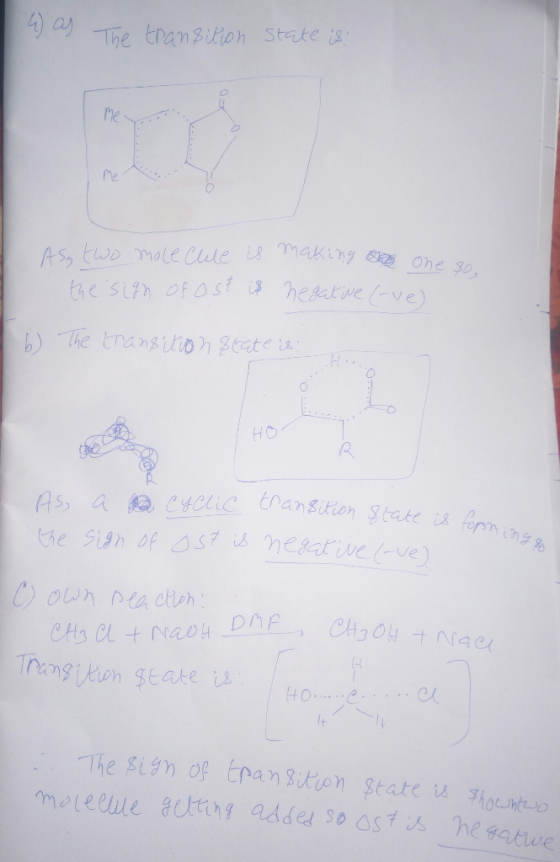
o @ Q Search 4. For the following chemical reactions, draw the transition state structure and predict the sign of A...
plz follow the instruction (7) Draw the structure of the transition state of the of the following chemical transfomatio...
 plz follow the instruction
(7) Draw the structure of the transition state of the of the following chemical transfomation. Draw all bonds Use dashed lines to draw bonds that are being broken/made and pay attention to their length. Draw partial charges on the atoms where bond is either being made or broken. (4 Pts) HCI
(7) Draw the structure of the transition state of the of the following chemical transfomation. Draw all bonds Use dashed lines to draw bonds that...
plz follow the instruction
(7) Draw the structure of the transition state of the of the following chemical transfomation. Draw all bonds Use dashed lines to draw bonds that are being broken/made and pay attention to their length. Draw partial charges on the atoms where bond is either being made or broken. (4 Pts) HCI
(7) Draw the structure of the transition state of the of the following chemical transfomation. Draw all bonds Use dashed lines to draw bonds that...
4. Predict the products of the following reactions & indicate whether they are most likely to...
 4. Predict the products of the following reactions & indicate whether they are most likely to go through an SN2, SN1, E1, or E2 mechanism. NaCN DMSO NaOH CH3OH heat Only one product is formed in the following E2 elimination reaction. Draw an arrow-pushing mechanism for the reaction and provide the correct product structure. Include a 3-D drawing (chair conformation) displaying proper stereochemistry of the transition state to explain formation of only the major product. CH3 •Br NaOCH3 ~"'CHS
1. Predict the major organic products of the following reactions. Draw all stereoisomers that are formed....
 1. Predict the major organic products of the following reactions. Draw all stereoisomers that are formed. НО, OH 1 eq ,H2SO4 (assume H2O workup of reaction to neutralize product) 1. LDA 2. (assume H,O workup of reaction to neutralize product) 3. Hg(OAC)2 4. NaBH, EtOH 1eq HBr EtOH ambiente 1. Brz. CCL 2. NaOET, ETOH OH
II. Draw the structure for the major organic product of each of the following reactions. (7.5...
 II. Draw the structure for the major organic product of each of the following reactions. (7.5 pts each, 45 pts) Ç(CH3)3 0 11. 1) PhCCI, AICI: 2) Et2NH, H2, Raney-Ni, heat 12. co Me 1) EtMgBr (2 equiv.) 2) H2O, H30* 13. o CNH, 1) Bra, NaOH, HẠO o 2) (CH3)CHČCI, pyridine 14. CHO Но+н HTOH Br2, H20 н+ОН НО-НН CH OH 4
II. Draw the structure for the major organic product of each of the following reactions. (7.5...
 II. Draw the structure for the major organic product of each of the following reactions. (7.5 pts each, 45 pts) Ç(CH3)3 0 11. 1) PhCCI, AICI: 2) Et2NH, H2, Raney-Ni, heat 12. co Me 1) EtMgBr (2 equiv.) 2) H2O, H30* 13. o CNH, 1) Bra, NaOH, HẠO o 2) (CH3)CHČCI, pyridine 14. CHO Но+н HTOH Br2, H20 н+ОН НО-НН CH OH 4
4. (2 points) For the following S2 reaction, (a) predict the product, including stereochemistry, and (b)...
 4. (2 points) For the following S2 reaction, (a) predict the product, including stereochemistry, and (b) draw the 3D transition state structure leading to the S2 product (using lines, dashes, wedges, dotted lines for partial bonds, and any needed partial charges). (a) OTs кCN CH3 (b) Transition state structure 5. (3 points) Complete the following sequences by filling in missing reagents from the list provided. Sequential steps, if necessary, should be numbered. Он Reagent List: PCI3 pyridine НС PBr3 NaH...
1) Predict the outcome of the following 4 reactions 1) Predict the outcome of the following...
 1) Predict the outcome of the following 4 reactions
 MeOH Ph reflux XPh MeΝΟ, reflux Y Br MeNO2 MeSNa DMSO Ph reflux Br 2) For the following 5 molecules predict whether an E2 elimination would be possible for the DRAWN conformation. Do not attempt to rotate around any bonds, judge based on the conformation shown. If yes, show the product. Br Ph BCH Meph Me Y y o tadi men 3)...
1) Predict the outcome of the following 4 reactions
1) Predict the outcome of the following 4 reactions MeOH Ph reflux XPh MeΝΟ, reflux Y Br MeNO2 MeSNa DMSO Ph reflux Br 2) For the following 5 molecules predict whether an E2 elimination would be possible for the DRAWN conformation. Do not attempt to rotate around any bonds, judge based on the conformation shown. If yes, show the product. Br Ph BCH Meph Me Y y o tadi men 3)...
Please help me!! 6. (4) In each of the following reactions, predict the mechanism by which...
 Please help me!!
6. (4) In each of the following reactions, predict the mechanism by which each reaction procedu! (SNI, SN2, E1, or E2) CH,CH,OH NO SH NASH acetone/H,0 these forms of Y? 7. (6) An unknown molecule Y has a molecular formula of CsH1002, a broad spectrum from 3200 to 3550 cm ecular formula of CsH1002, a broad absorption in its IR region. No region, and no absorption in the 1620 to 170 n' region, and no absorption in...
Please help me!!
6. (4) In each of the following reactions, predict the mechanism by which each reaction procedu! (SNI, SN2, E1, or E2) CH,CH,OH NO SH NASH acetone/H,0 these forms of Y? 7. (6) An unknown molecule Y has a molecular formula of CsH1002, a broad spectrum from 3200 to 3550 cm ecular formula of CsH1002, a broad absorption in its IR region. No region, and no absorption in the 1620 to 170 n' region, and no absorption in...
Draw the structure of the final product(s) of this series of reactions 1pt ernces 1 pt...
 Draw the structure of the final product(s) of this series of reactions 1pt ernces 1 pt 1. Br 1 pt 2.3 equivalents of NaNH 3. mild acid 1 pt 4. BH 5. H202/ NaOH 1 pt 1 pt 1 pt Use the wedge/hash bond tools to indicate stereochemistry where it exists Include H atoms at chiral centers only If a group is achiral, do not use wedged or hashed bonds on it Draw organic species only. Do not include lone...
6. Draw the structure of Compound Y 1. O 2. Zn, H3O 7. Draw all resonance contributors to this species: CHz 8. a) State the hybridization (sp, sp2, sp) of each carbon in this compound, going left...
 6. Draw the structure of Compound Y 1. O 2. Zn, H3O 7. Draw all resonance contributors to this species: CHz 8. a) State the hybridization (sp, sp2, sp) of each carbon in this compound, going left to right. b) Write "highest under the compound which is in the highest oxidation state. Write "lowest" under the compound which is in the lowest oxidation state. CH2Cl2 CH4 9. a) Write out seven separate reactions of 2-methyl-2-butene, including reagent(s) and products(s). Include...
 plz follow the instruction
(7) Draw the structure of the transition state of the of the following chemical transfomation. Draw all bonds Use dashed lines to draw bonds that are being broken/made and pay attention to their length. Draw partial charges on the atoms where bond is either being made or broken. (4 Pts) HCI
(7) Draw the structure of the transition state of the of the following chemical transfomation. Draw all bonds Use dashed lines to draw bonds that...
plz follow the instruction
(7) Draw the structure of the transition state of the of the following chemical transfomation. Draw all bonds Use dashed lines to draw bonds that are being broken/made and pay attention to their length. Draw partial charges on the atoms where bond is either being made or broken. (4 Pts) HCI
(7) Draw the structure of the transition state of the of the following chemical transfomation. Draw all bonds Use dashed lines to draw bonds that...
 4. Predict the products of the following reactions & indicate whether they are most likely to go through an SN2, SN1, E1, or E2 mechanism. NaCN DMSO NaOH CH3OH heat Only one product is formed in the following E2 elimination reaction. Draw an arrow-pushing mechanism for the reaction and provide the correct product structure. Include a 3-D drawing (chair conformation) displaying proper stereochemistry of the transition state to explain formation of only the major product. CH3 •Br NaOCH3 ~"'CHS
 1. Predict the major organic products of the following reactions. Draw all stereoisomers that are formed. НО, OH 1 eq ,H2SO4 (assume H2O workup of reaction to neutralize product) 1. LDA 2. (assume H,O workup of reaction to neutralize product) 3. Hg(OAC)2 4. NaBH, EtOH 1eq HBr EtOH ambiente 1. Brz. CCL 2. NaOET, ETOH OH
 II. Draw the structure for the major organic product of each of the following reactions. (7.5 pts each, 45 pts) Ç(CH3)3 0 11. 1) PhCCI, AICI: 2) Et2NH, H2, Raney-Ni, heat 12. co Me 1) EtMgBr (2 equiv.) 2) H2O, H30* 13. o CNH, 1) Bra, NaOH, HẠO o 2) (CH3)CHČCI, pyridine 14. CHO Но+н HTOH Br2, H20 н+ОН НО-НН CH OH 4
 II. Draw the structure for the major organic product of each of the following reactions. (7.5 pts each, 45 pts) Ç(CH3)3 0 11. 1) PhCCI, AICI: 2) Et2NH, H2, Raney-Ni, heat 12. co Me 1) EtMgBr (2 equiv.) 2) H2O, H30* 13. o CNH, 1) Bra, NaOH, HẠO o 2) (CH3)CHČCI, pyridine 14. CHO Но+н HTOH Br2, H20 н+ОН НО-НН CH OH 4
 4. (2 points) For the following S2 reaction, (a) predict the product, including stereochemistry, and (b) draw the 3D transition state structure leading to the S2 product (using lines, dashes, wedges, dotted lines for partial bonds, and any needed partial charges). (a) OTs кCN CH3 (b) Transition state structure 5. (3 points) Complete the following sequences by filling in missing reagents from the list provided. Sequential steps, if necessary, should be numbered. Он Reagent List: PCI3 pyridine НС PBr3 NaH...
 1) Predict the outcome of the following 4 reactions
 MeOH Ph reflux XPh MeΝΟ, reflux Y Br MeNO2 MeSNa DMSO Ph reflux Br 2) For the following 5 molecules predict whether an E2 elimination would be possible for the DRAWN conformation. Do not attempt to rotate around any bonds, judge based on the conformation shown. If yes, show the product. Br Ph BCH Meph Me Y y o tadi men 3)...
1) Predict the outcome of the following 4 reactions
1) Predict the outcome of the following 4 reactions MeOH Ph reflux XPh MeΝΟ, reflux Y Br MeNO2 MeSNa DMSO Ph reflux Br 2) For the following 5 molecules predict whether an E2 elimination would be possible for the DRAWN conformation. Do not attempt to rotate around any bonds, judge based on the conformation shown. If yes, show the product. Br Ph BCH Meph Me Y y o tadi men 3)...
 Please help me!!
6. (4) In each of the following reactions, predict the mechanism by which each reaction procedu! (SNI, SN2, E1, or E2) CH,CH,OH NO SH NASH acetone/H,0 these forms of Y? 7. (6) An unknown molecule Y has a molecular formula of CsH1002, a broad spectrum from 3200 to 3550 cm ecular formula of CsH1002, a broad absorption in its IR region. No region, and no absorption in the 1620 to 170 n' region, and no absorption in...
Please help me!!
6. (4) In each of the following reactions, predict the mechanism by which each reaction procedu! (SNI, SN2, E1, or E2) CH,CH,OH NO SH NASH acetone/H,0 these forms of Y? 7. (6) An unknown molecule Y has a molecular formula of CsH1002, a broad spectrum from 3200 to 3550 cm ecular formula of CsH1002, a broad absorption in its IR region. No region, and no absorption in the 1620 to 170 n' region, and no absorption in...
 Draw the structure of the final product(s) of this series of reactions 1pt ernces 1 pt 1. Br 1 pt 2.3 equivalents of NaNH 3. mild acid 1 pt 4. BH 5. H202/ NaOH 1 pt 1 pt 1 pt Use the wedge/hash bond tools to indicate stereochemistry where it exists Include H atoms at chiral centers only If a group is achiral, do not use wedged or hashed bonds on it Draw organic species only. Do not include lone...
 6. Draw the structure of Compound Y 1. O 2. Zn, H3O 7. Draw all resonance contributors to this species: CHz 8. a) State the hybridization (sp, sp2, sp) of each carbon in this compound, going left to right. b) Write "highest under the compound which is in the highest oxidation state. Write "lowest" under the compound which is in the lowest oxidation state. CH2Cl2 CH4 9. a) Write out seven separate reactions of 2-methyl-2-butene, including reagent(s) and products(s). Include...
Most questions answered within 3 hours.
-
Where is the error in this code sequence?
String s1 = "Hello";
String s2 = "ello";...
asked 11 months ago -
Financial data for Joel de Paris, Inc., for last year
follow:
Joel de Paris, Inc.
Balance...
asked 11 months ago -
Consider this reaction:
Al2(SO4)3 (aq)+ BaCl3
(aq) Al2Cl6 (aq)- +
3BaSO4(s) . What is the...
asked 11 months ago -
Suppose that Savneet is considering increasing her
recent random sample from 20 car rentals to 40...
asked 11 months ago -
Trucks arrive at an unloading terminal at an average rate of 120
per hour.
Trucks arrive...
asked 11 months ago -
Why are methanol and ethanol completely soluble in water while
octanol is not very little soluble....
asked 11 months ago -
A facilities manager at a university reads in a research report
that the mean amount of...
asked 11 months ago -
When the CuSO4 is rehydrated by adding water to the anhydrous
compound, is this an endothermic...
asked 11 months ago -
A ray of sunlight is passing from diamond into crown glass; the
angle of incidence is...
asked 11 months ago -
A block of mass 0.249 kg is placed on top of a light, vertical
spring of...
asked 11 months ago -
how do the kidneys compensate in the presences of acidosis
a) trigger hyperventilate
b) reserve acid...
asked 11 months ago -
Question 501 pts
The rental rate of capital to the firm increases. Which of the
following...
asked 11 months ago