If the central bank prints $5000, which is handed to citizens with a currency ratio of 0.2 and a bankers’ reserve ratio...
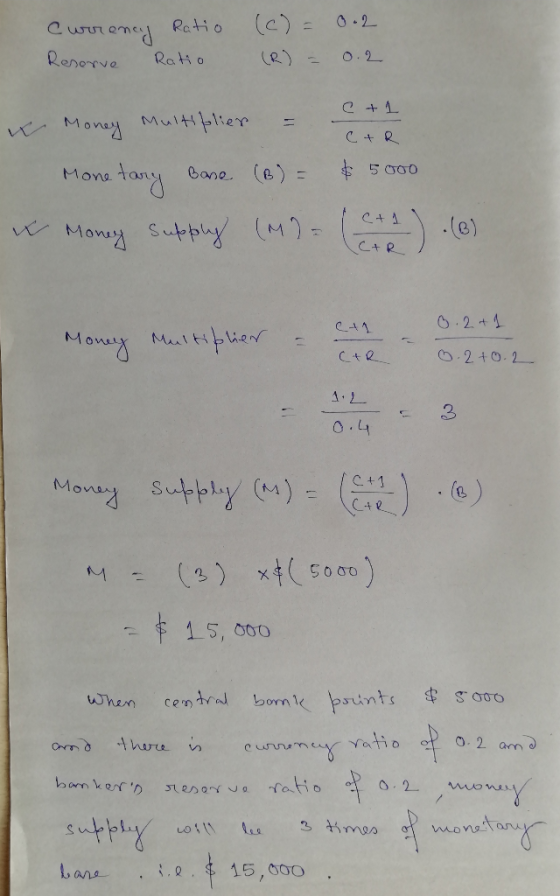
If the central bank prints $5000, which is handed to citizens with a currency ratio of 0.2 and a bankers’ reserve ratio of 0.2, what will happen?
What is the final chance to the money supply? What is the money multiplier?
Homework Answers
Add Answer to:
If the central bank prints $5000, which is handed to citizens with a currency ratio of 0.2 and a bankers’ reserve ratio...
What about in the opposite scenario? If the central bank withdraws $5000 from circulation, in a...
What about in the opposite scenario? If the central bank withdraws $5000 from circulation, in a population with a currency ratio of 0.05 and a reserve ratio of 0.1, what is the final effect on the money supply?
The currency drain ratio is 0.2 and the desired reserve ratio is 0.4. What is the...
 The currency drain ratio is 0.2 and the desired reserve ratio is 0.4. What is the money multiplier? The money multiplier is >>> Answer to 1 decimal place.
Question A Suppose that the the reserve ratio is 25%. 1. Define the reserve ratio. 2....
 Question A Suppose that the the reserve ratio is 25%. 1. Define the reserve ratio. 2. Define the money multiplier. 3. If people deposit all of their cash in the bank, what is the money multi- plier? 4. If people only deposit 2/3 of their cash in the bank, what is the money multiplier? 5. Explain how buying and selling assets by the central bank increases or decreases the money supply. 6. If people deposit all of their cash in...
Suppose the currency-to-deposit ratio is 0.25, the excess reserve-to-deposit ratio is 0.03, and the required reserve...
Suppose the currency-to-deposit ratio is 0.25, the excess reserve-to-deposit ratio is 0.03, and the required reserve ratio is 0.1. Which will have a larger impact on the money multiplier: a rise of 0.05 in the currency ratio or in the excess reserve ratio? Instructions: Enter your response rounded to two decimal places. If the currency-to-deposit ratio rises to 0.3, the multiplier will be m = If, instead, the excess reserve-to-deposit ratio rises, the multiplier will be m =
Explain the key role of a central bank (such as the Federal Reserve) in the monetary...
Explain the key role of a central bank (such as the Federal Reserve) in the monetary system. What happens to the money supply when a central bank (such as the Federal Reserve) buys bonds? Explain. You run a bank. The current reserve ratio mandates holding reserves equal to 20% of deposits. If someone comes into your bank and deposits $10,000, by how much will the money supply in the economy increase? You have equity (a capital share) in a bank....
a. Explain the key role of a central bank (such as the Federal Reserve) in the...
a. Explain the key role of a central bank (such as the Federal Reserve) in the monetary system. (4 points). What happens to the money supply when a central bank (such as the Federal Reserve) buys bonds? Explain. (4 points). You run a bank. The current reserve ratio mandates holding reserves equal to 20% of deposits. If someone comes into your bank and deposits $10,000, by how much will the money supply in the economy increase? (4 points) You have...
Which statement best describes the outcomes of a decrease in reserve requirements? The reserve ratio increases,...
 Which statement best describes the outcomes of a decrease in reserve requirements? The reserve ratio increases, the money multiplier decreases, and the money supply decreases. The reserve ratio decreases, the money multiplier decreases, and the money supply decreases. The reserve ratio decreases, the money multiplier increases, and the money supply increases. The reserve ratio increases, the money multiplier increases, and the money supply increases. Question 16 (1 point) Suppose the reserve ratio is 10 percent and banks do not hold...
Suppose the monetary base is $100. If the currency-deposit ratio is 0.20 and the reserve-deposit ratio...
 Suppose the monetary base is $100. If the currency-deposit ratio is 0.20 and the reserve-deposit ratio is 0.10, calculate the money multiplier and total money supply.
The sum of currency and bank deposits at the central bank is called: a. the money...
 The sum of currency and bank deposits at the central bank is called: a. the money supply. b. domestic assets. c. the monetary base. d. fractional reserves. Official intervention in the foreign exchange market to defend a fixed exchange rate when the value of the country's currency is under downward pressure causes a. international reserve holdings to rise. b. a downward pressure on the country's interest rates. c.an increase in the liabilities of the central bank. d. the domestic money...
Suppose the required reserve ratio is 15%, currency in circulation is $300 billion, the amount of...
Suppose the required reserve ratio is 15%, currency in circulation is $300 billion, the amount of checkable deposits is $450 billion, and excess reserves are $40.5 billion. Calculate the money supply. _________________ Calculate the currency/deposit ratio. _________________ Calculate the excess reserve ratio. _________________ Calculate the money multiplier. _________________
 The currency drain ratio is 0.2 and the desired reserve ratio is 0.4. What is the money multiplier? The money multiplier is >>> Answer to 1 decimal place.
 Question A Suppose that the the reserve ratio is 25%. 1. Define the reserve ratio. 2. Define the money multiplier. 3. If people deposit all of their cash in the bank, what is the money multi- plier? 4. If people only deposit 2/3 of their cash in the bank, what is the money multiplier? 5. Explain how buying and selling assets by the central bank increases or decreases the money supply. 6. If people deposit all of their cash in...
 Which statement best describes the outcomes of a decrease in reserve requirements? The reserve ratio increases, the money multiplier decreases, and the money supply decreases. The reserve ratio decreases, the money multiplier decreases, and the money supply decreases. The reserve ratio decreases, the money multiplier increases, and the money supply increases. The reserve ratio increases, the money multiplier increases, and the money supply increases. Question 16 (1 point) Suppose the reserve ratio is 10 percent and banks do not hold...
 Suppose the monetary base is $100. If the currency-deposit ratio is 0.20 and the reserve-deposit ratio is 0.10, calculate the money multiplier and total money supply.
 The sum of currency and bank deposits at the central bank is called: a. the money supply. b. domestic assets. c. the monetary base. d. fractional reserves. Official intervention in the foreign exchange market to defend a fixed exchange rate when the value of the country's currency is under downward pressure causes a. international reserve holdings to rise. b. a downward pressure on the country's interest rates. c.an increase in the liabilities of the central bank. d. the domestic money...
Most questions answered within 3 hours.
-
Where is the error in this code sequence?
String s1 = "Hello";
String s2 = "ello";...
asked 11 months ago -
Financial data for Joel de Paris, Inc., for last year
follow:
Joel de Paris, Inc.
Balance...
asked 11 months ago -
Consider this reaction:
Al2(SO4)3 (aq)+ BaCl3
(aq) Al2Cl6 (aq)- +
3BaSO4(s) . What is the...
asked 11 months ago -
Suppose that Savneet is considering increasing her
recent random sample from 20 car rentals to 40...
asked 11 months ago -
Trucks arrive at an unloading terminal at an average rate of 120
per hour.
Trucks arrive...
asked 11 months ago -
Why are methanol and ethanol completely soluble in water while
octanol is not very little soluble....
asked 11 months ago -
A facilities manager at a university reads in a research report
that the mean amount of...
asked 11 months ago -
When the CuSO4 is rehydrated by adding water to the anhydrous
compound, is this an endothermic...
asked 11 months ago -
A ray of sunlight is passing from diamond into crown glass; the
angle of incidence is...
asked 11 months ago -
A block of mass 0.249 kg is placed on top of a light, vertical
spring of...
asked 11 months ago -
how do the kidneys compensate in the presences of acidosis
a) trigger hyperventilate
b) reserve acid...
asked 11 months ago -
Question 501 pts
The rental rate of capital to the firm increases. Which of the
following...
asked 11 months ago