

Homework Answers
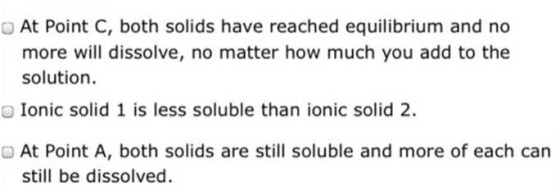
From the above statements, only statements 2, 4 and 5 are true which are given below
Add Answer to:
Figure 2: Solution Conductivity As A Function of The Moles of Ionic Solid Added To The System. Point A Point B Poi...
b. MgCl, is dissolved in distilled water at 25°C until the saturated solution is obtained (system...
 b. MgCl, is dissolved in distilled water at 25°C until the saturated solution is obtained (system reaches equilibrium). The concentration of Mg2 in the saturated solution is 1.35 x 10-'M. The dissolution of MgCl, in distilled water is endothermic. Write the balanced chemical equation to obtain the saturated solution Calculate the solubility product, K of MgCl2. Explain the effect of increasing the temperature on the amount of MgCl, Justify your answer. C. When solid Pbl, is added to pure water...
Please solve A B and C. Show each step to the solutions. I attached the answers...
 Please solve A B and C. Show each step to the solutions. I
attached the answers for B but am not sure how to get to these
solutions.
please solve A B and C. Show each step to the solutions 6.82. A salt A is soluble in a solvent S. A conductivity meter used to measure the solute concentration in A-S solutions is calibrated by dissolving a known quantity of A in S, adding more S to bring the solution...
Please solve A B and C. Show each step to the solutions. I
attached the answers for B but am not sure how to get to these
solutions.
please solve A B and C. Show each step to the solutions 6.82. A salt A is soluble in a solvent S. A conductivity meter used to measure the solute concentration in A-S solutions is calibrated by dissolving a known quantity of A in S, adding more S to bring the solution...
G of sodium nitrate (NaNO,) dissolves in 100 g of water at 20°C. Is this solution saturated or un...
 g of sodium nitrate (NaNO,) dissolves in 100 g of water at 20°C. Is this solution saturated or unsaturated? Wha t would happen if you added ten more grams of sodium nitrate to the solution? What would if you added the ten grams and raised the temperature to 40 C? lution is unsaturated. Adding ten additional grams of solute (NaNO,) would result in a homo geneous solution. Raising the temperature of the solution by 20°C would not affect the solution...
I understand that equivalents is the ratio of the # of moles of a reactant or...
 I understand that equivalents is the ratio of the # of moles
of a reactant or reagent compared to the # of moles of the
substrate. But I am confused on how to answer this question and why
the procedure would call for more NaI than Vanillin if Vanillin is
the substance needed substituted. Can you help?
Thanks!
3. How many equivalents of sodium iodide are used in this experiment? Show your calculation Speculate about why the procedure calls for...
I understand that equivalents is the ratio of the # of moles
of a reactant or reagent compared to the # of moles of the
substrate. But I am confused on how to answer this question and why
the procedure would call for more NaI than Vanillin if Vanillin is
the substance needed substituted. Can you help?
Thanks!
3. How many equivalents of sodium iodide are used in this experiment? Show your calculation Speculate about why the procedure calls for...
Model I: The Dissolution of Magnesium Hydroxide in Water When solid Mg(OH)2 dissolves in water, the...
Model I: The Dissolution of Magnesium Hydroxide in Water When solid Mg(OH)2 dissolves in water, the chemical reaction is: Mg(OH)2(s) Mg2+(aq) + 2OH-(aq) (1) Table I. These are the results after equilibrium has been established for the addition of solid Mg(OH)2(s) to water yielding a final volume of 10.0 L of solution. Total amount of Mg(OH)2 added Mg2+ concentration in the resulting solution at eq OH- concentration in the resulting solution at eq Mass of Mg(OH)2 that does not dissolve...
t in the orams ts. Conductivity Chem 113 Reading Assignment 1. Read sections 8.2-8.3 in your...
 t in the orams ts. Conductivity Chem 113 Reading Assignment 1. Read sections 8.2-8.3 in your lecture text. 2. Review Sample Exercise 8.4 on pages 326-327 of your lecture text. Introduction Properties of Solutions: Electrolytes and Non-Electrolytes In this experiment, you will discover some properties of strong electrolytes, weak electrolytes, and non- electrolytes by observing the behavior of these substances in aqueous solutions. You will determine these properties using a conductivity Probe. When the probe is placed in a solution...
please help me answer question 1 to 3, thank you Chapter 9, Solutions, Review & Extra Credit. 2 Points for each XC c...
 please help me answer question 1 to 3,
thank you
Chapter 9, Solutions, Review & Extra Credit. 2 Points for each XC correct answer; 6 points total, max. Partial Credit given. Suggestions...work in teams [it will improve the learning experience] 1. Solutions-A solution forms when a solute (the smaller quantity) dissolves in a solvent (the larger quantity). In a solution, the particles of solute are evenly distributed in the solvent. A solute may be a gas, liquid or solid. A...
please help me answer question 1 to 3,
thank you
Chapter 9, Solutions, Review & Extra Credit. 2 Points for each XC correct answer; 6 points total, max. Partial Credit given. Suggestions...work in teams [it will improve the learning experience] 1. Solutions-A solution forms when a solute (the smaller quantity) dissolves in a solvent (the larger quantity). In a solution, the particles of solute are evenly distributed in the solvent. A solute may be a gas, liquid or solid. A...
4.30. Using solubility rules, predict the solubility in water of the following ionic compounds. a. AI(OH) b. CaN...
 4.30. Using solubility rules, predict the solubility in water of the following ionic compounds. a. AI(OH) b. CaN C. NH4CI d. KOH 4.32. Using solubility rules, decide whether the following ionic solids are soluble or insoluble in water. If they are soluble, write the chemical equation for dissolving in water and indicate what ions you would expect to be present in solution. (NE SO b. BaCO c. Pb(NOs)2 d. Ca(OH) 4.34. Write net ionic equations for the following molecular equations....
Exercise 2 Separation of a Mixture Based on Acid-Base Properties One purpose of this exercise is...
Exercise 2 Separation of a Mixture Based on Acid-Base Properties One purpose of this exercise is to learn how to use a separatory funnel to extract a single component away from other compounds in solution. To do so, we will apply the principles of solubility and acid-base behavior you’re seeing in class. One of the compounds is neutral in the acid-base sense. It has no ability to either donate or accept a proton from an aqueous solution, and will remain...
need help Insert the missing coefficients to completely balance each chemical equation. equation...
 need help
Insert the missing coefficients to completely balance each chemical equation. equation 1: S+6 HNO, H,SO, + NO, +H,0 equation 2: 3 Cu + 8 HNO, Cu(NO), + NO + H2O We were unable to transcribe this imageBalance the equations by inserting coefficients as needed. equation 1: Sb + Cl, — SbCl, equation 2: Mg, N, + HCI — MgCl, +NH, Select the equation that best describes the reaction. O A+B, AB O 4 A +8 B — 4AB,...
need help
Insert the missing coefficients to completely balance each chemical equation. equation 1: S+6 HNO, H,SO, + NO, +H,0 equation 2: 3 Cu + 8 HNO, Cu(NO), + NO + H2O We were unable to transcribe this imageBalance the equations by inserting coefficients as needed. equation 1: Sb + Cl, — SbCl, equation 2: Mg, N, + HCI — MgCl, +NH, Select the equation that best describes the reaction. O A+B, AB O 4 A +8 B — 4AB,...
 b. MgCl, is dissolved in distilled water at 25°C until the saturated solution is obtained (system reaches equilibrium). The concentration of Mg2 in the saturated solution is 1.35 x 10-'M. The dissolution of MgCl, in distilled water is endothermic. Write the balanced chemical equation to obtain the saturated solution Calculate the solubility product, K of MgCl2. Explain the effect of increasing the temperature on the amount of MgCl, Justify your answer. C. When solid Pbl, is added to pure water...
 Please solve A B and C. Show each step to the solutions. I
attached the answers for B but am not sure how to get to these
solutions.
please solve A B and C. Show each step to the solutions 6.82. A salt A is soluble in a solvent S. A conductivity meter used to measure the solute concentration in A-S solutions is calibrated by dissolving a known quantity of A in S, adding more S to bring the solution...
Please solve A B and C. Show each step to the solutions. I
attached the answers for B but am not sure how to get to these
solutions.
please solve A B and C. Show each step to the solutions 6.82. A salt A is soluble in a solvent S. A conductivity meter used to measure the solute concentration in A-S solutions is calibrated by dissolving a known quantity of A in S, adding more S to bring the solution...
 g of sodium nitrate (NaNO,) dissolves in 100 g of water at 20°C. Is this solution saturated or unsaturated? Wha t would happen if you added ten more grams of sodium nitrate to the solution? What would if you added the ten grams and raised the temperature to 40 C? lution is unsaturated. Adding ten additional grams of solute (NaNO,) would result in a homo geneous solution. Raising the temperature of the solution by 20°C would not affect the solution...
 I understand that equivalents is the ratio of the # of moles
of a reactant or reagent compared to the # of moles of the
substrate. But I am confused on how to answer this question and why
the procedure would call for more NaI than Vanillin if Vanillin is
the substance needed substituted. Can you help?
Thanks!
3. How many equivalents of sodium iodide are used in this experiment? Show your calculation Speculate about why the procedure calls for...
I understand that equivalents is the ratio of the # of moles
of a reactant or reagent compared to the # of moles of the
substrate. But I am confused on how to answer this question and why
the procedure would call for more NaI than Vanillin if Vanillin is
the substance needed substituted. Can you help?
Thanks!
3. How many equivalents of sodium iodide are used in this experiment? Show your calculation Speculate about why the procedure calls for...
 t in the orams ts. Conductivity Chem 113 Reading Assignment 1. Read sections 8.2-8.3 in your lecture text. 2. Review Sample Exercise 8.4 on pages 326-327 of your lecture text. Introduction Properties of Solutions: Electrolytes and Non-Electrolytes In this experiment, you will discover some properties of strong electrolytes, weak electrolytes, and non- electrolytes by observing the behavior of these substances in aqueous solutions. You will determine these properties using a conductivity Probe. When the probe is placed in a solution...
 please help me answer question 1 to 3,
thank you
Chapter 9, Solutions, Review & Extra Credit. 2 Points for each XC correct answer; 6 points total, max. Partial Credit given. Suggestions...work in teams [it will improve the learning experience] 1. Solutions-A solution forms when a solute (the smaller quantity) dissolves in a solvent (the larger quantity). In a solution, the particles of solute are evenly distributed in the solvent. A solute may be a gas, liquid or solid. A...
please help me answer question 1 to 3,
thank you
Chapter 9, Solutions, Review & Extra Credit. 2 Points for each XC correct answer; 6 points total, max. Partial Credit given. Suggestions...work in teams [it will improve the learning experience] 1. Solutions-A solution forms when a solute (the smaller quantity) dissolves in a solvent (the larger quantity). In a solution, the particles of solute are evenly distributed in the solvent. A solute may be a gas, liquid or solid. A...
 4.30. Using solubility rules, predict the solubility in water of the following ionic compounds. a. AI(OH) b. CaN C. NH4CI d. KOH 4.32. Using solubility rules, decide whether the following ionic solids are soluble or insoluble in water. If they are soluble, write the chemical equation for dissolving in water and indicate what ions you would expect to be present in solution. (NE SO b. BaCO c. Pb(NOs)2 d. Ca(OH) 4.34. Write net ionic equations for the following molecular equations....
 need help
Insert the missing coefficients to completely balance each chemical equation. equation 1: S+6 HNO, H,SO, + NO, +H,0 equation 2: 3 Cu + 8 HNO, Cu(NO), + NO + H2O We were unable to transcribe this imageBalance the equations by inserting coefficients as needed. equation 1: Sb + Cl, — SbCl, equation 2: Mg, N, + HCI — MgCl, +NH, Select the equation that best describes the reaction. O A+B, AB O 4 A +8 B — 4AB,...
need help
Insert the missing coefficients to completely balance each chemical equation. equation 1: S+6 HNO, H,SO, + NO, +H,0 equation 2: 3 Cu + 8 HNO, Cu(NO), + NO + H2O We were unable to transcribe this imageBalance the equations by inserting coefficients as needed. equation 1: Sb + Cl, — SbCl, equation 2: Mg, N, + HCI — MgCl, +NH, Select the equation that best describes the reaction. O A+B, AB O 4 A +8 B — 4AB,...
Most questions answered within 3 hours.
-
Where is the error in this code sequence?
String s1 = "Hello";
String s2 = "ello";...
asked 10 months ago -
Financial data for Joel de Paris, Inc., for last year
follow:
Joel de Paris, Inc.
Balance...
asked 10 months ago -
Consider this reaction:
Al2(SO4)3 (aq)+ BaCl3
(aq) Al2Cl6 (aq)- +
3BaSO4(s) . What is the...
asked 10 months ago -
Suppose that Savneet is considering increasing her
recent random sample from 20 car rentals to 40...
asked 10 months ago -
Trucks arrive at an unloading terminal at an average rate of 120
per hour.
Trucks arrive...
asked 10 months ago -
Why are methanol and ethanol completely soluble in water while
octanol is not very little soluble....
asked 10 months ago -
A facilities manager at a university reads in a research report
that the mean amount of...
asked 10 months ago -
When the CuSO4 is rehydrated by adding water to the anhydrous
compound, is this an endothermic...
asked 10 months ago -
A ray of sunlight is passing from diamond into crown glass; the
angle of incidence is...
asked 10 months ago -
A block of mass 0.249 kg is placed on top of a light, vertical
spring of...
asked 10 months ago -
how do the kidneys compensate in the presences of acidosis
a) trigger hyperventilate
b) reserve acid...
asked 10 months ago -
Question 501 pts
The rental rate of capital to the firm increases. Which of the
following...
asked 10 months ago