What is the general trend in electronigativity within a group of elements in the periodic table?
What is the general trend in electronigativity within
a group of elements in the periodic table?
Homework Answers
*********as you move down a group on the periodic table,
the Electronegativity of an element decreases because the increased
number of energy levels puts the outer electrons very far away from
the pull of the nucleus. 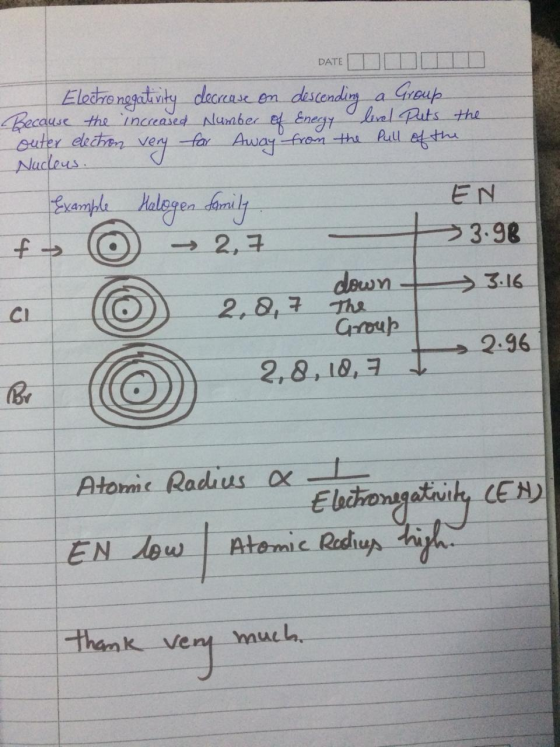
Add Answer to:
What is the general trend in electronigativity within a group of elements in the periodic table?
12. Give the general trend in the periodic table (period, group) for the main group elements...
 12. Give the general trend in the periodic table (period, group) for the main group elements (Groups I-VIII) for a) sizes of atoms, cations, anions (same charge) b) ionization energies c) electron affinities d) electronegativities
Font Paragraph F Styles Data Sheet Table 1: Periodic Trends Periodicity Observation What are the Group...
 Font Paragraph F Styles Data Sheet Table 1: Periodic Trends Periodicity Observation What are the Group 1 elements called? Within a group, what happens to the atomic radius as you go down the column? Within a period, what happens to the atomic radius as the atomic number increases? What is the general trend of electronegativity as you go left to right across the periodic table? What is the general trend of electronegativity as you go down the periodic table? What...
Periodic Trends in Group II Objective In this experiment, the trend in one of the several...
 Periodic Trends in Group
II
Objective
In this experiment, the trend in one of the several periodic
properties for group II of the Periodic Table will be
determined.
Introduction
Elements in the same group of the Periodic Table have similar
chemical and physical properties that gradually change as one goes
from one element in the group to the next. By observing the trends
in properties, the elements can be arranged in the order in which
they appear in the Periodic...
Periodic Trends in Group
II
Objective
In this experiment, the trend in one of the several periodic
properties for group II of the Periodic Table will be
determined.
Introduction
Elements in the same group of the Periodic Table have similar
chemical and physical properties that gradually change as one goes
from one element in the group to the next. By observing the trends
in properties, the elements can be arranged in the order in which
they appear in the Periodic...
What is the general trend in ionization energy across a row on the periodic table? Using...
 What is the general trend in ionization energy across a row on the periodic table? Using a ground state electron configuration as your basis of comparison, explain Why the ionization energy of boron is less than that of beryllium Why the ionization energy of oxygen is less than that of nitrogen
1. Explain why the general trend exists for elements getting smaller as you move across a...
1. Explain why the general trend exists for elements getting smaller as you move across a period on the periodic table. 2. Explain the importance of the VSEPR Theory.
The elements of which group in the periodic table release the most energy by gaining an electron? The e...
 The elements of which group in the periodic table release the most energy by gaining an electron? The elements of which group in the periodic table absorb the most energy when gaining an electron? ОТА ОТА О2А О ЗА O4А ОЗА 04А 05A 06A ОООО ОВА
General Chemistry Laboratory I Date: DISCUSSION QUESTIONS 1. Elements from which group on the periodic table...
 General Chemistry Laboratory I Date: DISCUSSION QUESTIONS 1. Elements from which group on the periodic table form ions that always remain soluble? 2. Salts containing which other positive ion were always soluble? 3. Salts containing which negative ion were always soluble? 4. Which negative ions were almost always soluble? 5. Summarize the solubility rules below. List them as Always Soluble, Mostly Soluble, and Mostly Insoluble.
Give the symbols of the elements that occupy the given positions in the periodic table. group...
 Give the symbols of the elements that occupy the given positions in the periodic table. group 13 (IIIA), period 6: group 4 (IVB), period 6: group 1 (IA), period 7: group 17 (VIIA), period 4: group 11 (IB), period 6:
For the main group elements,in general, upon going from left to right across a period of...
For the main group elements,in general, upon going from left to right across a period of the periodic table, the ionization energy__,theatomicsize,__ and the metallic character__
1. Describe and explain the trend of the ionization energy of elements: (i) across a period;...
1. Describe and explain the trend of the ionization energy of elements: (i) across a period; (ii) down a group, in the periodic table. 2. Reactivity of alkali metals (Group 1A) increases from top to bottom down the group, but the reactivity of halogen (Group 7A) decreases from top to bottom down the group. Explain why the difference.
 12. Give the general trend in the periodic table (period, group) for the main group elements (Groups I-VIII) for a) sizes of atoms, cations, anions (same charge) b) ionization energies c) electron affinities d) electronegativities
 Font Paragraph F Styles Data Sheet Table 1: Periodic Trends Periodicity Observation What are the Group 1 elements called? Within a group, what happens to the atomic radius as you go down the column? Within a period, what happens to the atomic radius as the atomic number increases? What is the general trend of electronegativity as you go left to right across the periodic table? What is the general trend of electronegativity as you go down the periodic table? What...
 Periodic Trends in Group
II
Objective
In this experiment, the trend in one of the several periodic
properties for group II of the Periodic Table will be
determined.
Introduction
Elements in the same group of the Periodic Table have similar
chemical and physical properties that gradually change as one goes
from one element in the group to the next. By observing the trends
in properties, the elements can be arranged in the order in which
they appear in the Periodic...
Periodic Trends in Group
II
Objective
In this experiment, the trend in one of the several periodic
properties for group II of the Periodic Table will be
determined.
Introduction
Elements in the same group of the Periodic Table have similar
chemical and physical properties that gradually change as one goes
from one element in the group to the next. By observing the trends
in properties, the elements can be arranged in the order in which
they appear in the Periodic...
 What is the general trend in ionization energy across a row on the periodic table? Using a ground state electron configuration as your basis of comparison, explain Why the ionization energy of boron is less than that of beryllium Why the ionization energy of oxygen is less than that of nitrogen
 The elements of which group in the periodic table release the most energy by gaining an electron? The elements of which group in the periodic table absorb the most energy when gaining an electron? ОТА ОТА О2А О ЗА O4А ОЗА 04А 05A 06A ОООО ОВА
 General Chemistry Laboratory I Date: DISCUSSION QUESTIONS 1. Elements from which group on the periodic table form ions that always remain soluble? 2. Salts containing which other positive ion were always soluble? 3. Salts containing which negative ion were always soluble? 4. Which negative ions were almost always soluble? 5. Summarize the solubility rules below. List them as Always Soluble, Mostly Soluble, and Mostly Insoluble.
 Give the symbols of the elements that occupy the given positions in the periodic table. group 13 (IIIA), period 6: group 4 (IVB), period 6: group 1 (IA), period 7: group 17 (VIIA), period 4: group 11 (IB), period 6:
Most questions answered within 3 hours.
-
Where is the error in this code sequence?
String s1 = "Hello";
String s2 = "ello";...
asked 10 months ago -
Financial data for Joel de Paris, Inc., for last year
follow:
Joel de Paris, Inc.
Balance...
asked 10 months ago -
Consider this reaction:
Al2(SO4)3 (aq)+ BaCl3
(aq) Al2Cl6 (aq)- +
3BaSO4(s) . What is the...
asked 10 months ago -
Suppose that Savneet is considering increasing her
recent random sample from 20 car rentals to 40...
asked 10 months ago -
Trucks arrive at an unloading terminal at an average rate of 120
per hour.
Trucks arrive...
asked 10 months ago -
Why are methanol and ethanol completely soluble in water while
octanol is not very little soluble....
asked 10 months ago -
A facilities manager at a university reads in a research report
that the mean amount of...
asked 10 months ago -
When the CuSO4 is rehydrated by adding water to the anhydrous
compound, is this an endothermic...
asked 10 months ago -
A ray of sunlight is passing from diamond into crown glass; the
angle of incidence is...
asked 10 months ago -
A block of mass 0.249 kg is placed on top of a light, vertical
spring of...
asked 10 months ago -
how do the kidneys compensate in the presences of acidosis
a) trigger hyperventilate
b) reserve acid...
asked 10 months ago -
Question 501 pts
The rental rate of capital to the firm increases. Which of the
following...
asked 10 months ago