
Homework Answers
Given Rate law is:
rate = k[A]^3
rate new / rate old = ([A]new/[A]old)^3
here:
[A]new/[A]old = 3
putting values
rate new / rate old = (3)^3
rate new / rate old = 27
Answer: increase by a factor of 27
Add Answer to:
A reaction was found to be third order in A. Increasing the concentration of A by a factor of 3 will cause the reaction...
Areaction was found to be zero-order in A and third-order in B. Increasing the concentration of...
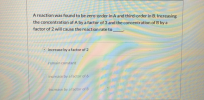 Areaction was found to be zero-order in A and third-order in B. Increasing the concentration of A by a factor of 3 and the concentration of B by a factor of 2 will cause the reaction rate to increase by a factor of 2 remain constant increase by a factor of 6 increase by a factor of 8
Review | Constants Periodic Table Leaming Goal: To understand reaction order and rate constants. For the...
 Review | Constants Periodic Table Leaming Goal: To understand reaction order and rate constants. For the general equation A+B+C+ dD. the rate law is expressed as follows: ratek AB" where mand n indicate the order of the reaction with respect to each reactant and must be determined experimentally and kis the rate constant, which is specific to each reaction Order For a particular reaction, aA +bB+CD the rate law was experimentally determined to be rate - KABC -- EBC2 A....
A reaction is found to be 0th order with respect to thiosulfate ion. If the concentration...
A reaction is found to be 0th order with respect to thiosulfate ion. If the concentration of thiosulfate ion is 0.159M after 20.5 seconds have passed, and the rate law constant is 0.0175 M/sec, what was the initial concentration of thiosulfate ion?
A reaction is found to be 2nd order with respect to cyanide ion. If the concentration...
A reaction is found to be 2nd order with respect to cyanide ion. If the concentration of cyanide ion is 0.175M after 16.9 seconds have passed, and the rate law constant is 0.0201 M/sec, what was the initial concentration of cyanide ion?
a reaction is second order with respect to one of its reactants. By what factor will...
a reaction is second order with respect to one of its reactants. By what factor will the rate increase if the reactant concentration is tripled and all the other reactants are held constant. explain
The reaction A+B → products was found to have the rate law; rate = k[A][B]2. While...
 The reaction A+B → products was found to have the rate law; rate = k[A][B]2. While holding the concentration of B constant, the concentration of A was increased from 0.010M to 0.030M. Predict by what factor the rate of reaction will increase. Select one: a. 9 b.3 c. No effect d. 16 e. 6
Increasing the concentration of a reactiong four times increases the rate of the reation by four...
Increasing the concentration of a reactiong four times increases the rate of the reation by four times. what is the order of the reaction with respect to that reactant ? A) zero B) second C) third D) first Explain.
The order of each reactant in the following reaction was determined by varying concentration and measuring...
The order of each reactant in the following reaction was determined by varying concentration and measuring the change in rate. 2NO(g)+Cl2(g)→2NOCl(g)2NO(g)+Cl2(g)→2NOCl(g) When the concentration of NONO was doubled while the concentration of Cl2Cl2 was held constant, the rate increased by a factor of 2. In a separate experiment, when the concentration of Cl2Cl2 was halved while the concentration of NONO was held constant, the rate decreased by a factor of 4. What is the overall reaction order? Express your answer...
The half-life of a reaction, t1/2, is the time it takes for the reactant concentration [A]...
 The half-life of a reaction,
t1/2, is the time it takes for the reactant concentration [A] to
decrease by half. For example, after one half-life the
concentration falls from the initial concentration [A]0 to [A]0/2,
after a second half-life to [A]0/4, after a third half-life to
[A]0/8, and so on. on. For a first-order reaction, the half-life is
constant. It depends only on the rate constant k and not on the
reactant concentration. It is expressed as t1/2=0.693k For a...
The half-life of a reaction,
t1/2, is the time it takes for the reactant concentration [A] to
decrease by half. For example, after one half-life the
concentration falls from the initial concentration [A]0 to [A]0/2,
after a second half-life to [A]0/4, after a third half-life to
[A]0/8, and so on. on. For a first-order reaction, the half-life is
constant. It depends only on the rate constant k and not on the
reactant concentration. It is expressed as t1/2=0.693k For a...
The reaction A + 2B → Products was studied and found to have the rate law:...
The reaction A + 2B → Products was studied and found to have the rate law: Rate = k[A][B]2. By what factor will the rate increase if the concentration of B is tripled while the concentration of A is held constant?
 Areaction was found to be zero-order in A and third-order in B. Increasing the concentration of A by a factor of 3 and the concentration of B by a factor of 2 will cause the reaction rate to increase by a factor of 2 remain constant increase by a factor of 6 increase by a factor of 8
 Review | Constants Periodic Table Leaming Goal: To understand reaction order and rate constants. For the general equation A+B+C+ dD. the rate law is expressed as follows: ratek AB" where mand n indicate the order of the reaction with respect to each reactant and must be determined experimentally and kis the rate constant, which is specific to each reaction Order For a particular reaction, aA +bB+CD the rate law was experimentally determined to be rate - KABC -- EBC2 A....
 The reaction A+B → products was found to have the rate law; rate = k[A][B]2. While holding the concentration of B constant, the concentration of A was increased from 0.010M to 0.030M. Predict by what factor the rate of reaction will increase. Select one: a. 9 b.3 c. No effect d. 16 e. 6
 The half-life of a reaction,
t1/2, is the time it takes for the reactant concentration [A] to
decrease by half. For example, after one half-life the
concentration falls from the initial concentration [A]0 to [A]0/2,
after a second half-life to [A]0/4, after a third half-life to
[A]0/8, and so on. on. For a first-order reaction, the half-life is
constant. It depends only on the rate constant k and not on the
reactant concentration. It is expressed as t1/2=0.693k For a...
The half-life of a reaction,
t1/2, is the time it takes for the reactant concentration [A] to
decrease by half. For example, after one half-life the
concentration falls from the initial concentration [A]0 to [A]0/2,
after a second half-life to [A]0/4, after a third half-life to
[A]0/8, and so on. on. For a first-order reaction, the half-life is
constant. It depends only on the rate constant k and not on the
reactant concentration. It is expressed as t1/2=0.693k For a...
Most questions answered within 3 hours.
-
Where is the error in this code sequence?
String s1 = "Hello";
String s2 = "ello";...
asked 10 months ago -
Financial data for Joel de Paris, Inc., for last year
follow:
Joel de Paris, Inc.
Balance...
asked 10 months ago -
Consider this reaction:
Al2(SO4)3 (aq)+ BaCl3
(aq) Al2Cl6 (aq)- +
3BaSO4(s) . What is the...
asked 10 months ago -
Suppose that Savneet is considering increasing her
recent random sample from 20 car rentals to 40...
asked 10 months ago -
Trucks arrive at an unloading terminal at an average rate of 120
per hour.
Trucks arrive...
asked 10 months ago -
Why are methanol and ethanol completely soluble in water while
octanol is not very little soluble....
asked 10 months ago -
A facilities manager at a university reads in a research report
that the mean amount of...
asked 10 months ago -
When the CuSO4 is rehydrated by adding water to the anhydrous
compound, is this an endothermic...
asked 10 months ago -
A ray of sunlight is passing from diamond into crown glass; the
angle of incidence is...
asked 10 months ago -
A block of mass 0.249 kg is placed on top of a light, vertical
spring of...
asked 10 months ago -
how do the kidneys compensate in the presences of acidosis
a) trigger hyperventilate
b) reserve acid...
asked 10 months ago -
Question 501 pts
The rental rate of capital to the firm increases. Which of the
following...
asked 10 months ago