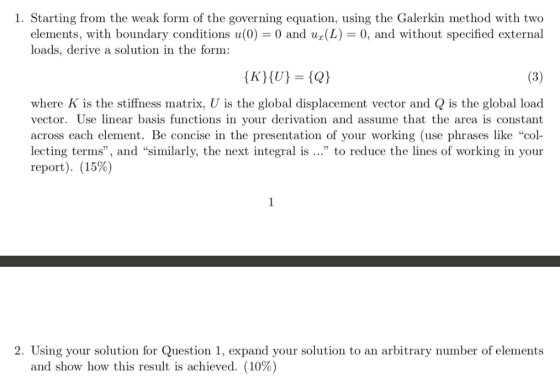
1. Starting from the weak form of the governing equation, using the Galerkin method with two elements, with boundary conditions u(0)-0 and uz(L) = 0, and without specified external loads, derive a solution in the form: where K is the stiffness matrix, U is the global displacement vector and Q is the global load vector. Use linear basis functions in your derivation and assume that the area is constant across each element. Be concise in the presentation of your working (use phrases like "col- lecting terms", and "similarly, the next integral is ..." to reduce the lines of working in your report). (15%) 2. Using your solution for Question 1, expand your solution to an arbitrary number of elements and show how this result is achieved. (10%)
Homework Answers
Add Answer to:
Section 1: Finite Element Derivation and Validation In this section of the report you will develop your own Finite Elem...
Section 1: Finite Element Derivation and Validation In this section of the report you will develop your own Finite Elem...
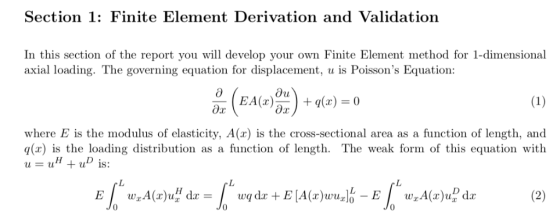
 Section 1: Finite Element Derivation and Validation In this section of the report you will develop your own Finite Element method for 1-dimensional axial loading. The governing equation for displacement, u is Poisson's Equation: อั1 where E is the modulus of elasticity, A(a) is the cross-sectional area as a function of length, and q(x) is the loading distribution as a function of length. The weak form of this equation with 0 1. Starting from the weak form of the governing...
Answer #1 EM 4123/6123: Introduction to Finite Element Methods: Assignment 2 Assigned: Jan. 23, 2019, Due:...
 Answer #1
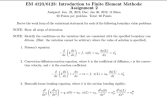
EM 4123/6123: Introduction to Finite Element Methods: Assignment 2 Assigned: Jan. 23, 2019, Due: Jan 30, 2019, 11.00am 20 Points per problem. Total: 60 Points Derive the weak form of the variational statement for each of the following boundary value problems NOTE: Show all steps of derivation NOTE: Identify the conditions on the variation that are consistent with the specified boundary con- ditions. (Hint: the variation cannot be arbitrary where the value of solution is specified) 1. Poisson's...
Answer #1
EM 4123/6123: Introduction to Finite Element Methods: Assignment 2 Assigned: Jan. 23, 2019, Due: Jan 30, 2019, 11.00am 20 Points per problem. Total: 60 Points Derive the weak form of the variational statement for each of the following boundary value problems NOTE: Show all steps of derivation NOTE: Identify the conditions on the variation that are consistent with the specified boundary con- ditions. (Hint: the variation cannot be arbitrary where the value of solution is specified) 1. Poisson's...
need to solve the mathematical model to prove that we can get the equations i Q1...
 need to solve the mathematical model to prove
that we can get the equations i Q1 a methematically
please use only the weighted resedual and gerkins
methods to prove it
1. A metal bar of length, L = 100 mm, and a constant cross-sectional area of A = 10 mm? is shown in figure Q1. The bar material has an elastic modulus, E = 200,000 N/mm2 with an applied load P at one end. The governing equation for elastostatic problems...
need to solve the mathematical model to prove
that we can get the equations i Q1 a methematically
please use only the weighted resedual and gerkins
methods to prove it
1. A metal bar of length, L = 100 mm, and a constant cross-sectional area of A = 10 mm? is shown in figure Q1. The bar material has an elastic modulus, E = 200,000 N/mm2 with an applied load P at one end. The governing equation for elastostatic problems...
Q1 An elastic cantilever beam of varying cross section, as shown in Figure Q1(a), is subjected...
 Q1 An elastic cantilever beam of varying cross section, as shown in Figure Q1(a), is subjected to an increase in temperature of 60°C in an unnatural environment. The equation governing the displacement of the elastic column and the finite element stiffness matrix are respectively given as -O and ΑΕ) - where A is the cross sectional area of the beam, E is the Young's modulus of the beam material, u is the displacement and / is the finite element length....
(40 pts) 2a. Show that u(z) is the solution to the problem where k(x)-1 for x < 1/2 and k = 2 for...
 (40 pts) 2a. Show that u(z) is the solution to the problem where k(x)-1 for x < 1/2 and k = 2 for x > 1 /2. 2b. Set up the weak form for the differential equation above and the resulting element stiffness and element load vector and calculate the element stiffness matrix and load vector for 4 quadratic elements by using the Gaussian quadrature that is going to exactly calculate the integrals Then set up the global K and...
Section 4.4 Finite Element Formulation of Frames 235 256 of 929 where the transformation matrix is...
 Section 4.4 Finite Element Formulation of Frames 235 256 of 929 where the transformation matrix is sine cose 0 0 0 0 0 sine 0 0 0 -sine cose 0 0 In the previous section, we developed the stines matributed to bending for a beancement. This matracounts for lateral deplacements and rotaties teach mode andis TO 0 0 0 60-126 0 0 0 0 0 LO 621041 To represent the contribution of each term to nodal degrees of freedom, the...
Exercise 2: Finite element method We are interested in computing numerically the solution to a 2D...
 Exercise 2: Finite element method We are interested in computing numerically the solution to a 2D Laplace equation u 0, The triangulated domain is given in the file mesh.mat on Blackboard. which contains the V × 2 nnatrix vertices storing the two coordinates of the vertices and a F × 3 matrix triangles in which each ro w J contains the indices in {1,····V) of the three vertices of the j-th triangle. a) Using for example MATLAB's triplot or trimesh...
solve problem #1 depending on the given information Consider the following 1D second order elliptic equation with Dirichlet boundary conditions du(x) (c(x)du ) = f(x) (a $15 b), u(a) = ga, u(b) = gb...
 solve problem #1 depending on the given information
Consider the following 1D second order elliptic equation with Dirichlet boundary conditions du(x) (c(x)du ) = f(x) (a $15 b), u(a) = ga, u(b) = gb dr: where u(x) is the unknown function, ga and gb are the Dirichlet boundary values, c(x) is a given coefficient function and f(x) is a given source function. See the theorem 10.1 in the textbook for the existence and uniqueness of the solution. 1.1 Weak Formulation...
solve problem #1 depending on the given information
Consider the following 1D second order elliptic equation with Dirichlet boundary conditions du(x) (c(x)du ) = f(x) (a $15 b), u(a) = ga, u(b) = gb dr: where u(x) is the unknown function, ga and gb are the Dirichlet boundary values, c(x) is a given coefficient function and f(x) is a given source function. See the theorem 10.1 in the textbook for the existence and uniqueness of the solution. 1.1 Weak Formulation...
Problem 1 (Section 6.3) Starting with the finite difference expressions for the partial derivatives, re-derive the forward Euler method for the heat equation with an extra nonlinear term: u(0,t)- u(1...
 Problem 1 (Section 6.3) Starting with the finite difference expressions for the partial derivatives, re-derive the forward Euler method for the heat equation with an extra nonlinear term: u(0,t)- u(1t)-0 Then, find the solution over three time steps (i.e. find the twelve vawith 3 decimal digits of precision, assuming k = 1, γ=2, M = 0.01, L = 1 and N=5, with initial condition u a table to show your results. It is strongly recommended that you write a short...
need to solve the mathematical model to prove that we can get the equations i Q1...
 need to solve the mathematical model to prove
that we can get the equations i Q1 a methematically
QI. A vertical pile is used to transfer the vertical load from the soft ground surface to the rock surface. It is assumed that the stiffness of the rock is sufficient to prevent any vertical displacement so that the lower edge of the rod may be considered as fixed. The soft ground acts on the pile along its length with a force...
need to solve the mathematical model to prove
that we can get the equations i Q1 a methematically
QI. A vertical pile is used to transfer the vertical load from the soft ground surface to the rock surface. It is assumed that the stiffness of the rock is sufficient to prevent any vertical displacement so that the lower edge of the rod may be considered as fixed. The soft ground acts on the pile along its length with a force...
 Section 1: Finite Element Derivation and Validation In this section of the report you will develop your own Finite Element method for 1-dimensional axial loading. The governing equation for displacement, u is Poisson's Equation: อั1 where E is the modulus of elasticity, A(a) is the cross-sectional area as a function of length, and q(x) is the loading distribution as a function of length. The weak form of this equation with 0 1. Starting from the weak form of the governing...
 Answer #1
EM 4123/6123: Introduction to Finite Element Methods: Assignment 2 Assigned: Jan. 23, 2019, Due: Jan 30, 2019, 11.00am 20 Points per problem. Total: 60 Points Derive the weak form of the variational statement for each of the following boundary value problems NOTE: Show all steps of derivation NOTE: Identify the conditions on the variation that are consistent with the specified boundary con- ditions. (Hint: the variation cannot be arbitrary where the value of solution is specified) 1. Poisson's...
Answer #1
EM 4123/6123: Introduction to Finite Element Methods: Assignment 2 Assigned: Jan. 23, 2019, Due: Jan 30, 2019, 11.00am 20 Points per problem. Total: 60 Points Derive the weak form of the variational statement for each of the following boundary value problems NOTE: Show all steps of derivation NOTE: Identify the conditions on the variation that are consistent with the specified boundary con- ditions. (Hint: the variation cannot be arbitrary where the value of solution is specified) 1. Poisson's...
 need to solve the mathematical model to prove
that we can get the equations i Q1 a methematically
please use only the weighted resedual and gerkins
methods to prove it
1. A metal bar of length, L = 100 mm, and a constant cross-sectional area of A = 10 mm? is shown in figure Q1. The bar material has an elastic modulus, E = 200,000 N/mm2 with an applied load P at one end. The governing equation for elastostatic problems...
need to solve the mathematical model to prove
that we can get the equations i Q1 a methematically
please use only the weighted resedual and gerkins
methods to prove it
1. A metal bar of length, L = 100 mm, and a constant cross-sectional area of A = 10 mm? is shown in figure Q1. The bar material has an elastic modulus, E = 200,000 N/mm2 with an applied load P at one end. The governing equation for elastostatic problems...
 Q1 An elastic cantilever beam of varying cross section, as shown in Figure Q1(a), is subjected to an increase in temperature of 60°C in an unnatural environment. The equation governing the displacement of the elastic column and the finite element stiffness matrix are respectively given as -O and ΑΕ) - where A is the cross sectional area of the beam, E is the Young's modulus of the beam material, u is the displacement and / is the finite element length....
 (40 pts) 2a. Show that u(z) is the solution to the problem where k(x)-1 for x < 1/2 and k = 2 for x > 1 /2. 2b. Set up the weak form for the differential equation above and the resulting element stiffness and element load vector and calculate the element stiffness matrix and load vector for 4 quadratic elements by using the Gaussian quadrature that is going to exactly calculate the integrals Then set up the global K and...
 Section 4.4 Finite Element Formulation of Frames 235 256 of 929 where the transformation matrix is sine cose 0 0 0 0 0 sine 0 0 0 -sine cose 0 0 In the previous section, we developed the stines matributed to bending for a beancement. This matracounts for lateral deplacements and rotaties teach mode andis TO 0 0 0 60-126 0 0 0 0 0 LO 621041 To represent the contribution of each term to nodal degrees of freedom, the...
 Exercise 2: Finite element method We are interested in computing numerically the solution to a 2D Laplace equation u 0, The triangulated domain is given in the file mesh.mat on Blackboard. which contains the V × 2 nnatrix vertices storing the two coordinates of the vertices and a F × 3 matrix triangles in which each ro w J contains the indices in {1,····V) of the three vertices of the j-th triangle. a) Using for example MATLAB's triplot or trimesh...
 solve problem #1 depending on the given information
Consider the following 1D second order elliptic equation with Dirichlet boundary conditions du(x) (c(x)du ) = f(x) (a $15 b), u(a) = ga, u(b) = gb dr: where u(x) is the unknown function, ga and gb are the Dirichlet boundary values, c(x) is a given coefficient function and f(x) is a given source function. See the theorem 10.1 in the textbook for the existence and uniqueness of the solution. 1.1 Weak Formulation...
solve problem #1 depending on the given information
Consider the following 1D second order elliptic equation with Dirichlet boundary conditions du(x) (c(x)du ) = f(x) (a $15 b), u(a) = ga, u(b) = gb dr: where u(x) is the unknown function, ga and gb are the Dirichlet boundary values, c(x) is a given coefficient function and f(x) is a given source function. See the theorem 10.1 in the textbook for the existence and uniqueness of the solution. 1.1 Weak Formulation...
 Problem 1 (Section 6.3) Starting with the finite difference expressions for the partial derivatives, re-derive the forward Euler method for the heat equation with an extra nonlinear term: u(0,t)- u(1t)-0 Then, find the solution over three time steps (i.e. find the twelve vawith 3 decimal digits of precision, assuming k = 1, γ=2, M = 0.01, L = 1 and N=5, with initial condition u a table to show your results. It is strongly recommended that you write a short...
 need to solve the mathematical model to prove
that we can get the equations i Q1 a methematically
QI. A vertical pile is used to transfer the vertical load from the soft ground surface to the rock surface. It is assumed that the stiffness of the rock is sufficient to prevent any vertical displacement so that the lower edge of the rod may be considered as fixed. The soft ground acts on the pile along its length with a force...
need to solve the mathematical model to prove
that we can get the equations i Q1 a methematically
QI. A vertical pile is used to transfer the vertical load from the soft ground surface to the rock surface. It is assumed that the stiffness of the rock is sufficient to prevent any vertical displacement so that the lower edge of the rod may be considered as fixed. The soft ground acts on the pile along its length with a force...
Most questions answered within 3 hours.
-
Where is the error in this code sequence?
String s1 = "Hello";
String s2 = "ello";...
asked 11 months ago -
Financial data for Joel de Paris, Inc., for last year
follow:
Joel de Paris, Inc.
Balance...
asked 11 months ago -
Consider this reaction:
Al2(SO4)3 (aq)+ BaCl3
(aq) Al2Cl6 (aq)- +
3BaSO4(s) . What is the...
asked 11 months ago -
Suppose that Savneet is considering increasing her
recent random sample from 20 car rentals to 40...
asked 11 months ago -
Trucks arrive at an unloading terminal at an average rate of 120
per hour.
Trucks arrive...
asked 11 months ago -
Why are methanol and ethanol completely soluble in water while
octanol is not very little soluble....
asked 11 months ago -
A facilities manager at a university reads in a research report
that the mean amount of...
asked 11 months ago -
When the CuSO4 is rehydrated by adding water to the anhydrous
compound, is this an endothermic...
asked 11 months ago -
A ray of sunlight is passing from diamond into crown glass; the
angle of incidence is...
asked 11 months ago -
A block of mass 0.249 kg is placed on top of a light, vertical
spring of...
asked 11 months ago -
how do the kidneys compensate in the presences of acidosis
a) trigger hyperventilate
b) reserve acid...
asked 11 months ago -
Question 501 pts
The rental rate of capital to the firm increases. Which of the
following...
asked 11 months ago