


Lab 9: Paper Chromatography Adapted from: "Chemical Principles in the Laboratory" by Slowinski and Wolsey Materials 600-mL beaker Whatman paper - 0.1 M each silver nitrate, cobalt (II) nitrate, copper (II) nitrate, iron III nitrate, and mercury (II) nitrate Running solution (500 mL 6.0M HC1, 400 mL ethanol, and 400 mL n-butanol) Developing solution in a spray bottle (8.0 g potassium ferrocyanide and 3.5 g potassium iodide in 1.0 L of solution) - Capillary tubes Objectives: To identify metal cations in an unknown solution Background: Chromatography is defined as the separation of mixtures into their constituents by preferential adsorption by a solid, as a column of silica or a strip of filter paper. This field of separation science is one of the most important in science today. This technique is the basis for identifying the substances present in a newly discovered plant for drug research, for identifying the components of an unknown mixture by a forensic laboratory and to understand the products of a chemical reaction when performing chemical research. Chromatography in its many forms is one of the tools of the analytical chemist In this experiment, you will perform paper chromatography of metal cations. You will use known solutions of cations to determine the composition of an unknown mixture. You will use several methods to develop and identify the cations on the paper substrate. Chromatography takes a number of forms in the modern laboratory high-performance liquid chromatography (HPLC), gas-liquid chromatography (GLC), column chromatography, thin-layer chromatography (TLC), and paper chromatography, to name the most common. All of these techniques have elements in common that give rise to the separation of the compounds in a mixture
In 1906, Mikhail Semenovich Tswett, a Russian botanist, is credited with the first experimental work in this field. Tswett extracted the compounds responsible for the green color of leaves using ether and passed the extract through a column packed with CaCO (white chalk). The separated compounds appeared as colored bands on the column, thus the name chromatography For this technique to work the compounds do not need to be colored, most are in fact colorless compounds. There are a variety of ways to detect the position of the compound on the substrate and/or collect it when it flows off the substrate in the solvent. Two factors are common to chromatography: the movement and interaction of the sample through the substrate (solid phase) by a mobile phase (gas or liquid phase). The sample mixture of substances to be separated is placed in a very small spot on the substrate. The substrate is then treated with a mobile (gas/liquid) phase to begin the movement of the sample across or through the substrate. The liquid phase is composed of a mixture of solvents or a pure solvent in which the components of the sample to be separated are partially soluble. Components that are not soluble will be left in the original location of the sample on the substrate. The solid phase particles or material will interact with the sample and hold onto the molecules to varying degrees. The components of the sample mixture will have differing solubility in the liquid phase and varying attraction to the substrate. As the liquid phase moves through the substrate the molecules that are alike will tend to form a band and become separated from other molecules in the mixture. Some components of the mixture will quickly flow through the substrate. Others will move more slowly. In this way, the sample will be separated into its components. To quantify the separation and give a measure that can be used to identify a compound, a mathematical function called the retention factor, Rf, has been defined. distance traveled by spot distance traveled by solvent The Rf value will vary with different substrates and solvent mixtures. For a comparison to be made, conditions must be controlled, i.e., the substrate and solvent system must be the same as well as the temperature. To reduce variations, a known sample is generally analyzed at the same time as an unknown. When the chromatogram is analyzed afterward, a direct comparison can be made between the unknown and the known samples. Ifa component appears in the same area of the substrate in both samples, the scientist will know what particular compound is present in the unknown You will be using paper chromatography to separate a mixture of metal cations. The paper substrate will be spotted with known solutions of cations and several unknown mixtures of cations. The solvent will be a mixture of concentrated hydrochloric acid, ethanol, and butanol. A developing solution will be used to bring out hidden spots on the paper. The known spots will be used to determine the composition of the unknown.
Procedure: Prepare a developing chamber by obtaining a CLEAN, DRY 600mL beaker, plastic wrap, a rubber band, and approximately 10 mL of the prepared running solution. Pour the solvent carefully into the bottom of the beaker and immediately cover with the plastic wrap secured with a rubber band. The solvent will saturate the atmosphere inside the beaker while you prepare the paper Obtain a piece of Whatman #1 filter paper 10 cm x 20 cm. Be careful to handle the paper by the edges ONLY! Fingerprints will be visible on the surface of the paper after developing has taken place. Using a PENCIL, mark a line about 1.5 cm from one of the 20 cm long sides of the paper. You must use a pencil for all marks because ink is a mixture of compounds that is soluble in the solvent that will be used. You would end up with a chromatogram of the ink. Make marks at 1 cm intervals along the line you just drew. Below the line, label the eight marks for the five cations being investigated (Ag', Co2, Cu Fe, Hg and the unknowns (UI, U2, and U3). See figure below Using the sample bottles provided and the associated capillary pipette, make a small spot of the solution at each of the labeled marks on the paper. The spot should be kept as small as possible to prevent the bleeding together of the substances on the paper as they move with the solvent. A separate capillary pipette must be used for each solution. If there is any doubt about which solution a pipette was used form, discard it and obtain a new one. Once the spots have been placed on the paper, carefully pick up the paper and wave it in the air to evaporate the water solvent used for the cation solutions. You must not start the chromatography process until ALL of the water has evaporated. Water will interfère with the interaction between the cations and the solvent. Once the water is gone, the paper and staple the edges together as shown by your instructor. The edges of the paper must make a cylinder with NOT touch each other Quickly remove the plastic wrap from the 600 mL beaker and lay the circular chromatogram on the bottom of the beaker with the spots at the bottom. The pool of solvent must not reach the
level of the spotted chemicals on the paper. The paper must also not touch the walls of the beaker Watch the beaker as the solvent front moves up the paper toward the top of the beaker. When the solvent has reached within 1.5 cm of the top of the paper, open the beaker and remove the chromatogram. With your PENCIL, mark the paper where the solvent front reached along the top. While they are still visible, mark as many of the cation spots as possible by outlining them with your pencil and indicating the color. Allow the paper to completely dry in the air. If the odor bothers you, go to the fume hood and wave the paper (holding it by the edge) through the air to increase the evaporation of the solvent After the chromatogram is dry, spray with the developing solution and mark any spots that appear. Be sure to note the color of the spots. Allow the chromatogram to dry completely again and measure the distance the solvent front moved (from the 1.5 cm baseline at the bottom). Then, measure the distance that each cation spots has moved from the starting baseline. Calculate the Rr value for each of the known cations and for the spots found for each of the unknowns. By comparing colors and Rr values you should be able to determine the composition of each of the unknowns
Homework Answers
Add Answer to:
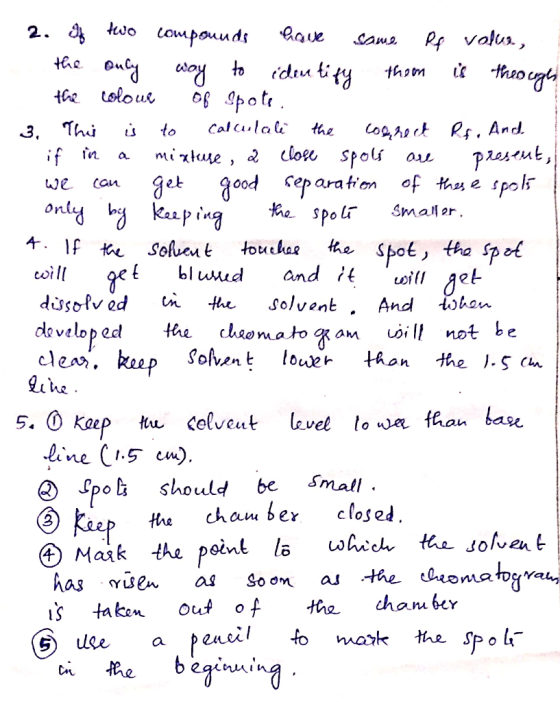
2. If two different compounds have the same Rr value, how might they be identified using paper chromatography?...
You are given a sample of several compounds to separate by paper chromatography. You draw a...
You are given a sample of several compounds to separate by paper chromatography. You draw a pencil line exactly 1.0 cm from the bottom of the paper, and place a spot of sample on it. You dry the sample, then develop it in a solvent. When the chromatogram is taken out of the solvent, the paper is wet up to 9.0 cm from the bottom of the sheet. The compound you are interested in shows up as a spot 7.3...
Can someone please help me out with the Rf value PLEASE!! Thin Layer Chromatography Procedures 1)...
 Can someone please help me out with the Rf value
PLEASE!!
Thin Layer Chromatography Procedures 1) Prepare a solvent solution in a 150 mL beaker by using 5 mL of Hexane and 3 mL of ethyl acetate Take one plate and spot (small spots) it with the three different standard solutions given. The standard solutions are 2-nitroaniline, 3-nitroaniline, and 4-nitroaniline. The fourth spot will be the unknown sample obtained. 2) 3) Align these spots at 1 cm from the bottom...
Can someone please help me out with the Rf value
PLEASE!!
Thin Layer Chromatography Procedures 1) Prepare a solvent solution in a 150 mL beaker by using 5 mL of Hexane and 3 mL of ethyl acetate Take one plate and spot (small spots) it with the three different standard solutions given. The standard solutions are 2-nitroaniline, 3-nitroaniline, and 4-nitroaniline. The fourth spot will be the unknown sample obtained. 2) 3) Align these spots at 1 cm from the bottom...
Pre-Lab Question a) What is chromatography? What is the origin of the name? b) What is...
Pre-Lab Question a) What is chromatography? What is the origin of the name? b) What is the Rf value and how is it calculated? c) How is the Rf value used to identify the components in a mixture? d) Why must spots on the paper not be allowed to touch the solvent in the bottom of the developing chamber (600 mL beaker)?
Case C Thin Layer Chromatography 1. TOXI-LAB is a screening method that uses: chromatography (column /...
 Case C Thin Layer Chromatography 1. TOXI-LAB is a screening method that uses: chromatography (column / planar) The first step consists of the extraction of drug metabolites from biological fluids when we place the sample in a test tube containing a mixture of solvents and buffering salts that cause the extraction of basic and neutral drugs. The solvent extract of the sample is concentrated by heat and evaporation, then is deposited onto a small disc of chromatographic media (small circle...
PRELABORATORY ASSIGNMENT 1. Provide the key term that corresponds to each of the following definitions. (a)...
 PRELABORATORY ASSIGNMENT 1. Provide the key term that corresponds to each of the following definitions. (a) the study of compounds derived from plants and animals (b) a method for separating a mixture into its components as a result of a varying attraction of compounds for a mobile solvent on a stationary solid (c) the leading edge of the solvent, which travels from the bottom of the developing chamber to the upper portion of the chromatogram (d) refers to solvent that...
A mixture of two compounds (A and B) was separated by gas chromatography on a non-polar...
A mixture of two compounds (A and B) was separated by gas chromatography on a non-polar column. The chromatogram was recorded on a chart recorder that fed paper at a constant speed of 100 mm per minute, and a mark was made on the chart when the sample was injected. The first peak on the chromatogram corresponds to compound A, and that peak was observed at a distance of 5.42 cm from the sample injection point, and it had a...
Question 5 (0.5 points) A certain compound is spotted on the starting line of a small paper chromatogram and that same compound is spotted again on a much larger paper chromatogram. Both papers...
 Question 5 (0.5 points) A certain compound is spotted on the starting line of a small paper chromatogram and that same compound is spotted again on a much larger paper chromatogram. Both papers are developed using the same solvent and are pulled out when the solvent is 2 cm from the top. Which statement is true regarding the R of the spot after development? C) The spot on the larger paper should have a higher Rf because the spot travels...
2. An unknown compound was analyzed using thin layer chromatography, its constituted of two components (A...
 2. An unknown compound was analyzed using thin layer chromatography, its constituted of two components (A and B) as shown in the TLC (Silica coated stationary phase; Chloroform and Ethyl acetate as mobile phase). The mixture was then loaded onto column with silica as the stationary phase and the same solvent system was used. (2 points) Column Chromatography TLC time A В Predict the order of elution of the compounds (A and B). which one would be eluted first/last and...
Table 2: Alcohol and Ketone Standards GC Retention Times GC#: Retention time Alcohol Standard Mixture Phent...
 Table 2: Alcohol and Ketone Standards GC Retention Times GC#: Retention time Alcohol Standard Mixture Phent ion= 2.05Smin low Peak 1 Compound Name: athanol Rapesnal utanal aclapeatanal 4.755min oilng 6.895min .230 min Peak 2 Compound Name: Peak 3 Compound Name: Peak 4 Compound Name: GC#:1 Ketone Standard Mixture Retention time 2.575un Peak 1 Compound Name: Acclono Butanon a Pentanone 2tHex anon Peak 2 Compound Name: min Peak 3 Compound Name: 615 min 1D. 307 min Peak 4 Compound Name: Part...
Place approximately 10 mg of each of the four reference compounds in labeled vials or 10 X 75-mm ...
 can you solve this for me,
please
Place approximately 10 mg of each of the four reference compounds in labeled vials or 10 X 75-mm test tubes and dissolve the samples in a few drops of methanol. In a fifth tube place a quarter of an analgesic tablet and add 1 mL of methanol. Crush the tablet with a rod, stir well, and allow the insoluble material to settle. Note that aspirin is not stable in methanol, so fresh solutions...
can you solve this for me,
please
Place approximately 10 mg of each of the four reference compounds in labeled vials or 10 X 75-mm test tubes and dissolve the samples in a few drops of methanol. In a fifth tube place a quarter of an analgesic tablet and add 1 mL of methanol. Crush the tablet with a rod, stir well, and allow the insoluble material to settle. Note that aspirin is not stable in methanol, so fresh solutions...
 Can someone please help me out with the Rf value
PLEASE!!
Thin Layer Chromatography Procedures 1) Prepare a solvent solution in a 150 mL beaker by using 5 mL of Hexane and 3 mL of ethyl acetate Take one plate and spot (small spots) it with the three different standard solutions given. The standard solutions are 2-nitroaniline, 3-nitroaniline, and 4-nitroaniline. The fourth spot will be the unknown sample obtained. 2) 3) Align these spots at 1 cm from the bottom...
Can someone please help me out with the Rf value
PLEASE!!
Thin Layer Chromatography Procedures 1) Prepare a solvent solution in a 150 mL beaker by using 5 mL of Hexane and 3 mL of ethyl acetate Take one plate and spot (small spots) it with the three different standard solutions given. The standard solutions are 2-nitroaniline, 3-nitroaniline, and 4-nitroaniline. The fourth spot will be the unknown sample obtained. 2) 3) Align these spots at 1 cm from the bottom...
 Case C Thin Layer Chromatography 1. TOXI-LAB is a screening method that uses: chromatography (column / planar) The first step consists of the extraction of drug metabolites from biological fluids when we place the sample in a test tube containing a mixture of solvents and buffering salts that cause the extraction of basic and neutral drugs. The solvent extract of the sample is concentrated by heat and evaporation, then is deposited onto a small disc of chromatographic media (small circle...
 PRELABORATORY ASSIGNMENT 1. Provide the key term that corresponds to each of the following definitions. (a) the study of compounds derived from plants and animals (b) a method for separating a mixture into its components as a result of a varying attraction of compounds for a mobile solvent on a stationary solid (c) the leading edge of the solvent, which travels from the bottom of the developing chamber to the upper portion of the chromatogram (d) refers to solvent that...
 Question 5 (0.5 points) A certain compound is spotted on the starting line of a small paper chromatogram and that same compound is spotted again on a much larger paper chromatogram. Both papers are developed using the same solvent and are pulled out when the solvent is 2 cm from the top. Which statement is true regarding the R of the spot after development? C) The spot on the larger paper should have a higher Rf because the spot travels...
 2. An unknown compound was analyzed using thin layer chromatography, its constituted of two components (A and B) as shown in the TLC (Silica coated stationary phase; Chloroform and Ethyl acetate as mobile phase). The mixture was then loaded onto column with silica as the stationary phase and the same solvent system was used. (2 points) Column Chromatography TLC time A В Predict the order of elution of the compounds (A and B). which one would be eluted first/last and...
 Table 2: Alcohol and Ketone Standards GC Retention Times GC#: Retention time Alcohol Standard Mixture Phent ion= 2.05Smin low Peak 1 Compound Name: athanol Rapesnal utanal aclapeatanal 4.755min oilng 6.895min .230 min Peak 2 Compound Name: Peak 3 Compound Name: Peak 4 Compound Name: GC#:1 Ketone Standard Mixture Retention time 2.575un Peak 1 Compound Name: Acclono Butanon a Pentanone 2tHex anon Peak 2 Compound Name: min Peak 3 Compound Name: 615 min 1D. 307 min Peak 4 Compound Name: Part...
 can you solve this for me,
please
Place approximately 10 mg of each of the four reference compounds in labeled vials or 10 X 75-mm test tubes and dissolve the samples in a few drops of methanol. In a fifth tube place a quarter of an analgesic tablet and add 1 mL of methanol. Crush the tablet with a rod, stir well, and allow the insoluble material to settle. Note that aspirin is not stable in methanol, so fresh solutions...
can you solve this for me,
please
Place approximately 10 mg of each of the four reference compounds in labeled vials or 10 X 75-mm test tubes and dissolve the samples in a few drops of methanol. In a fifth tube place a quarter of an analgesic tablet and add 1 mL of methanol. Crush the tablet with a rod, stir well, and allow the insoluble material to settle. Note that aspirin is not stable in methanol, so fresh solutions...
Most questions answered within 3 hours.
-
Where is the error in this code sequence?
String s1 = "Hello";
String s2 = "ello";...
asked 11 months ago -
Financial data for Joel de Paris, Inc., for last year
follow:
Joel de Paris, Inc.
Balance...
asked 11 months ago -
Consider this reaction:
Al2(SO4)3 (aq)+ BaCl3
(aq) Al2Cl6 (aq)- +
3BaSO4(s) . What is the...
asked 11 months ago -
Suppose that Savneet is considering increasing her
recent random sample from 20 car rentals to 40...
asked 11 months ago -
Trucks arrive at an unloading terminal at an average rate of 120
per hour.
Trucks arrive...
asked 11 months ago -
Why are methanol and ethanol completely soluble in water while
octanol is not very little soluble....
asked 11 months ago -
A facilities manager at a university reads in a research report
that the mean amount of...
asked 11 months ago -
When the CuSO4 is rehydrated by adding water to the anhydrous
compound, is this an endothermic...
asked 11 months ago -
A ray of sunlight is passing from diamond into crown glass; the
angle of incidence is...
asked 11 months ago -
A block of mass 0.249 kg is placed on top of a light, vertical
spring of...
asked 11 months ago -
how do the kidneys compensate in the presences of acidosis
a) trigger hyperventilate
b) reserve acid...
asked 11 months ago -
Question 501 pts
The rental rate of capital to the firm increases. Which of the
following...
asked 11 months ago