Which of the following molecules has bonding that can be described as an sp2-sp2 σσ-overlap and one p-p ππ-overlap using...
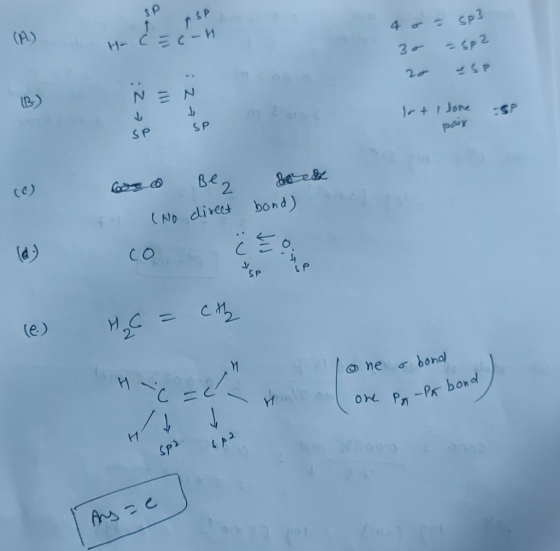
Which of the following molecules has bonding that can be described as an sp2-sp2 σσ-overlap and one p-p ππ-overlap using Valence Bond Theory? Do not consider bonds to hydrogen.
a. HCCH
b. N22
c. Be22
d. CO
e. H22CCH2
Homework Answers
Add Answer to:
Which of the following molecules has bonding that can be described as an sp2-sp2 σσ-overlap and one p-p ππ-overlap using...
What kind of molecular orbital for a diatomic molecule is represented by the drawing shown? Select...
 What kind of molecular orbital for a diatomic molecule is represented by the drawing shown? Select one: a. op ob. 02p C. Tt2p O d. tip e. 02 Which of the following molecules has bonding that can be described as an sp2-sp? o-overlap and one p-p 1-overlap using Valence Bond Theory? Do not consider bonds to hydrogen. Select one: a. N2 b. HCCH c. H2CCH2 d. Bez e. CO
How is the bonding in the CO molecule best described using Valence Bond Theory? Select one: a. s-p o-overlap only b. s-...
 How is the bonding in the CO molecule best described using Valence Bond Theory? Select one: a. s-p o-overlap only b. s-s o-overlap only c. p-p o-overlap only d. p-p o-overlap and two p-p A-Overlaps e. p-p o-overlap and one p-p n-overlap Which of the following is polar (has a net dipole moment)? Select one: а. [AsO,]3- b. XeF4 с. PBГ3 d. PF5 e. [SeO4]2 Which of the following has a central atom that adopts sp2 hybridization? Select one: a....
A sigma bond is best described as the end-to-end overlap of two orbitals with a pair...
 A sigma bond is best described as the end-to-end overlap of two orbitals with a pair of electrons in the overlap region the side-to-side overlap of two orbitals with a pair of electrons in the overlap region the end-to-end overlap results in a bond with the electron density above and below the bond axis. the side-to-side overlap results in a bond with the electron density along the bond axis a bond whose rotation results in differential overlap of the bonding...
1. What is the dominant term in ionic bonding? a. Electronegativity b. Coulombic Attraction c. Bond...
1. What is the dominant term in ionic bonding? a. Electronegativity b. Coulombic Attraction c. Bond Dissociation d. Electron affinity 2.Which cannot exceed an octet in the Lewis structure of a molecule? a. P b. S c. C d. Xe 3. Considering electronegativity, CCl4 should have a. nonpolar covalent bonds b. polar covalent bonds with a partial negative on Cl c. polar covalent bonds with a partial positive on Cl d. ionic bonds 4. A pi bond in valence bond...
Continuous p orbital overlap requires sp or sp2 hybridized orbitals, which leaves an unhybridized p orbital...
 Continuous p orbital overlap
requires sp or sp2 hybridized
orbitals, which leaves an unhybridized p orbital on
successive carbon atoms for overlap. It also requires that the
p orbitals lie in the same plane such that the p
orbitals are parallel to one another. Using your knowledge of
molecular orbitals, determine which of the following structures has
a continuous ring of overlapping p orbitals.
Continuous p orbital overlap
requires sp or sp2 hybridized
orbitals, which leaves an unhybridized p orbital on
successive carbon atoms for overlap. It also requires that the
p orbitals lie in the same plane such that the p
orbitals are parallel to one another. Using your knowledge of
molecular orbitals, determine which of the following structures has
a continuous ring of overlapping p orbitals.
Continuous p orbital overlap requires sp or sp2 hybridized orbitals, which leaves an unhybridized p orbital...
 Continuous p orbital overlap requires sp
or sp2 hybridized orbitals, which leaves an unhybridized p orbital
on successive carbon atoms for overlap. It also requires that the p
orbitals lie in the same plane such that the p orbitals are
parallel to one another. Using your knowledge of molecular
orbitals, determine which of the following structures has a
continuous ring of overlapping p orbitals.
Continuous p orbital overlap requires sp
or sp2 hybridized orbitals, which leaves an unhybridized p orbital
on successive carbon atoms for overlap. It also requires that the p
orbitals lie in the same plane such that the p orbitals are
parallel to one another. Using your knowledge of molecular
orbitals, determine which of the following structures has a
continuous ring of overlapping p orbitals.
Please explain if the following are true or false and how you got your answer. A....
Please explain if the following are true or false and how you got your answer. A. A molecule which contains polar bonds will always have a dipole moment. B. Valence bond theory explains the bonding in diatomic molecules such as HCl without resortingto the use of hybrid orbitals. C. In molecular orbital theory, combination of two atomic orbitals produces two molecular orbitals. D. In applying molecular orbital theory, the bond order is calculated in the same way as with Lewis...
The hybridization of the central atom in a molecule is described as sp^2. The arrangement in...
 The hybridization of the central atom in a molecule is described as sp^2. The arrangement in space of the hybrid orbitals about that atom is linear. trigonal planar. Tetrahedral. Trigonal bipyramidal. Octahedral. What is the hybridization of Br in BrF_3? sp: sp^2 sp^3 dsp^3 d^2 sp^3 Which of these statements is true? A pi bond is twice as strong as a single bond. At bond has cylindrical symmetry about the bonding axis A double bond consists of a pi bond...
Multiple choice. Please answer all questions 1) Which material can display Van der Waals Bonding? Metals Cer...
Multiple choice. Please answer all questions 1) Which material can display Van der Waals Bonding? Metals Ceramics Metals Molecular Solids Semi-Metals 2) Which type of bonding is a secondary bonding? Metallic Covelant Ionic Pair bonding Van Der Waals 3) What type of bonding do semi-metals have? Ionic Van der Waals Mixed covalent-metallic Covalent Mixed metallic-ionic 4) Which of the following are a primary atomic bond? hybridize valence van der Waals electrical metallic 5) In Hydrogen bonds: highly polar molecules form...
INTERMOLECLAR FORCES WORKSHEET 2. Determine which molecules can hydrogen bond to one another. For molecules that...
 INTERMOLECLAR FORCES WORKSHEET 2. Determine which molecules can hydrogen bond to one another. For molecules that can hydrogen bond, draw a picture of what the hydrogen bonding looks like. (a) NHs (b) CHaF (c) Hso 3. Rank the ollowing molecules in order of increasing boiling point: Nal, co2, CS2, HF, and HaCO. Be sure to give specific reasoning for your order. PAGE 2 OF 5
 What kind of molecular orbital for a diatomic molecule is represented by the drawing shown? Select one: a. op ob. 02p C. Tt2p O d. tip e. 02 Which of the following molecules has bonding that can be described as an sp2-sp? o-overlap and one p-p 1-overlap using Valence Bond Theory? Do not consider bonds to hydrogen. Select one: a. N2 b. HCCH c. H2CCH2 d. Bez e. CO
 How is the bonding in the CO molecule best described using Valence Bond Theory? Select one: a. s-p o-overlap only b. s-s o-overlap only c. p-p o-overlap only d. p-p o-overlap and two p-p A-Overlaps e. p-p o-overlap and one p-p n-overlap Which of the following is polar (has a net dipole moment)? Select one: а. [AsO,]3- b. XeF4 с. PBГ3 d. PF5 e. [SeO4]2 Which of the following has a central atom that adopts sp2 hybridization? Select one: a....
 A sigma bond is best described as the end-to-end overlap of two orbitals with a pair of electrons in the overlap region the side-to-side overlap of two orbitals with a pair of electrons in the overlap region the end-to-end overlap results in a bond with the electron density above and below the bond axis. the side-to-side overlap results in a bond with the electron density along the bond axis a bond whose rotation results in differential overlap of the bonding...
 Continuous p orbital overlap
requires sp or sp2 hybridized
orbitals, which leaves an unhybridized p orbital on
successive carbon atoms for overlap. It also requires that the
p orbitals lie in the same plane such that the p
orbitals are parallel to one another. Using your knowledge of
molecular orbitals, determine which of the following structures has
a continuous ring of overlapping p orbitals.
Continuous p orbital overlap
requires sp or sp2 hybridized
orbitals, which leaves an unhybridized p orbital on
successive carbon atoms for overlap. It also requires that the
p orbitals lie in the same plane such that the p
orbitals are parallel to one another. Using your knowledge of
molecular orbitals, determine which of the following structures has
a continuous ring of overlapping p orbitals.
 Continuous p orbital overlap requires sp
or sp2 hybridized orbitals, which leaves an unhybridized p orbital
on successive carbon atoms for overlap. It also requires that the p
orbitals lie in the same plane such that the p orbitals are
parallel to one another. Using your knowledge of molecular
orbitals, determine which of the following structures has a
continuous ring of overlapping p orbitals.
Continuous p orbital overlap requires sp
or sp2 hybridized orbitals, which leaves an unhybridized p orbital
on successive carbon atoms for overlap. It also requires that the p
orbitals lie in the same plane such that the p orbitals are
parallel to one another. Using your knowledge of molecular
orbitals, determine which of the following structures has a
continuous ring of overlapping p orbitals.
 The hybridization of the central atom in a molecule is described as sp^2. The arrangement in space of the hybrid orbitals about that atom is linear. trigonal planar. Tetrahedral. Trigonal bipyramidal. Octahedral. What is the hybridization of Br in BrF_3? sp: sp^2 sp^3 dsp^3 d^2 sp^3 Which of these statements is true? A pi bond is twice as strong as a single bond. At bond has cylindrical symmetry about the bonding axis A double bond consists of a pi bond...
 INTERMOLECLAR FORCES WORKSHEET 2. Determine which molecules can hydrogen bond to one another. For molecules that can hydrogen bond, draw a picture of what the hydrogen bonding looks like. (a) NHs (b) CHaF (c) Hso 3. Rank the ollowing molecules in order of increasing boiling point: Nal, co2, CS2, HF, and HaCO. Be sure to give specific reasoning for your order. PAGE 2 OF 5
Most questions answered within 3 hours.
-
Where is the error in this code sequence?
String s1 = "Hello";
String s2 = "ello";...
asked 10 months ago -
Financial data for Joel de Paris, Inc., for last year
follow:
Joel de Paris, Inc.
Balance...
asked 10 months ago -
Consider this reaction:
Al2(SO4)3 (aq)+ BaCl3
(aq) Al2Cl6 (aq)- +
3BaSO4(s) . What is the...
asked 10 months ago -
Suppose that Savneet is considering increasing her
recent random sample from 20 car rentals to 40...
asked 10 months ago -
Trucks arrive at an unloading terminal at an average rate of 120
per hour.
Trucks arrive...
asked 10 months ago -
Why are methanol and ethanol completely soluble in water while
octanol is not very little soluble....
asked 10 months ago -
A facilities manager at a university reads in a research report
that the mean amount of...
asked 10 months ago -
When the CuSO4 is rehydrated by adding water to the anhydrous
compound, is this an endothermic...
asked 10 months ago -
A ray of sunlight is passing from diamond into crown glass; the
angle of incidence is...
asked 10 months ago -
A block of mass 0.249 kg is placed on top of a light, vertical
spring of...
asked 10 months ago -
how do the kidneys compensate in the presences of acidosis
a) trigger hyperventilate
b) reserve acid...
asked 10 months ago -
Question 501 pts
The rental rate of capital to the firm increases. Which of the
following...
asked 10 months ago