
Homework Answers
![CQ (8) T Wcaq) co (aq) + HOU) - 12003 (aq) Overall rom co, (g) + Holl) - 140₂ (aq) 2. 2 (9) T W cag) Kelto, ca9] = 1.44810- 4](http://img.homeworklib.com/questions/ebca3d20-0820-11ea-acae-6d3ecb380afa.png?x-oss-process=image/resize,w_560)
Add Answer to:
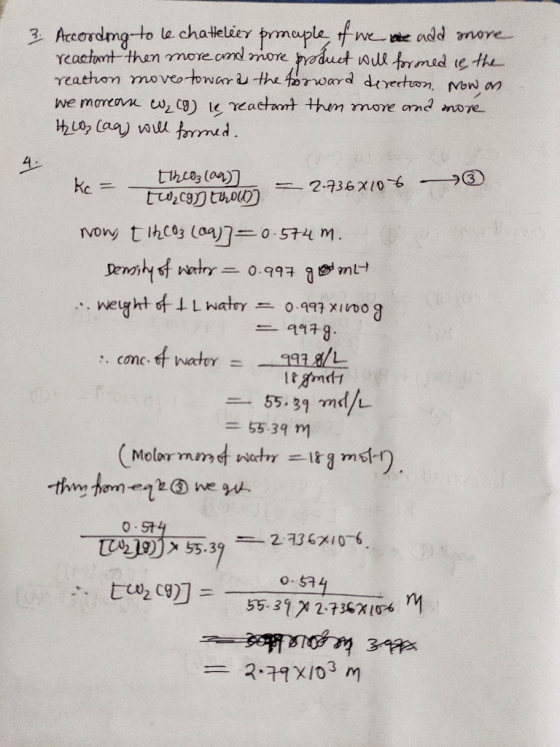
Atmospheric CO2 (g) is in equilibrium with dissolved CO, (aq), CO2(g) CO2 (aq) CO: (aq) then can react with water t...
Reversible reaction to consider: CO2(g) + H2O(l) + Na+(aq)+Cl-(aq)= HCO3(aq) +H+(aq)+Cl-(aq) Note: This reaction models atmospheric CO2...
Reversible reaction to consider: CO2(g) + H2O(l) + Na+(aq)+Cl-(aq)= HCO3(aq) +H+(aq)+Cl-(aq) Note: This reaction models atmospheric CO2 which dissolves in the ocean in a reversible reaction. Answer the following questions: 1. From an equilibrium perspective, what happens to the pH of the ocean when the concentration of CO2 in the atmosphere increases? 2. What affect on equilibrium would occur if some Na is removed from the reaction? 3. If the pH of the ocean was lowered by adding a large quantity...
Carbon dioxide dissolves in water to form carbonic acid, which is primarily dissolved CO2 . Dissolved...
Carbon dioxide dissolves in water to form carbonic acid, which is primarily dissolved CO2 . Dissolved CO2 satisfies the equilibrium equation CO2(g)↽−−⇀CO2(aq)?=0.032 CO 2 ( g ) ↽ − − ⇀ CO 2 ( aq ) K = 0.032 The acid dissociation constants listed in most standard reference texts for carbonic acid actually apply to dissolved CO2 CO 2 . For a CO2 CO 2 partial pressure of 2.6×10⁻⁴ bar 2.6 × 10 − 4 bar in the atmosphere, what...
The solubility of Co, in water at 25 °C and 0.1 atm is 0.0037 M. The...
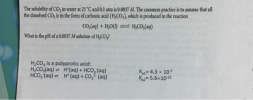 The solubility of Co, in water at 25 °C and 0.1 atm is 0.0037 M. The common practice is to assume that all the dissolved CO is in the form of carbonic acid (H,CO), which is produced in the reaction CO:(aq) + H.0(1) = H2CO3(aq) What is the pH of a 0.0037 M solution of H,CO,? H2CO3 is a polyprotic acid: H.CO(aq) • H'(aq) + HCO,(aq) HCO,(aq) + H+ (aq) + CO + (aq) K = 4.3 x 10⁷ K2=...
2. Given ky of 3.4 x 10⁻² [mol L atm'), calculate the dissolved aqueous concentration of...
 2. Given ky of 3.4 x 10⁻² [mol L atm'), calculate the dissolved aqueous concentration of CO2 that would be at equilibrium with current CO2 concentrations in the atmosphere. (2 pts) The other reactions above are similarly associated with equilibrium constants: K, - [H.CO] CO2/01)] , [H][HCO3] K - TH.CO;] H][co;] THCO3] where K, = 1.7x10⁻³, K, = 2.5x10+ , and K. = 4.7 x 10⁻¹¹ 3. Knowing the reaction constants above, calculate the pH of water that is in...
16. For the system CO + CO2(g) → CaCO(s) the equilibrium constant expression is a. [CO]...
 16. For the system CO + CO2(g) → CaCO(s) the equilibrium constant expression is a. [CO] b. 1/[CO] c. COCO/CaCO, d. Cacos/CaoCO 17. The value of K, for the reaction 2NOH). N204) is 1.52 at 319 K. What is the value of ko at this temperature for the reaction N04() → 2NOR ? b. 1.23 c. 5.74 x 10 d. 0.658 18. The value of Ke for the reaction C() + COX() -----2CO(g) is 1.6. What is the equilibrium concentration...
1. What is the value (in V) of Eocell for the following reaction? Co2+ (aq) +...
1. What is the value (in V) of Eocell for the following reaction? Co2+ (aq) + Be (s) → Co (s) + Be2+ (aq) 2.What is Eocell (in V) for a redox reaction where one electron is transferred with an equilibrium constant (K) of 1.44 x 10⁻¹⁴? 3.Consider the following reaction: Cu2+ (aq) + Pb (s) → Cu (s) + Pb2+ (aq) What will be Ecell for this reaction (in V) when [Cu2+] = 0.500 M and [Pb2+] = 0.0350...
H2CO3(aq) → H20 (aq) + CO2 (aq) He fills a reaction vessel with H,CO, and measures...
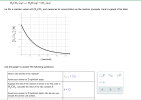 H2CO3(aq) → H20 (aq) + CO2 (aq) He fills a reaction vessel with H,CO, and measures its concentration as the reaction proceeds. Here's a graph of his data: [H,C03](M) 40 6080 1 (seconds) Use this graph to answer the following questions: What is the half life of the reaction? '1/2 = Is Round your answer to 2 significant digits. 0. Suppose the rate of the reaction is known to be first order in H.CO. Calculate the value of the rate...
Carbon dioxide dissolves in water to form carbonic acid, which is primarily dissolved CO2. Dissolved CO2...
 Carbon dioxide dissolves in water to form carbonic acid, which
is primarily dissolved CO2. Dissolved CO2 satisfies the equilibrium
equation The acid dissociation constants listed in most standard
reference texts for carbonic acid actually apply to dissolved CO2.
For a CO2 partial pressure of 1.8×10⁻⁴ bar in the atmosphere, what
is the pH of water in equilibrium with the atmosphere? (For
carbonic acid Ka1 = 4.46× 10⁻⁷ and Ka2 = 4.69× 10⁻¹¹).
Carbon dioxide dissolves in water to form carbonic...
Carbon dioxide dissolves in water to form carbonic acid, which
is primarily dissolved CO2. Dissolved CO2 satisfies the equilibrium
equation The acid dissociation constants listed in most standard
reference texts for carbonic acid actually apply to dissolved CO2.
For a CO2 partial pressure of 1.8×10⁻⁴ bar in the atmosphere, what
is the pH of water in equilibrium with the atmosphere? (For
carbonic acid Ka1 = 4.46× 10⁻⁷ and Ka2 = 4.69× 10⁻¹¹).
Carbon dioxide dissolves in water to form carbonic...
Calculate the equilibrium constant at 25 ∘C for the reaction Co(s) + 2Ag+(aq) → Co2+(aq) +...
Calculate the equilibrium constant at 25 ∘C for the reaction Co(s) + 2Ag+(aq) → Co2+(aq) + 2Ag(s) Standard Reduction Potentials at 25 ∘C Co2+(aq)+2e−→Co(s) E∘= −0.28 V Ag+(aq)+e−→Ag(s) E∘= 0.80 V Express your answer using two significant figures. K = ?
(6 marks) An easy way to analyse the amount of CO2 in a gaseous mixture of CO2 and CO is to pass the gaseous mixture through an aqueous solution that contains excess Ba(OH)2. The CO2 will react...
 (6 marks) An easy way to analyse the amount of CO2 in a gaseous mixture of CO2 and CO is to pass the gaseous mixture through an aqueous solution that contains excess Ba(OH)2. The CO2 will react yielding a precipitate of BaCOs but the CO does not react (you will learn why in higher classes). The aforementioned method was used to analyse the equilibrium composition of the gas evolved when 1.77 g of CO2 reacted with 2.0 g of graphite...
 The solubility of Co, in water at 25 °C and 0.1 atm is 0.0037 M. The common practice is to assume that all the dissolved CO is in the form of carbonic acid (H,CO), which is produced in the reaction CO:(aq) + H.0(1) = H2CO3(aq) What is the pH of a 0.0037 M solution of H,CO,? H2CO3 is a polyprotic acid: H.CO(aq) • H'(aq) + HCO,(aq) HCO,(aq) + H+ (aq) + CO + (aq) K = 4.3 x 10⁷ K2=...
 2. Given ky of 3.4 x 10⁻² [mol L atm'), calculate the dissolved aqueous concentration of CO2 that would be at equilibrium with current CO2 concentrations in the atmosphere. (2 pts) The other reactions above are similarly associated with equilibrium constants: K, - [H.CO] CO2/01)] , [H][HCO3] K - TH.CO;] H][co;] THCO3] where K, = 1.7x10⁻³, K, = 2.5x10+ , and K. = 4.7 x 10⁻¹¹ 3. Knowing the reaction constants above, calculate the pH of water that is in...
 16. For the system CO + CO2(g) → CaCO(s) the equilibrium constant expression is a. [CO] b. 1/[CO] c. COCO/CaCO, d. Cacos/CaoCO 17. The value of K, for the reaction 2NOH). N204) is 1.52 at 319 K. What is the value of ko at this temperature for the reaction N04() → 2NOR ? b. 1.23 c. 5.74 x 10 d. 0.658 18. The value of Ke for the reaction C() + COX() -----2CO(g) is 1.6. What is the equilibrium concentration...
 H2CO3(aq) → H20 (aq) + CO2 (aq) He fills a reaction vessel with H,CO, and measures its concentration as the reaction proceeds. Here's a graph of his data: [H,C03](M) 40 6080 1 (seconds) Use this graph to answer the following questions: What is the half life of the reaction? '1/2 = Is Round your answer to 2 significant digits. 0. Suppose the rate of the reaction is known to be first order in H.CO. Calculate the value of the rate...
 Carbon dioxide dissolves in water to form carbonic acid, which
is primarily dissolved CO2. Dissolved CO2 satisfies the equilibrium
equation The acid dissociation constants listed in most standard
reference texts for carbonic acid actually apply to dissolved CO2.
For a CO2 partial pressure of 1.8×10⁻⁴ bar in the atmosphere, what
is the pH of water in equilibrium with the atmosphere? (For
carbonic acid Ka1 = 4.46× 10⁻⁷ and Ka2 = 4.69× 10⁻¹¹).
Carbon dioxide dissolves in water to form carbonic...
Carbon dioxide dissolves in water to form carbonic acid, which
is primarily dissolved CO2. Dissolved CO2 satisfies the equilibrium
equation The acid dissociation constants listed in most standard
reference texts for carbonic acid actually apply to dissolved CO2.
For a CO2 partial pressure of 1.8×10⁻⁴ bar in the atmosphere, what
is the pH of water in equilibrium with the atmosphere? (For
carbonic acid Ka1 = 4.46× 10⁻⁷ and Ka2 = 4.69× 10⁻¹¹).
Carbon dioxide dissolves in water to form carbonic...
 (6 marks) An easy way to analyse the amount of CO2 in a gaseous mixture of CO2 and CO is to pass the gaseous mixture through an aqueous solution that contains excess Ba(OH)2. The CO2 will react yielding a precipitate of BaCOs but the CO does not react (you will learn why in higher classes). The aforementioned method was used to analyse the equilibrium composition of the gas evolved when 1.77 g of CO2 reacted with 2.0 g of graphite...
Most questions answered within 3 hours.
-
Where is the error in this code sequence?
String s1 = "Hello";
String s2 = "ello";...
asked 10 months ago -
Financial data for Joel de Paris, Inc., for last year
follow:
Joel de Paris, Inc.
Balance...
asked 10 months ago -
Consider this reaction:
Al2(SO4)3 (aq)+ BaCl3
(aq) Al2Cl6 (aq)- +
3BaSO4(s) . What is the...
asked 10 months ago -
Suppose that Savneet is considering increasing her
recent random sample from 20 car rentals to 40...
asked 10 months ago -
Trucks arrive at an unloading terminal at an average rate of 120
per hour.
Trucks arrive...
asked 10 months ago -
Why are methanol and ethanol completely soluble in water while
octanol is not very little soluble....
asked 10 months ago -
A facilities manager at a university reads in a research report
that the mean amount of...
asked 10 months ago -
When the CuSO4 is rehydrated by adding water to the anhydrous
compound, is this an endothermic...
asked 10 months ago -
A ray of sunlight is passing from diamond into crown glass; the
angle of incidence is...
asked 10 months ago -
A block of mass 0.249 kg is placed on top of a light, vertical
spring of...
asked 10 months ago -
how do the kidneys compensate in the presences of acidosis
a) trigger hyperventilate
b) reserve acid...
asked 10 months ago -
Question 501 pts
The rental rate of capital to the firm increases. Which of the
following...
asked 10 months ago