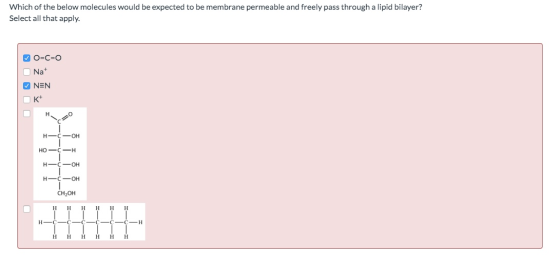
Which of the below molecules would be expected to be membrane
permeable and freely pass through a lipid bilayer?
Select all that apply
Homework Answers
Lipd Soluble, Non-charged non-polar molecules can easily pass through lipid bilayer.
CO2, N2 and Hexane (C6H14) can easily pass through lipid bilayer.
Na+ and K+ are charged ions and glucose has large molecular size to Cross through lipid bilayer...though glucose pass through transmembrane protein.
Add Answer to:
Which of the below molecules would be expected to be membrane permeable and freely pass through a lipid bilayer? Select...
Order the following compounds from most permeable (will easily pass through the lipid bilayer) to least...
 Order the following compounds from most permeable (will easily pass through the lipid bilayer) to least permeable (will not pass through the lipid bilayer). Water [Select] Adenine (a large polar compound) [Select] Ammonium ion [Select CO2 Select
Which of the following substances can easily pass directly through the lipid portion of the bilayer...
Which of the following substances can easily pass directly through the lipid portion of the bilayer unassisted? Select all that apply! a. ions b. water c. steroid hormones d. gases e. large biomolecules
Which of the following molecules will diffuse most quickly across a lipid bilayer membrane? A. H2O...
Which of the following molecules will diffuse most quickly across a lipid bilayer membrane? A. H2O B. O2 C. H2PO4 D. glucose E. Na+
Which of the following molecules will diffuse most quickly across a lipid bilayer membrane? a. H2O...
Which of the following molecules will diffuse most quickly across a lipid bilayer membrane? a. H2O b. Na+ c. Glucose d. H2PO4 e. O2 (I've isolated it down to H2O and O2, but I'm not sure which one diffuses faster than the other and why. Thanks!)
Which of the following molecules may diffuse freely through a phospholipid bilayer? please select two answers-...
Which of the following molecules may diffuse freely through a phospholipid bilayer? please select two answers- -asparagine, an amino acid with a large, hydrophilic side chain -alanine, an amino acid with a small, hydrophobic side-chain -testosterone, a steroid hormone -fructose, a monosaccharide molecular oxygen (O2)
Which of the following would produce the most fluid lipid bilayer? O phospholipids with tails of...
 Which of the following would produce the most fluid lipid bilayer? O phospholipids with tails of 26 carbon atoms and two double bonds O phospholipids with fully saturated tails of 20 carbon atoms O large amounts of cholesterol O phospholipids with tails of 20 carbon atoms and two double bonds o phospholipids with fully saturated tails of 24 carbon atoms Which of the following can influence the rate at which a molecule will move across a lipid bilayer? (Check all...
Which of the following best describes the structure of lipid bilayer? Select the correct answer below....
 Which of the following best describes the structure of lipid bilayer? Select the correct answer below. O A double layer of phospholipids with the polar ends facing inwards. O A double layer of phospholipids with the polar ends facing outwards. O A double layer of cholesterol molecules with the polar ends facing inwards O A double layer of cholesterol molecules with the polar ends facing outwards
If the lipid bilayer in Section B represents the ER membrane, which part of the protein...
 If the lipid bilayer in Section B represents the ER membrane, which part of the protein is found INSIDE the ER (in the ER lumen)? A. COOH 26 oligosaccharides transmembrane a helix cause lipid bilayer B. LSH- C. -NH2 SH Figure 10-22. Molecular Biology of the Cell, 4th Edition O The entire protein must be inside the lumen of the ER. O All sections are equally likely to be in the ER lumen. Section B is inside the ER lumen....
What molecules can pass people? through a lipid membrane? Which molecules are at 4. What technology...
 What molecules can pass people? through a lipid membrane? Which molecules are at 4. What technology was used to figure out the fluidity of cell membranesie the membrane pids are mobile? 5. Does the mobily membrane proteins der so why Look at worksheet for das 21 Compare MPL MP2 and MP3 proteins & What is the role of SRP in the rouch ER? 7. Draw apath for a n d protein from gene expression to secretion Nudes where the is...
3. Based on the structure to the right what type of lipid would this figure below...
 3. Based on the structure to the right what type of lipid would
this figure below be characterized as?
a. Is this lipid more likely to move laterally 200 Å in
the
bilayer or to move 50 Å in a transverse direction (through the
bilayer) from one leaflet to another? Why?
b. You treat this lipid with phospholipase A2 to remove the
fatty acid at position C2. You then place the extracted fatty acid
into a non-polar solvent. What type...
3. Based on the structure to the right what type of lipid would
this figure below be characterized as?
a. Is this lipid more likely to move laterally 200 Å in
the
bilayer or to move 50 Å in a transverse direction (through the
bilayer) from one leaflet to another? Why?
b. You treat this lipid with phospholipase A2 to remove the
fatty acid at position C2. You then place the extracted fatty acid
into a non-polar solvent. What type...
 Order the following compounds from most permeable (will easily pass through the lipid bilayer) to least permeable (will not pass through the lipid bilayer). Water [Select] Adenine (a large polar compound) [Select] Ammonium ion [Select CO2 Select
 Which of the following would produce the most fluid lipid bilayer? O phospholipids with tails of 26 carbon atoms and two double bonds O phospholipids with fully saturated tails of 20 carbon atoms O large amounts of cholesterol O phospholipids with tails of 20 carbon atoms and two double bonds o phospholipids with fully saturated tails of 24 carbon atoms Which of the following can influence the rate at which a molecule will move across a lipid bilayer? (Check all...
 Which of the following best describes the structure of lipid bilayer? Select the correct answer below. O A double layer of phospholipids with the polar ends facing inwards. O A double layer of phospholipids with the polar ends facing outwards. O A double layer of cholesterol molecules with the polar ends facing inwards O A double layer of cholesterol molecules with the polar ends facing outwards
 If the lipid bilayer in Section B represents the ER membrane, which part of the protein is found INSIDE the ER (in the ER lumen)? A. COOH 26 oligosaccharides transmembrane a helix cause lipid bilayer B. LSH- C. -NH2 SH Figure 10-22. Molecular Biology of the Cell, 4th Edition O The entire protein must be inside the lumen of the ER. O All sections are equally likely to be in the ER lumen. Section B is inside the ER lumen....
 What molecules can pass people? through a lipid membrane? Which molecules are at 4. What technology was used to figure out the fluidity of cell membranesie the membrane pids are mobile? 5. Does the mobily membrane proteins der so why Look at worksheet for das 21 Compare MPL MP2 and MP3 proteins & What is the role of SRP in the rouch ER? 7. Draw apath for a n d protein from gene expression to secretion Nudes where the is...
 3. Based on the structure to the right what type of lipid would
this figure below be characterized as?
a. Is this lipid more likely to move laterally 200 Å in
the
bilayer or to move 50 Å in a transverse direction (through the
bilayer) from one leaflet to another? Why?
b. You treat this lipid with phospholipase A2 to remove the
fatty acid at position C2. You then place the extracted fatty acid
into a non-polar solvent. What type...
3. Based on the structure to the right what type of lipid would
this figure below be characterized as?
a. Is this lipid more likely to move laterally 200 Å in
the
bilayer or to move 50 Å in a transverse direction (through the
bilayer) from one leaflet to another? Why?
b. You treat this lipid with phospholipase A2 to remove the
fatty acid at position C2. You then place the extracted fatty acid
into a non-polar solvent. What type...
Most questions answered within 3 hours.
-
Where is the error in this code sequence?
String s1 = "Hello";
String s2 = "ello";...
asked 10 months ago -
Financial data for Joel de Paris, Inc., for last year
follow:
Joel de Paris, Inc.
Balance...
asked 10 months ago -
Consider this reaction:
Al2(SO4)3 (aq)+ BaCl3
(aq) Al2Cl6 (aq)- +
3BaSO4(s) . What is the...
asked 10 months ago -
Suppose that Savneet is considering increasing her
recent random sample from 20 car rentals to 40...
asked 10 months ago -
Trucks arrive at an unloading terminal at an average rate of 120
per hour.
Trucks arrive...
asked 10 months ago -
Why are methanol and ethanol completely soluble in water while
octanol is not very little soluble....
asked 10 months ago -
A facilities manager at a university reads in a research report
that the mean amount of...
asked 10 months ago -
When the CuSO4 is rehydrated by adding water to the anhydrous
compound, is this an endothermic...
asked 10 months ago -
A ray of sunlight is passing from diamond into crown glass; the
angle of incidence is...
asked 10 months ago -
A block of mass 0.249 kg is placed on top of a light, vertical
spring of...
asked 10 months ago -
how do the kidneys compensate in the presences of acidosis
a) trigger hyperventilate
b) reserve acid...
asked 10 months ago -
Question 501 pts
The rental rate of capital to the firm increases. Which of the
following...
asked 10 months ago