
Homework Answers
 d. Seven key processing steps
to fabricate p-n junction are-
d. Seven key processing steps
to fabricate p-n junction are-
| A. Silicon wafer cleaning (RCA process) |
|
In the IC processing wafers it is necessary to maintain the purity and perfection of material. Silicon wafer is cleaned by standard RCA process. It useful to remove oil/grease, organic/ionic contamination, heavy metal ion and native oxide from the surface of wafer. Oil/grease/dust is removed by boiling wafer in trichloroethylene (TCE), acetone and methanol. |
| B. Oxidation |
|
Process by which a layer of silicon dioxide (SiO2) is grown on a silicon substrate is known as oxidation. This process is carried out in a furnace in high temperature. In this process dry wet dry oxidation is performed. When silicon wafers are heated in a pure oxidizing gas ambient such as dry oxygen it known is as Dry Oxidation. Oxide layers are very uniform but Dry oxide grows very slowly i.e oxidation rate is very low When silicon wafers are heated in an ambience of wet oxidizing gas such as oxygen bubbled through hot D.I Water (carrying steam vapors) it is known as wet oxidation. |
| C. Photolithography |
|
In I.C Technology, photolithography is used to transfer patterns made on a mask to a semiconductor wafer. Therefore, to fabricate a device or an I.C, the oxide layer needed to be removed from the Selective regions on silicon wafer, where diffusion is desired. First silicon wafer is coated with photo resist and exposed in ultra violet light. By the application of photo resist oxide layer is etched . Photo resist is an organic polymer, sensitive to UV light. It is temporarily coated on wafer surface to transfer design image on it through exposure in UV light. |
| D. Oxide etching |
| To remove SiO2 from regions exposed through photolithography is called oxide etching. After post bake, the wafer is dipped in Buffer HF solution for a particular time (determined by oxide thickness and etch rate) followed by thorough rinsing in D.I Water. It is called wet etching. To remove photo resist water cleaned wafer is boiled in acetone 2 min. to completely remove the photo resist from the wafer surface. If Wafer is subjected to Chemical Vapor Etching i.e subjected to a reacting gas mixture in a CVD reactor. It is called dry etching. |
| E. Diffusion |
|
As the given wafer is N type so we need to diffuse P type impurity into the wafer to create P-N junction and we take Boron (P type) impurity for diffusion. Boron activation, pre deposition of boron and oxidation is going on. During boron activation a layer of B2O3 is formed on BN wafer. After that silicon wafer is placed with BN wafer and boron will diffuse in to silicon wafer. |
| F. Metallization |
|
Metallization is the final step in the wafer processing sequence. Metallization is the process by which the components of IC’s are interconnected by aluminium conductor. This process produces a thin-film metal layer that will serve as the required conductor pattern for the interconnection of the various components on the chip. Another use of metallization is to produce metalized areas called bonding pads around the periphery of the chip to produce metalized areas for the bonding of wire leads from the package to the chip |
| G.Annealing |
| First step in IC fabrication is to introduce dopant atom. Implantation damages the target and displaces atoms from its site. The electrical behavior after implantation is dominated by deep level electron and hole traps, which capture carriers and make the resistivity high. Annealing is the process which is used to repair the lattice damage by putting atoms on substitutional sites where they will be electrically active |
Add Answer to:
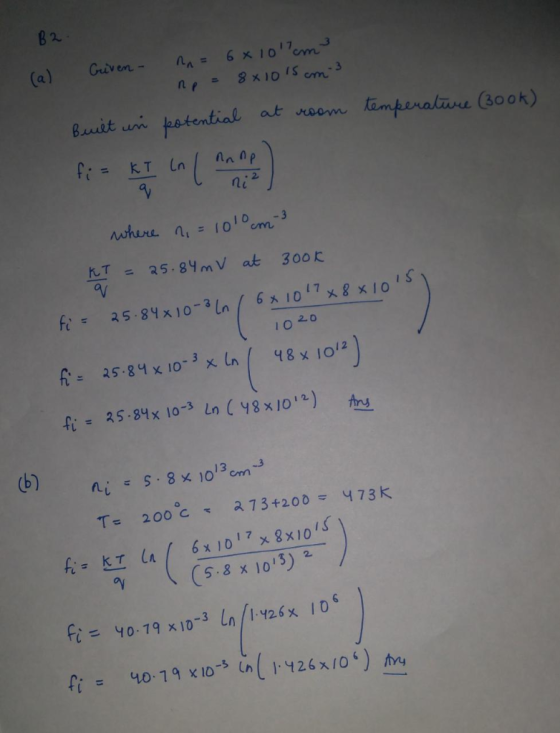
B2 Consider a diode formed by making a p-n junction structure in a silicon sample as shown in Fig. B2. nt laver p-type...
A silicon PN junction diode is constructed using N-type silicon in which the Fermi level is...
 A silicon PN junction diode is constructed using N-type silicon in which the Fermi level is 100 meV below the conduction band edge and P-type silicon in which the Fermi level is 120 meV above the valence band edge a) What are the majority and minority carrier concentrations on each side of the junction under thermal equilibrium? b) What is the value of the built-in voltage? c) Determine the width of the depletion region on both sides of the junction...
Assume a p-n step junction in silicon wi concentration of 2x10¹⁶,c? and the n-type material doped...
 Assume a p-n step junction in silicon wi concentration of 2x10¹⁶,c? and the n-type material doped at 3X10-s,cm3 The intrinsic carrier density is 1.25X101°/cm and all dopants are fully ionized Assume that the effective density of states for silicon is 3.3x10 cm3 for the conduction band and 1.75x101 cm for the valence band. Assume that the temperature is 300K and silicon relative permittivity of 11.7 a. Compute the hole concentration on the n-side and electron concentration th the p-type material...
Consider an abrupt p-n junction formed by two steps; an entire silicon sample was first doped...
Consider an abrupt p-n junction formed by two steps; an entire silicon sample was first doped with 1.0E+15 cm-3 acceptors (step I), and then a half of the sample was doped with 2.0E+15 cm-3 donors at room temperature (step II). a. Calculate the Fermi levels on each side of the junction with respect to Ei. Use the Special Conditions to find the concentrations. b. Calculate the contact potential. c. Calculate the ratio , Xpo/Xno
A silicon p+ n step junction diode at room temperature has N_d = 10^16 cm-3. a)...
A silicon p+ n step junction diode at room temperature has N_d = 10^16 cm-3. a) What breakdown mechanism do you expect will be dominant in this device? Explain. b) Find the approximate breakdown voltage for this diode. c) Calculate the depletion width at the breakdown voltage. d) What is the maximum magnitude of the electric field in the depletion region at the breakdown voltage?
Your supervisor tasked you to design a square cross-section silicon p-n junction diode with the following...
 Your supervisor tasked you to design a square cross-section silicon p-n junction diode with the following specifications: 1. Intrinsic concentration at 300K: n. = 1.5x 10"/cmº. 2. p-side doping: N = 101/cm. 2. n-side doping: No = 1021/cm. 3. QNR length: W, =W, = 1 um. (a) Determine the sidelength so that the turn-on voltage of the designed diode to be 0.7V if the current rating of the diode is to be specified as 1 mA at room temperature. [Hint:...
Your supervisor tasked you to design a square cross-section silicon p-n junction diode with the following...
 Your supervisor tasked you to design a square cross-section silicon p-n junction diode with the following specifications: 1. Intrinsic concentration at 300K: n; = 1.5x 101° /cmº. 2. p-side doping: N = 1018/cm. 2. n-side doping: N = 1021/cm. 3. QNR length: W=W, = 1 um. p (a) Determine the sidelength so that the turn-on voltage of the designed diode to be 0.7V if the current rating of the diode is to be specified as 1 mA at room temperature....
2. An abrupt silicon p-n junction is formed from p-type material with a resistivity of 1.3x10-...
 2. An abrupt silicon p-n junction is formed from p-type material with a resistivity of 1.3x10- 12m and n-type material with resistivity of 4.6x10- Sam at room temperature. The lifetimes of the p- and n-materials are 100 us and 150 us respectively, and the junction area is 1.0 mm?.if Mp 4.8x10² m²/V.s „Mn = 0.135 m²/V.s and n; = 1.5x10¹⁶ carrier /m , calculate the reverse bias leakage current. Then calculate forward bias current if a 0.3 volt is applied.
Consider an abrupt p-n junction consisted of a p-side silicon doped with 1.0E+15 cm-3 acceptors and...
Consider an abrupt p-n junction consisted of a p-side silicon doped with 1.0E+15 cm-3 acceptors and an n- side silicon doped with 1.0E+15 cm-3 donors at room temperature (no donors in p-side and no acceptors in n-side). a. Calculate the Fermi levels on each side of the junction with respect to Ei. Use the Special Conditions to find the concentrations. b. Calculate the contact potential. c .Calculate the ratio, Xpo/Xno
Please answer all your works correctly. Thanks. Q3) A germanium p-n junction diode is created with...
 Please answer all your works
correctly. Thanks.
Q3) A germanium p-n junction diode is created with NA 1016cm3 in p-side and ND 1017cm-3 in the n-side. The intrinsic carrier concentration of Ge at the room temperature is 2 x 1013cm-3. Calculate the built in potential, electric field and potential distribution in the space charge region, and width of the space charge region? (Dielectric coefficient of german iurm is 16, є0-8.85 x 10⁻¹⁴ F/cm). WI
Please answer all your works
correctly. Thanks.
Q3) A germanium p-n junction diode is created with NA 1016cm3 in p-side and ND 1017cm-3 in the n-side. The intrinsic carrier concentration of Ge at the room temperature is 2 x 1013cm-3. Calculate the built in potential, electric field and potential distribution in the space charge region, and width of the space charge region? (Dielectric coefficient of german iurm is 16, є0-8.85 x 10⁻¹⁴ F/cm). WI
For a Si p-n junction with p-type doping of 1 x 10^16/cm3 and n-type doping of...
For a Si p-n junction with p-type doping of 1 x 10^16/cm3 and n-type doping of 1 x 10^19/cm3, calculate the built-in potential Vb at 300K, dark, thermal equilibrium condition. Please show the equations and parameters used in the calculation and the value of Ec-Ef, Ef-Ev, and Vb. Please draw a band structure similar to the one in lecture 5 slide 6 based on your results, please also label Ec, Ev, Vb, and Ef in the drawing.
 A silicon PN junction diode is constructed using N-type silicon in which the Fermi level is 100 meV below the conduction band edge and P-type silicon in which the Fermi level is 120 meV above the valence band edge a) What are the majority and minority carrier concentrations on each side of the junction under thermal equilibrium? b) What is the value of the built-in voltage? c) Determine the width of the depletion region on both sides of the junction...
 Assume a p-n step junction in silicon wi concentration of 2x10¹⁶,c? and the n-type material doped at 3X10-s,cm3 The intrinsic carrier density is 1.25X101°/cm and all dopants are fully ionized Assume that the effective density of states for silicon is 3.3x10 cm3 for the conduction band and 1.75x101 cm for the valence band. Assume that the temperature is 300K and silicon relative permittivity of 11.7 a. Compute the hole concentration on the n-side and electron concentration th the p-type material...
 Your supervisor tasked you to design a square cross-section silicon p-n junction diode with the following specifications: 1. Intrinsic concentration at 300K: n. = 1.5x 10"/cmº. 2. p-side doping: N = 101/cm. 2. n-side doping: No = 1021/cm. 3. QNR length: W, =W, = 1 um. (a) Determine the sidelength so that the turn-on voltage of the designed diode to be 0.7V if the current rating of the diode is to be specified as 1 mA at room temperature. [Hint:...
 Your supervisor tasked you to design a square cross-section silicon p-n junction diode with the following specifications: 1. Intrinsic concentration at 300K: n; = 1.5x 101° /cmº. 2. p-side doping: N = 1018/cm. 2. n-side doping: N = 1021/cm. 3. QNR length: W=W, = 1 um. p (a) Determine the sidelength so that the turn-on voltage of the designed diode to be 0.7V if the current rating of the diode is to be specified as 1 mA at room temperature....
 2. An abrupt silicon p-n junction is formed from p-type material with a resistivity of 1.3x10- 12m and n-type material with resistivity of 4.6x10- Sam at room temperature. The lifetimes of the p- and n-materials are 100 us and 150 us respectively, and the junction area is 1.0 mm?.if Mp 4.8x10² m²/V.s „Mn = 0.135 m²/V.s and n; = 1.5x10¹⁶ carrier /m , calculate the reverse bias leakage current. Then calculate forward bias current if a 0.3 volt is applied.
 Please answer all your works
correctly. Thanks.
Q3) A germanium p-n junction diode is created with NA 1016cm3 in p-side and ND 1017cm-3 in the n-side. The intrinsic carrier concentration of Ge at the room temperature is 2 x 1013cm-3. Calculate the built in potential, electric field and potential distribution in the space charge region, and width of the space charge region? (Dielectric coefficient of german iurm is 16, є0-8.85 x 10⁻¹⁴ F/cm). WI
Please answer all your works
correctly. Thanks.
Q3) A germanium p-n junction diode is created with NA 1016cm3 in p-side and ND 1017cm-3 in the n-side. The intrinsic carrier concentration of Ge at the room temperature is 2 x 1013cm-3. Calculate the built in potential, electric field and potential distribution in the space charge region, and width of the space charge region? (Dielectric coefficient of german iurm is 16, є0-8.85 x 10⁻¹⁴ F/cm). WI
Most questions answered within 3 hours.
-
Where is the error in this code sequence?
String s1 = "Hello";
String s2 = "ello";...
asked 11 months ago -
Financial data for Joel de Paris, Inc., for last year
follow:
Joel de Paris, Inc.
Balance...
asked 11 months ago -
Consider this reaction:
Al2(SO4)3 (aq)+ BaCl3
(aq) Al2Cl6 (aq)- +
3BaSO4(s) . What is the...
asked 11 months ago -
Suppose that Savneet is considering increasing her
recent random sample from 20 car rentals to 40...
asked 11 months ago -
Trucks arrive at an unloading terminal at an average rate of 120
per hour.
Trucks arrive...
asked 11 months ago -
Why are methanol and ethanol completely soluble in water while
octanol is not very little soluble....
asked 11 months ago -
A facilities manager at a university reads in a research report
that the mean amount of...
asked 11 months ago -
When the CuSO4 is rehydrated by adding water to the anhydrous
compound, is this an endothermic...
asked 11 months ago -
A ray of sunlight is passing from diamond into crown glass; the
angle of incidence is...
asked 11 months ago -
A block of mass 0.249 kg is placed on top of a light, vertical
spring of...
asked 11 months ago -
how do the kidneys compensate in the presences of acidosis
a) trigger hyperventilate
b) reserve acid...
asked 11 months ago -
Question 501 pts
The rental rate of capital to the firm increases. Which of the
following...
asked 11 months ago