c++ using i think the assignment want hashing function to check date if was efficiently transferred or missing any data if transferred please look for the graph like in L1 AND L2 they transfer data then when they all match then i think means transferred correctly or missing anything pleas help
im not sure if question want with hashing but please do any coding with hashing anything will help
Given the attached Merkle Tree from
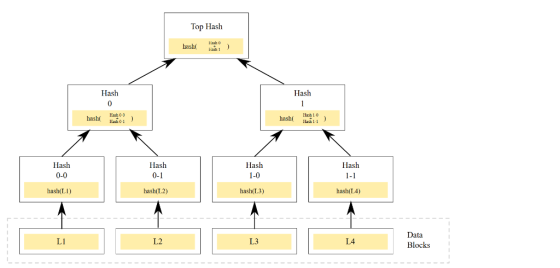
Let
L1=Then out spake brave Horatius,
The Captain of the Gate:
L2="To every man upon this earth
Death cometh soon or late.
L3=And how can man die better
Than facing fearful odds,
and
L4=For the ashes of his fathers,
And the temples of his Gods."
Create all hashes 0-0, 0-1, 1-0, 1-1, 0, 1 with top
Show all you need to do to confirm
L1 is 0-1, 0, top
L2 is 0-0, 1, top
L3 is 1-1, 0, top and
L4 is 1-0, 0, top
Homework Answers
You have not framed the question pretty well but from what I have gathered from the question is that we have to generate the hashes 0-0, 0-1, 1-0, 1-1, 0, 1 and top hash value with the given information values L1, L2, L3, L4. Now we use sha256 encrypting algorithm to hash the values in a Merkle tree. I will not write the algorithm from scratch because there exists a python library that does the job of sha256 hashing. Writing the sha256 from hand is an extremely tedious task and cannot be done within my given limited time window to answer the question hence I have used python to answer your question.You can get the hash value of the Merkle root recursively but since we want the hash values at every step, we would do it step by step because the number of blocks is really small (4) being L1, L2, L3, L4. So first we will hash L1 with itself and we will do the same for the rest and the resulting hash values will be 0-0, 0-1, 1-0, 1-1 respectively. Then we will hash 0-0 with 0-1 and hash 1-0 with 1-1 and let the result be 0 and 1 respectively. Finally, we will hash 0 and 1 respectively to get the Merkle Root hash. Remember that when we say we are hashing we using sha256 hashing algorithm present in the hashlib library of python. So I will provide you with a python code along with the respective outputs. So here goes the code:-
(before that one very important thing you should notice and remember that sha256 encoding is possible on strings having even length and containing only hexadecimal characters, so first we have to change the string to its hexadecimal value and that is the extra step that I have done after that I have used those hexadecimal strings in sha256 encoding).
Python Code:-
import hashlib
import binascii
def hesh(a, b):
a1 = a.decode('hex')[::-1]
b1 = b.decode('hex')[::-1]
h = hashlib.sha256(hashlib.sha256(a1 + b1).digest()).digest()
#sha256 encyption used to encrypt the data in a merkle tree
return h[::-1].encode('hex')
str1 = "Then out spake brave Horatius, The Captain of the
Gate:"
str2 = "To every man upon this earth Death cometh soon or
late."
str3 = "And how can man die better Than facing fearful odds,
and"
str4 = "For the ashes of his fathers, And the temples of his
Gods."
#hexa1 = str1.encode('utf-8')
#hexa1 = hexa1.hex()
'''
what i did in this step is that I used the small snippet of
code
written above in comments to generate the hexadecimal values
for
all the given strings str1, str2, str3, str4. Then i copied
the
hexadecimal values from the terminal after running the code
and
stored them into separate variables
'''
L1 =
"5468656e206f7574207370616b6520627261766520486f7261746975732c20546865204361707461696e206f662074686520476174653a"
L2 =
"546f206576657279206d616e2075706f6e207468697320656172746820446561746820636f6d65746820736f6f6e206f72206c6174652e"
L3 =
"416e6420686f772063616e206d616e2064696520626574746572205468616e20666163696e67206665617266756c206f6464732c20616e64"
L4 =
"466f7220746865206173686573206f662068697320666174686572732c20416e64207468652074656d706c6573206f662068697320476f64732e"
hash00 = hesh(L1, L1);
hash01 = hesh(L2, L2);
hash10 = hesh(L3, L3);
hash11 = hesh(L4, L4);
print ("Hash00 is " + hash00)
print ("Hash01 is " + hash01)
print ("Hash10 is " + hash10)
print ("Hash11 is " + hash11)
hash0 = hesh(hash00, hash01)
hash1 = hesh(hash10, hash11)
print ("Hash0 is " + hash0)
print ("Hash1 is " + hash1)
merkle_root = hesh(hash0, hash1)
print ("Value at merkle root is " + merkle_root)
If you have any problem regarding the concept or of what I did in this problem just leave a comment down below regarding your problem and I will be more than happy to help you any time. Thank you. Happy coding.
Add Answer to:
c++ using i think the assignment want hashing function to check date if was efficiently transferred or missing any data...
Most questions answered within 3 hours.
-
Where is the error in this code sequence?
String s1 = "Hello";
String s2 = "ello";...
asked 10 months ago -
Financial data for Joel de Paris, Inc., for last year
follow:
Joel de Paris, Inc.
Balance...
asked 10 months ago -
Consider this reaction:
Al2(SO4)3 (aq)+ BaCl3
(aq) Al2Cl6 (aq)- +
3BaSO4(s) . What is the...
asked 10 months ago -
Suppose that Savneet is considering increasing her
recent random sample from 20 car rentals to 40...
asked 10 months ago -
Trucks arrive at an unloading terminal at an average rate of 120
per hour.
Trucks arrive...
asked 10 months ago -
Why are methanol and ethanol completely soluble in water while
octanol is not very little soluble....
asked 10 months ago -
A facilities manager at a university reads in a research report
that the mean amount of...
asked 10 months ago -
When the CuSO4 is rehydrated by adding water to the anhydrous
compound, is this an endothermic...
asked 10 months ago -
A ray of sunlight is passing from diamond into crown glass; the
angle of incidence is...
asked 10 months ago -
A block of mass 0.249 kg is placed on top of a light, vertical
spring of...
asked 10 months ago -
how do the kidneys compensate in the presences of acidosis
a) trigger hyperventilate
b) reserve acid...
asked 10 months ago -
Question 501 pts
The rental rate of capital to the firm increases. Which of the
following...
asked 10 months ago