
Homework Answers
Add Answer to:
Please show all your work step by step 1. Suppose the production function is Cobb-Douglas and f(x1,22) = x122. (...
1. Suppose the production function is Cobb-Douglas and f(11,12) = 21222 (a) Write an expression for...
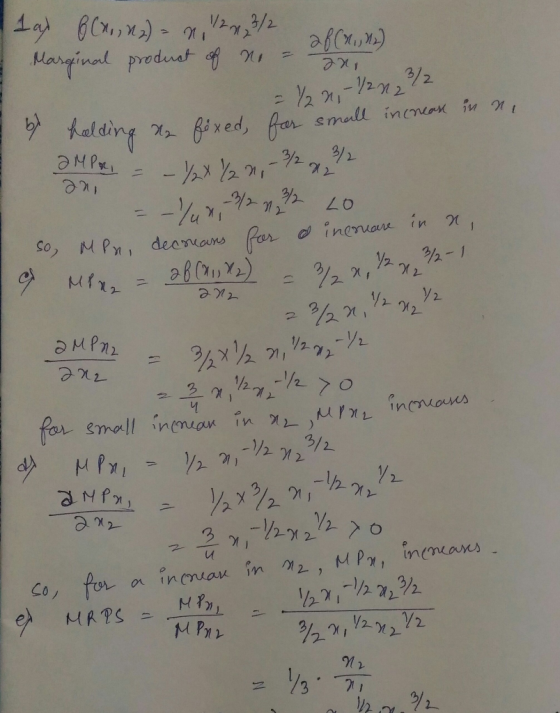
 1. Suppose the production function is Cobb-Douglas and f(11,12) = 21222 (a) Write an expression for the marginal product of 21 at the point (21,12). (b) Holding 22 fixed, for small increases in I, will the marginal product of 2 increase, decrease or remain constant? (c) What's the marginal product of factor 2? Will it increase, remain constant or decrease for small increases in ra? (d) Does an increase in the amount of 22 increase, leave unchanged or decrease the...
Suppose the production function is Cobb-Douglas and f(x1, x2) = x^1/2 x^3/2 (e) What's the technical...
 Suppose the production function is Cobb-Douglas and f(x1, x2) =
x^1/2 x^3/2
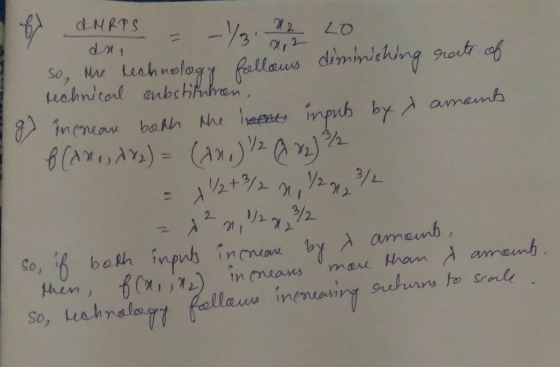
(e) What's the technical rate of substitution TRS (11, 12)? (f) Does this technology have diminishing technical rate of substitution? (g) Does this technology demonstrate increasing, constant or decreasing returns to scale?
Suppose the production function is Cobb-Douglas and f(x1, x2) =
x^1/2 x^3/2
(e) What's the technical rate of substitution TRS (11, 12)? (f) Does this technology have diminishing technical rate of substitution? (g) Does this technology demonstrate increasing, constant or decreasing returns to scale?
Question-3 (Marginal Products and Returns to Scale) (30 points) Suppose the production function is Cobb-Douglas and...
 Question-3 (Marginal Products and Returns to Scale) (30 points)
Suppose the production function is Cobb-Douglas and f(x1; x2) =
x1^1/2 x2^3/2
1. Write an expression for the marginal product of x1.
2. Does marginal product of x1 increase for small increases in
x1, holding x2 fixed? Explain
3. Does an increase in the amount of x2 lead to decrease in the
marginal product of x1? Explain
4. What is the technical rate of substitution between x2 and
x1?
5. What...
Question-3 (Marginal Products and Returns to Scale) (30 points)
Suppose the production function is Cobb-Douglas and f(x1; x2) =
x1^1/2 x2^3/2
1. Write an expression for the marginal product of x1.
2. Does marginal product of x1 increase for small increases in
x1, holding x2 fixed? Explain
3. Does an increase in the amount of x2 lead to decrease in the
marginal product of x1? Explain
4. What is the technical rate of substitution between x2 and
x1?
5. What...
SHOW ALL WORK!!! 2. For the following Cobb-Douglas production function, q=f(L,K) = _0.45 0.7 a. Derive expressions for m...
 SHOW ALL WORK!!!
2. For the following Cobb-Douglas production function, q=f(L,K) = _0.45 0.7 a. Derive expressions for marginal product of labor and marginal product of capital, MP, and MPK. b. Derive the expression for marginal rate of technical substitution, MRTS. C. Does this production function display constant, increasing, or decreasing returns to scale? Why? d. By how much would output increase if the firm increased each input by 50%?
SHOW ALL WORK!!!
2. For the following Cobb-Douglas production function, q=f(L,K) = _0.45 0.7 a. Derive expressions for marginal product of labor and marginal product of capital, MP, and MPK. b. Derive the expression for marginal rate of technical substitution, MRTS. C. Does this production function display constant, increasing, or decreasing returns to scale? Why? d. By how much would output increase if the firm increased each input by 50%?
2. For the following Cobb-Douglas production function, q = f(L,K) = _0.45 0.7 a. Derive expressions...
 2. For the following Cobb-Douglas production function, q = f(L,K) = _0.45 0.7 a. Derive expressions for marginal product of labor and marginal product of capital, MP, and MPK. b. Derive the expression for marginal rate of technical substitution, MRTS. C. Does this production function display constant, increasing, or decreasing returns to scale? Why? d. By how much would output increase if the firm increased each input by 50%?
Question 2: Production Function and Profit Maxi- mization Consider a production function of Cobb-Douglas form: for...
 Question 2: Production Function and Profit Maxi- mization Consider a production function of Cobb-Douglas form: for some α, β E (0, 1) (a) Plot the isoquant of F (b) Derive that technical rate of substitution of F. Does F exhibit diminishing technical rate of substitution? (c) Does F exhibit diminishing marginal productivity of labor? What about marginal (d) Find out the conditions for α and β such that F is increasing return to scale, (e) Suppose that F does not...
Douglas production function F(x,, x)- xg, where X1, xl are Consider the Cobb- values of generic...
 Douglas production function F(x,, x)- xg, where X1, xl are Consider the Cobb- values of generic inputs, while α marginal product of input i? For any i, for what parameter values is there diminishing marginal product of inpu increasing, constant, and decreasing returns to scale? While a general answer is preferable, you can answer these questions for 1-3. 2. a, are constant nt parameters. Forthe , t i? Under what parameter values does the production fu
Assume a Cobb-Douglas production function F(KL) = Kal1-a with 0 < x < 1, which means...
 Assume a Cobb-Douglas production function F(KL) = Kal1-a with 0 < x < 1, which means f(k) = k«. (f) [4 marks] Does the saving rate SGR needed for the Golden rule rise, remain the same, or fall when climate change increases 8? Explain your argument.
An economy has a Cobb Douglas production function, given by: a, (1-a) (1) YAK L Where...
 An economy has a Cobb Douglas production function, given by: a, (1-a) (1) YAK L Where Yis equal to total production, K is equal to the capital input of production and L is equal to the labour input of production. The constant, A, represents technology in the economy and a the elasticity of capital. function exhibits, decreasing, increasing or constant returns to scale. [ 10 Marks A2. Carefully derive the marginal product of labour and explain how this might be...
Assume a Cobb-Douglas function such that ? where A=1, K=20, L=16, , and ?. Calculate Q....
 Assume a Cobb-Douglas function such that
? where A=1, K=20, L=16,
, and
?. Calculate Q. Does the function show increasing, decreasing, or
constant returns to scale? Why? Calculate the marginal produce of K
and L. Let K increase to 21 ceteris paribus and calculate the
marginal product of K and L. Explain the results.
Q = ᎪK L°
Assume a Cobb-Douglas function such that
? where A=1, K=20, L=16,
, and
?. Calculate Q. Does the function show increasing, decreasing, or
constant returns to scale? Why? Calculate the marginal produce of K
and L. Let K increase to 21 ceteris paribus and calculate the
marginal product of K and L. Explain the results.
Q = ᎪK L°
 1. Suppose the production function is Cobb-Douglas and f(11,12) = 21222 (a) Write an expression for the marginal product of 21 at the point (21,12). (b) Holding 22 fixed, for small increases in I, will the marginal product of 2 increase, decrease or remain constant? (c) What's the marginal product of factor 2? Will it increase, remain constant or decrease for small increases in ra? (d) Does an increase in the amount of 22 increase, leave unchanged or decrease the...
 Suppose the production function is Cobb-Douglas and f(x1, x2) =
x^1/2 x^3/2
(e) What's the technical rate of substitution TRS (11, 12)? (f) Does this technology have diminishing technical rate of substitution? (g) Does this technology demonstrate increasing, constant or decreasing returns to scale?
Suppose the production function is Cobb-Douglas and f(x1, x2) =
x^1/2 x^3/2
(e) What's the technical rate of substitution TRS (11, 12)? (f) Does this technology have diminishing technical rate of substitution? (g) Does this technology demonstrate increasing, constant or decreasing returns to scale?
 Question-3 (Marginal Products and Returns to Scale) (30 points)
Suppose the production function is Cobb-Douglas and f(x1; x2) =
x1^1/2 x2^3/2
1. Write an expression for the marginal product of x1.
2. Does marginal product of x1 increase for small increases in
x1, holding x2 fixed? Explain
3. Does an increase in the amount of x2 lead to decrease in the
marginal product of x1? Explain
4. What is the technical rate of substitution between x2 and
x1?
5. What...
Question-3 (Marginal Products and Returns to Scale) (30 points)
Suppose the production function is Cobb-Douglas and f(x1; x2) =
x1^1/2 x2^3/2
1. Write an expression for the marginal product of x1.
2. Does marginal product of x1 increase for small increases in
x1, holding x2 fixed? Explain
3. Does an increase in the amount of x2 lead to decrease in the
marginal product of x1? Explain
4. What is the technical rate of substitution between x2 and
x1?
5. What...
 SHOW ALL WORK!!!
2. For the following Cobb-Douglas production function, q=f(L,K) = _0.45 0.7 a. Derive expressions for marginal product of labor and marginal product of capital, MP, and MPK. b. Derive the expression for marginal rate of technical substitution, MRTS. C. Does this production function display constant, increasing, or decreasing returns to scale? Why? d. By how much would output increase if the firm increased each input by 50%?
SHOW ALL WORK!!!
2. For the following Cobb-Douglas production function, q=f(L,K) = _0.45 0.7 a. Derive expressions for marginal product of labor and marginal product of capital, MP, and MPK. b. Derive the expression for marginal rate of technical substitution, MRTS. C. Does this production function display constant, increasing, or decreasing returns to scale? Why? d. By how much would output increase if the firm increased each input by 50%?
 2. For the following Cobb-Douglas production function, q = f(L,K) = _0.45 0.7 a. Derive expressions for marginal product of labor and marginal product of capital, MP, and MPK. b. Derive the expression for marginal rate of technical substitution, MRTS. C. Does this production function display constant, increasing, or decreasing returns to scale? Why? d. By how much would output increase if the firm increased each input by 50%?
 Question 2: Production Function and Profit Maxi- mization Consider a production function of Cobb-Douglas form: for some α, β E (0, 1) (a) Plot the isoquant of F (b) Derive that technical rate of substitution of F. Does F exhibit diminishing technical rate of substitution? (c) Does F exhibit diminishing marginal productivity of labor? What about marginal (d) Find out the conditions for α and β such that F is increasing return to scale, (e) Suppose that F does not...
 Douglas production function F(x,, x)- xg, where X1, xl are Consider the Cobb- values of generic inputs, while α marginal product of input i? For any i, for what parameter values is there diminishing marginal product of inpu increasing, constant, and decreasing returns to scale? While a general answer is preferable, you can answer these questions for 1-3. 2. a, are constant nt parameters. Forthe , t i? Under what parameter values does the production fu
 Assume a Cobb-Douglas production function F(KL) = Kal1-a with 0 < x < 1, which means f(k) = k«. (f) [4 marks] Does the saving rate SGR needed for the Golden rule rise, remain the same, or fall when climate change increases 8? Explain your argument.
 An economy has a Cobb Douglas production function, given by: a, (1-a) (1) YAK L Where Yis equal to total production, K is equal to the capital input of production and L is equal to the labour input of production. The constant, A, represents technology in the economy and a the elasticity of capital. function exhibits, decreasing, increasing or constant returns to scale. [ 10 Marks A2. Carefully derive the marginal product of labour and explain how this might be...
 Assume a Cobb-Douglas function such that
? where A=1, K=20, L=16,
, and
?. Calculate Q. Does the function show increasing, decreasing, or
constant returns to scale? Why? Calculate the marginal produce of K
and L. Let K increase to 21 ceteris paribus and calculate the
marginal product of K and L. Explain the results.
Q = ᎪK L°
Assume a Cobb-Douglas function such that
? where A=1, K=20, L=16,
, and
?. Calculate Q. Does the function show increasing, decreasing, or
constant returns to scale? Why? Calculate the marginal produce of K
and L. Let K increase to 21 ceteris paribus and calculate the
marginal product of K and L. Explain the results.
Q = ᎪK L°
Most questions answered within 3 hours.
-
Where is the error in this code sequence?
String s1 = "Hello";
String s2 = "ello";...
asked 10 months ago -
Financial data for Joel de Paris, Inc., for last year
follow:
Joel de Paris, Inc.
Balance...
asked 10 months ago -
Consider this reaction:
Al2(SO4)3 (aq)+ BaCl3
(aq) Al2Cl6 (aq)- +
3BaSO4(s) . What is the...
asked 10 months ago -
Suppose that Savneet is considering increasing her
recent random sample from 20 car rentals to 40...
asked 10 months ago -
Trucks arrive at an unloading terminal at an average rate of 120
per hour.
Trucks arrive...
asked 10 months ago -
Why are methanol and ethanol completely soluble in water while
octanol is not very little soluble....
asked 10 months ago -
A facilities manager at a university reads in a research report
that the mean amount of...
asked 10 months ago -
When the CuSO4 is rehydrated by adding water to the anhydrous
compound, is this an endothermic...
asked 10 months ago -
A ray of sunlight is passing from diamond into crown glass; the
angle of incidence is...
asked 10 months ago -
A block of mass 0.249 kg is placed on top of a light, vertical
spring of...
asked 10 months ago -
how do the kidneys compensate in the presences of acidosis
a) trigger hyperventilate
b) reserve acid...
asked 10 months ago -
Question 501 pts
The rental rate of capital to the firm increases. Which of the
following...
asked 10 months ago