The first step in the commercial production of titanium metal is the reaction of rutile (TiO2) with chlorine and graph...
The first step in the commercial production of titanium metal is the reaction of rutile (TiO2) with chlorine and graphite:
TiO2(s) + 2Cl2(g) +
2C (s) TiCl4(l) + 2CO (g)
Use the following data to calculate Keq for this reaction at 25° C.
| Formula | ?H°f (KJ/mol) | S° (J/K mol) |
| TiO2(s) | -944.0 | 50.6 |
| Cl2(g) | 0 | 223.0 |
| C (s) | 0 | 5.7 |
| TiCl4(l) | -804.2 | 252.3 |
| CO (g) | -110.5 | 197.6 |
Homework Answers
TiO2(s) + 2Cl2 (g) + 2C (s) TiCl4(l) + 2CO (g)
Ho =
Hof(products)-
Hof(reactants)
Ho
=
Hof(TiCl4)
+ 2 x
Hof
(CO) - (
Hof(TiO2)+2
x
Hof(Cl2)
+ 2 x
Hof(C))
Ho =
-804.2 + 2 x (-110.5) -(-944.0 + 2 x 0 +2 x 0)
Ho =
-1025.2 + 944.0 kJ/mol
Ho =
-81.2 kJ/mol
So =
Sof(products)-
Sof(reactants)
So
=
Sof(TiCl4)
+ 2 x
Sof
(CO) - (
Sof(TiO2)+2
x
Sof(Cl2)
+ 2 x
Sof(C))
So =
252.3 + 2 x (197.6) -(50.6 + 2 x 223.0 +2 x 5.7)
So =
647.5 - 508.6 J/K mol
So =
138.9 J/K mol
Go =
Ho -
T
So
Go
= -81.2 kJ/mol - 298 x 138.9 J/K mol
Go =
-122.59 kJ/mol
Go =
-RT ln Keq
-122.59 x 10³ J/mol = - 8.314 J mol-1 K-1 x 298 K x ln Keq
ln Keq = 122590/2477.57
ln Keq = 49.47
Keq = e49.47
Keq = 3.082 x 10²¹
Add Answer to:
The first step in the commercial production of titanium metal is
the reaction of rutile (TiO2) with chlorine and
graph...
5. The first step in the commercial production of titanium metal is the reaction of TiO2...
 5. The first step in the commercial production of titanium metal is the reaction of TiO2 with chlorine and graphite: TiO2 (s) + 2 Cl2 (g) + 2 C(s) TiCl4 (1) + 2 CO (g) Calculate AGº for the reaction. Substance AG? (kJ/mol) Substance AG (kJ/mol) C(s) 0 TiCl4 (1) -804.2 CO (g) -110.5 TiO2 (s) -944.0 Cl2 (8) 121.3
5. The first step in the commercial production of titanium metal is the reaction of TiO2...
 5. The first step in the commercial production of titanium metal is the reaction of TiO2 with chlorine an graphite: TiO2 (s) + 2 Clz (g) + 2 C(s) TiCl4 (1) + 2 CO (g) Calculate AGⓇ for the reaction. Substance AG? (kJ/mol Substance AG® (kJ/mol) C() 0 TiCl4 (1) -804.2 CO(g) -110.5 TiO2 (s) -944.0 121.3 Cl2 (g)
AH-116.4 kJ/mol 4. Consider the following reaction: NH.NO, (s) N20 (8) + 2 H20 (g) Calculate...
 AH-116.4 kJ/mol 4. Consider the following reaction: NH.NO, (s) N20 (8) + 2 H20 (g) Calculate AGⓇ for the reaction. Substance S” (J/mol K) NH.NO, (3) 151 N:0 (8) 220 H:0 (9) 183 5. The first step in the commercial production of titanium metal is the reaction of Tio: with chlorine an graphite: TiO2 (s) + 2 Cl: (g) + 2C (5) Tici: (1) + 2 CO(g) Calculate AGº for the reaction. Substance AG? (kJ/mol Substance AG® (kJ/mol) C(s) TiCl...
Titanium(IV) chloride decomposes to form titanium and chlorine, Iike this: TiCl4)Ti(s)+2 C12(g) At a certain temperature,...
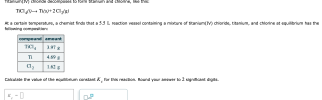 Titanium(IV) chloride decomposes to form titanium and chlorine, Iike this: TiCl4)Ti(s)+2 C12(g) At a certain temperature, a chemist finds that a 5.5 L reaction vessel containing a mixture of titanium(IV) chloride, titanium, and chlorine at equilibrium has the following composition: compound amount TiCl4 3.97 g 4.69 g Ti Cl2 1.62 g с Calculate the value of the equilibrium constant K for this reaction. Round your answer to 2 significant digits. К x10
Use the standard molar entropies B to calculate the standard entropy of reaction for the oxidation...
Use the standard molar entropies B to calculate the standard entropy of reaction for the oxidation of graphite to carbon monoxide: 2C(s)+O2(g)→2CO(g) C(s) = 5.7 J/K*mol, O2(g) = 205.0 J/K*mol, CO(g)= 197.6 J/K*mol Express your answer using one decimal place and include the appropriate units.
Thermodynamic properties of pure substances Standard thermodynamic quantities for selected substances at 25 ° C listed...
 Thermodynamic properties of pure
substances
Standard thermodynamic quantities for selected substances at 25
°
C listed alphabetically by most important atom.
substance
Δ
Hf
°
(kJ/mol)
Δ
Gf
°
(kJ/mol)
S
°
(J/mol∙K)
Aluminum
Al3+ (aq)
---
-485.0
---
Al (s)
0
0
28.3
Al2O3 (s)
-1675.7
-1582.3
50.9
Al(OH)3 (s)
---
-1147.25
---
Bromine
Br− (aq)
---
-104.0
---
Br2 (l)
0
0
152.2
Br2 (g)
30.9
3.1
245.5
HBr (g)
-36.3
-53.4
198.7
Calcium
Ca2+ (aq)
---
-553.6...
Thermodynamic properties of pure
substances
Standard thermodynamic quantities for selected substances at 25
°
C listed alphabetically by most important atom.
substance
Δ
Hf
°
(kJ/mol)
Δ
Gf
°
(kJ/mol)
S
°
(J/mol∙K)
Aluminum
Al3+ (aq)
---
-485.0
---
Al (s)
0
0
28.3
Al2O3 (s)
-1675.7
-1582.3
50.9
Al(OH)3 (s)
---
-1147.25
---
Bromine
Br− (aq)
---
-104.0
---
Br2 (l)
0
0
152.2
Br2 (g)
30.9
3.1
245.5
HBr (g)
-36.3
-53.4
198.7
Calcium
Ca2+ (aq)
---
-553.6...
Consider the reaction SnO2(s) + 2C(graphite) + 2Cl2(g) SnCl4(l) + 2CO(g) Determine the following at 298...
Consider the reaction SnO2(s) + 2C(graphite) + 2Cl2(g) SnCl4(l) + 2CO(g) Determine the following at 298 K: Ho = -186.13 Correct: Your answer is correct. kJ/mol So = 144.75 Correct: Your answer is correct. J/mol-K Go = 229.04 Incorrect: Your answer is incorrect. kJ/mol What is log K at 298K (log K = ln K/2.3026)? log K = 40.15 Correct: Your answer is correct. (Hint log K = (ln K)/2.3026) Assume that Ho and So are temperature independent to determine...
please explain each step in clear writing. Chloroform (CHCI3) is formed from methane and chlorine in...
 please explain each step in clear writing.
Chloroform (CHCI3) is formed from methane and chlorine in the following reaction: CH4 (g)3C12 (g)3HC1(g)+CHCI3 (g) Calculate A, Ho, the enthalpy change for this reaction, using the standard molar enthalpy change of formation of CHCI3 (g), AfH° = -103.1 kJ mol1, and the standard enthalpy changes for the following reactions: CH4 (g)202 (g)2H2O (e) CO2 (g) AH°=-890.4 kJ mol-1 2HC1(g) H2 (g)Cl2 (g) A,.H +184.6 kJ mol1 C(graphite)O2 (g)CO2 (g) A H°=-393.5 kJ...
please explain each step in clear writing.
Chloroform (CHCI3) is formed from methane and chlorine in the following reaction: CH4 (g)3C12 (g)3HC1(g)+CHCI3 (g) Calculate A, Ho, the enthalpy change for this reaction, using the standard molar enthalpy change of formation of CHCI3 (g), AfH° = -103.1 kJ mol1, and the standard enthalpy changes for the following reactions: CH4 (g)202 (g)2H2O (e) CO2 (g) AH°=-890.4 kJ mol-1 2HC1(g) H2 (g)Cl2 (g) A,.H +184.6 kJ mol1 C(graphite)O2 (g)CO2 (g) A H°=-393.5 kJ...
help with this please Ca(OH)2(aq) + 2 HCl(aq) +CaCl2(8) + 2 H2O(1) Using the standard thermodynamic...
 help with this please
Ca(OH)2(aq) + 2 HCl(aq) +CaCl2(8) + 2 H2O(1) Using the standard thermodynamic data in the tables linked above, calculate the equilibrium constant for this reaction at 298.15K ANSWER: N2(g) + O2(g) +2NO(g) Using the standard thermodynamic data in the tables linked above, calculate the equilibrium constant for this reaction at 298.15K ANSWER: 2CO(g) + O2(g) +2002(9) - der e en manos de 20, ali ne more than one so mi dicogna undan Using standard thermodynamic data...
help with this please
Ca(OH)2(aq) + 2 HCl(aq) +CaCl2(8) + 2 H2O(1) Using the standard thermodynamic data in the tables linked above, calculate the equilibrium constant for this reaction at 298.15K ANSWER: N2(g) + O2(g) +2NO(g) Using the standard thermodynamic data in the tables linked above, calculate the equilibrium constant for this reaction at 298.15K ANSWER: 2CO(g) + O2(g) +2002(9) - der e en manos de 20, ali ne more than one so mi dicogna undan Using standard thermodynamic data...
An 78.5 g piece of metal whose T = 63.00 oC is placed in a coffee cup calorimeter containing 125 g water. &n...
An 78.5 g piece of metal whose T = 63.00 oC is placed in a coffee cup calorimeter containing 125 g water. When the system reaches equilibrium, the water has changed from 20.00 oC to 24.00 oC. What is specific heat of metal? An 88.5 g piece of metal whose T = 78.8 oC is placed in a coffee cup calorimeter containing 244 g water. When the system reaches equilibrium, the water has changed from 18.80 oC to 200 oC....
 5. The first step in the commercial production of titanium metal is the reaction of TiO2 with chlorine and graphite: TiO2 (s) + 2 Cl2 (g) + 2 C(s) TiCl4 (1) + 2 CO (g) Calculate AGº for the reaction. Substance AG? (kJ/mol) Substance AG (kJ/mol) C(s) 0 TiCl4 (1) -804.2 CO (g) -110.5 TiO2 (s) -944.0 Cl2 (8) 121.3
 5. The first step in the commercial production of titanium metal is the reaction of TiO2 with chlorine an graphite: TiO2 (s) + 2 Clz (g) + 2 C(s) TiCl4 (1) + 2 CO (g) Calculate AGⓇ for the reaction. Substance AG? (kJ/mol Substance AG® (kJ/mol) C() 0 TiCl4 (1) -804.2 CO(g) -110.5 TiO2 (s) -944.0 121.3 Cl2 (g)
 AH-116.4 kJ/mol 4. Consider the following reaction: NH.NO, (s) N20 (8) + 2 H20 (g) Calculate AGⓇ for the reaction. Substance S” (J/mol K) NH.NO, (3) 151 N:0 (8) 220 H:0 (9) 183 5. The first step in the commercial production of titanium metal is the reaction of Tio: with chlorine an graphite: TiO2 (s) + 2 Cl: (g) + 2C (5) Tici: (1) + 2 CO(g) Calculate AGº for the reaction. Substance AG? (kJ/mol Substance AG® (kJ/mol) C(s) TiCl...
 Titanium(IV) chloride decomposes to form titanium and chlorine, Iike this: TiCl4)Ti(s)+2 C12(g) At a certain temperature, a chemist finds that a 5.5 L reaction vessel containing a mixture of titanium(IV) chloride, titanium, and chlorine at equilibrium has the following composition: compound amount TiCl4 3.97 g 4.69 g Ti Cl2 1.62 g с Calculate the value of the equilibrium constant K for this reaction. Round your answer to 2 significant digits. К x10
 Thermodynamic properties of pure
substances
Standard thermodynamic quantities for selected substances at 25
°
C listed alphabetically by most important atom.
substance
Δ
Hf
°
(kJ/mol)
Δ
Gf
°
(kJ/mol)
S
°
(J/mol∙K)
Aluminum
Al3+ (aq)
---
-485.0
---
Al (s)
0
0
28.3
Al2O3 (s)
-1675.7
-1582.3
50.9
Al(OH)3 (s)
---
-1147.25
---
Bromine
Br− (aq)
---
-104.0
---
Br2 (l)
0
0
152.2
Br2 (g)
30.9
3.1
245.5
HBr (g)
-36.3
-53.4
198.7
Calcium
Ca2+ (aq)
---
-553.6...
Thermodynamic properties of pure
substances
Standard thermodynamic quantities for selected substances at 25
°
C listed alphabetically by most important atom.
substance
Δ
Hf
°
(kJ/mol)
Δ
Gf
°
(kJ/mol)
S
°
(J/mol∙K)
Aluminum
Al3+ (aq)
---
-485.0
---
Al (s)
0
0
28.3
Al2O3 (s)
-1675.7
-1582.3
50.9
Al(OH)3 (s)
---
-1147.25
---
Bromine
Br− (aq)
---
-104.0
---
Br2 (l)
0
0
152.2
Br2 (g)
30.9
3.1
245.5
HBr (g)
-36.3
-53.4
198.7
Calcium
Ca2+ (aq)
---
-553.6...
 please explain each step in clear writing.
Chloroform (CHCI3) is formed from methane and chlorine in the following reaction: CH4 (g)3C12 (g)3HC1(g)+CHCI3 (g) Calculate A, Ho, the enthalpy change for this reaction, using the standard molar enthalpy change of formation of CHCI3 (g), AfH° = -103.1 kJ mol1, and the standard enthalpy changes for the following reactions: CH4 (g)202 (g)2H2O (e) CO2 (g) AH°=-890.4 kJ mol-1 2HC1(g) H2 (g)Cl2 (g) A,.H +184.6 kJ mol1 C(graphite)O2 (g)CO2 (g) A H°=-393.5 kJ...
please explain each step in clear writing.
Chloroform (CHCI3) is formed from methane and chlorine in the following reaction: CH4 (g)3C12 (g)3HC1(g)+CHCI3 (g) Calculate A, Ho, the enthalpy change for this reaction, using the standard molar enthalpy change of formation of CHCI3 (g), AfH° = -103.1 kJ mol1, and the standard enthalpy changes for the following reactions: CH4 (g)202 (g)2H2O (e) CO2 (g) AH°=-890.4 kJ mol-1 2HC1(g) H2 (g)Cl2 (g) A,.H +184.6 kJ mol1 C(graphite)O2 (g)CO2 (g) A H°=-393.5 kJ...
 help with this please
Ca(OH)2(aq) + 2 HCl(aq) +CaCl2(8) + 2 H2O(1) Using the standard thermodynamic data in the tables linked above, calculate the equilibrium constant for this reaction at 298.15K ANSWER: N2(g) + O2(g) +2NO(g) Using the standard thermodynamic data in the tables linked above, calculate the equilibrium constant for this reaction at 298.15K ANSWER: 2CO(g) + O2(g) +2002(9) - der e en manos de 20, ali ne more than one so mi dicogna undan Using standard thermodynamic data...
help with this please
Ca(OH)2(aq) + 2 HCl(aq) +CaCl2(8) + 2 H2O(1) Using the standard thermodynamic data in the tables linked above, calculate the equilibrium constant for this reaction at 298.15K ANSWER: N2(g) + O2(g) +2NO(g) Using the standard thermodynamic data in the tables linked above, calculate the equilibrium constant for this reaction at 298.15K ANSWER: 2CO(g) + O2(g) +2002(9) - der e en manos de 20, ali ne more than one so mi dicogna undan Using standard thermodynamic data...
Most questions answered within 3 hours.
-
Where is the error in this code sequence?
String s1 = "Hello";
String s2 = "ello";...
asked 10 months ago -
Financial data for Joel de Paris, Inc., for last year
follow:
Joel de Paris, Inc.
Balance...
asked 10 months ago -
Consider this reaction:
Al2(SO4)3 (aq)+ BaCl3
(aq) Al2Cl6 (aq)- +
3BaSO4(s) . What is the...
asked 10 months ago -
Suppose that Savneet is considering increasing her
recent random sample from 20 car rentals to 40...
asked 10 months ago -
Trucks arrive at an unloading terminal at an average rate of 120
per hour.
Trucks arrive...
asked 10 months ago -
Why are methanol and ethanol completely soluble in water while
octanol is not very little soluble....
asked 10 months ago -
A facilities manager at a university reads in a research report
that the mean amount of...
asked 10 months ago -
When the CuSO4 is rehydrated by adding water to the anhydrous
compound, is this an endothermic...
asked 10 months ago -
A ray of sunlight is passing from diamond into crown glass; the
angle of incidence is...
asked 10 months ago -
A block of mass 0.249 kg is placed on top of a light, vertical
spring of...
asked 10 months ago -
how do the kidneys compensate in the presences of acidosis
a) trigger hyperventilate
b) reserve acid...
asked 10 months ago -
Question 501 pts
The rental rate of capital to the firm increases. Which of the
following...
asked 10 months ago