1. Recall the definition of red, green, blue numbers. Let R denote the set of red numbers. Let G be the set of green num...
1. Recall the definition of red, green, blue numbers. Let R denote the set of red numbers. Let G be the set of green numbers, and let B denote the set of blue numbers. Is R S G S B = Z. Here Z is the set of all intergers. Explain.
Homework Answers
Solution:
RGB (red, green, and blue) refers to a system for representing the colors to be used on a computer display. Red, green, and blue can be combined in various proportions to obtain any color in the visible spectrum. Levels of R, G, and B can each range from 0 to 100 percent of full intensity. Each level is represented by the range of decimal numbers from 0 to 255 (256 levels for each color), equivalent to the range of binary numbers from 00000000 to 11111111, or hexadecimal 00 to FF. The total number of available colors is 256 x 256 x 256, or 16,777,216 possible colors.
Here we can not produce negative integers hence RSGSB not equal to Z , where Z is the set of all integers.
Add Answer to:
1. Recall the definition of red, green, blue numbers. Let R denote the set of red numbers. Let G be the set of green num...
5. Let R denote the set of real numbers. Which of the following subsets of R...
 5. Let R denote the set of real numbers. Which of the following subsets of R xR can be written as Ax B for appropriate subsets A, B of R? In case of a positive answer, specify the sets A and B. (a) {(z,y)12z<3, 1<y< 2}, (b) {z,)2+y= 1), (c) {(z,y)|z= 2, y R), (d) {(z,y)|z,yS 0}, (e) {(z,y) z y is an integer).
An urn contains 11 ball: 2 red, 4 blue, 5 green. One ball is removed, with...
An urn contains 11 ball: 2 red, 4 blue, 5 green. One ball is removed, with uniform probability. Let R, B, G denote three different events: the ball chosen is red, blue, or green respectively. Find: p(R), p(Bc), p(R ∪ B), p(B ∩ G), p(Rc ∩ Bc), p(Bc ∪ Gc).
Let R denote the ring of Gaussian integers, i.e., the set of all complex numbers a + bi with a, b...
Let R denote the ring of Gaussian integers, i.e., the set of all complex numbers a + bi with a, b ∈ Z. Define N : R → Z by N(a + bi) = a^2 + b^2. (i) For x,y ∈ R, prove that N(xy) = N(x)N(y). (ii) Use part (i) to prove that 1, −1, i, −i are the only units in R.
Let X1, X2, X3, X4, X5, and X6 denote the numbers of blue, brown, green, orange,...
Let X1, X2, X3, X4, X5, and X6 denote the numbers of blue, brown, green, orange, red, and yellow M&M candies, respectively, in a sample of size n. Then these Xi's have a multinomial distribution. Suppose it is claimed that the color proportions are p1 = 0.21, p2 = 0.13, p3 = 0.19, p4 = 0.2, p5 = 0.12, and p6 = 0.15. (a) If n = 12, what is the probability that there are exactly two M&Ms of each...
Need help with 8 and 9 only please QUESTION6 Let R denote the set of positive...
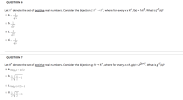 Need help with 8 and 9 only please
QUESTION6 Let R denote the set of positive real numbers. Consider the bijection f R R, where for everyxeR, x) 12. What is flos? o b._1 ?? od.1 QUESTION 7 Let R+ denote the set of positive real numbers. Consider the bijection g: R R+, where for every ? ? R, gw-22x+1. what is g-1(O? a. (00g2x-1)/2 C.0920x/2)-1
Need help with 8 and 9 only please
QUESTION6 Let R denote the set of positive real numbers. Consider the bijection f R R, where for everyxeR, x) 12. What is flos? o b._1 ?? od.1 QUESTION 7 Let R+ denote the set of positive real numbers. Consider the bijection g: R R+, where for every ? ? R, gw-22x+1. what is g-1(O? a. (00g2x-1)/2 C.0920x/2)-1
probelms 9.1 9 Modular arithmetic Definition 9.1 Let S be a set. A relation R =...
 probelms 9.1
9 Modular arithmetic Definition 9.1 Let S be a set. A relation R = R(,y) on S is a statement about pairs (x,y) of elements of S. For r,y ES, I is related to y notation: Ry) if R(x,y) is true. A relation Ris: Reflexive if for any I ES, R. Symmetric if for any ry ES, Ry implies y Rr. Transitive if for any r.y.ES, Ry and yRimply R. An equivalence relation is a reflexive, symmetric and...
probelms 9.1
9 Modular arithmetic Definition 9.1 Let S be a set. A relation R = R(,y) on S is a statement about pairs (x,y) of elements of S. For r,y ES, I is related to y notation: Ry) if R(x,y) is true. A relation Ris: Reflexive if for any I ES, R. Symmetric if for any ry ES, Ry implies y Rr. Transitive if for any r.y.ES, Ry and yRimply R. An equivalence relation is a reflexive, symmetric and...
Suppose an experiment consists of drawing choosing two colors from the colors red,blue,green,pink. Which set best...
Suppose an experiment consists of drawing choosing two colors from the colors red,blue,green,pink. Which set best represents the sample space S of the experiment. For simplicity, I list only the first letter of the colors. S={r,b,g,p} S={(r,b),(r,g),(r,p),(b,g),(b,p),(p,g)} S={(r,b),(r,g),(r,p),(b,g)} S={(b,g),(b,p),(p,g)} S={r,g,b}
2. Let A = ZX Q and B = R? (1) Rewrite the definition of set...
 2. Let A = ZX Q and B = R? (1) Rewrite the definition of set A and B using set builder notation. (2) Show ACB (assuming Z S R and Q SR are already given).
PART 2 red: r = 0 green: g = 70+30 cos(1) blue: b = 60+10 cos(1)...
 PART 2 red: r = 0 green: g = 70+30 cos(1) blue: b = 60+10 cos(1) These functions produce green and blue. When green and blue are equal, they will produce an intensity of cyan. How many times does cyan appear to occur in the interval O SI<2x ? Find the value(s) of where the functions are producing equal amounts of green and blue (cyan)- Round answers to 4 decimal places Test your answer(s) by changing the Time_Out value from...
Question 1: Let R be the set of real numbers and let 2R be the set...
 Question 1: Let R be the set of real numbers and let 2R be the set of all subsets of the real numbers. Prove that 2 cannot be in one-to-one correspondence with R. Proof: Suppose 2 is in one-to-one correspondence with R. Then by definition of one- to-one correspondence there is a 1-to-1 and onto function B:R 2. Therefore, for each x in R, ?(x) is a function from R to {0, 1]. Moreover, since ? is onto, for every...
 5. Let R denote the set of real numbers. Which of the following subsets of R xR can be written as Ax B for appropriate subsets A, B of R? In case of a positive answer, specify the sets A and B. (a) {(z,y)12z<3, 1<y< 2}, (b) {z,)2+y= 1), (c) {(z,y)|z= 2, y R), (d) {(z,y)|z,yS 0}, (e) {(z,y) z y is an integer).
 Need help with 8 and 9 only please
QUESTION6 Let R denote the set of positive real numbers. Consider the bijection f R R, where for everyxeR, x) 12. What is flos? o b._1 ?? od.1 QUESTION 7 Let R+ denote the set of positive real numbers. Consider the bijection g: R R+, where for every ? ? R, gw-22x+1. what is g-1(O? a. (00g2x-1)/2 C.0920x/2)-1
Need help with 8 and 9 only please
QUESTION6 Let R denote the set of positive real numbers. Consider the bijection f R R, where for everyxeR, x) 12. What is flos? o b._1 ?? od.1 QUESTION 7 Let R+ denote the set of positive real numbers. Consider the bijection g: R R+, where for every ? ? R, gw-22x+1. what is g-1(O? a. (00g2x-1)/2 C.0920x/2)-1
 probelms 9.1
9 Modular arithmetic Definition 9.1 Let S be a set. A relation R = R(,y) on S is a statement about pairs (x,y) of elements of S. For r,y ES, I is related to y notation: Ry) if R(x,y) is true. A relation Ris: Reflexive if for any I ES, R. Symmetric if for any ry ES, Ry implies y Rr. Transitive if for any r.y.ES, Ry and yRimply R. An equivalence relation is a reflexive, symmetric and...
probelms 9.1
9 Modular arithmetic Definition 9.1 Let S be a set. A relation R = R(,y) on S is a statement about pairs (x,y) of elements of S. For r,y ES, I is related to y notation: Ry) if R(x,y) is true. A relation Ris: Reflexive if for any I ES, R. Symmetric if for any ry ES, Ry implies y Rr. Transitive if for any r.y.ES, Ry and yRimply R. An equivalence relation is a reflexive, symmetric and...
 2. Let A = ZX Q and B = R? (1) Rewrite the definition of set A and B using set builder notation. (2) Show ACB (assuming Z S R and Q SR are already given).
 PART 2 red: r = 0 green: g = 70+30 cos(1) blue: b = 60+10 cos(1) These functions produce green and blue. When green and blue are equal, they will produce an intensity of cyan. How many times does cyan appear to occur in the interval O SI<2x ? Find the value(s) of where the functions are producing equal amounts of green and blue (cyan)- Round answers to 4 decimal places Test your answer(s) by changing the Time_Out value from...
 Question 1: Let R be the set of real numbers and let 2R be the set of all subsets of the real numbers. Prove that 2 cannot be in one-to-one correspondence with R. Proof: Suppose 2 is in one-to-one correspondence with R. Then by definition of one- to-one correspondence there is a 1-to-1 and onto function B:R 2. Therefore, for each x in R, ?(x) is a function from R to {0, 1]. Moreover, since ? is onto, for every...
Most questions answered within 3 hours.
-
Where is the error in this code sequence?
String s1 = "Hello";
String s2 = "ello";...
asked 11 months ago -
Financial data for Joel de Paris, Inc., for last year
follow:
Joel de Paris, Inc.
Balance...
asked 11 months ago -
Consider this reaction:
Al2(SO4)3 (aq)+ BaCl3
(aq) Al2Cl6 (aq)- +
3BaSO4(s) . What is the...
asked 11 months ago -
Suppose that Savneet is considering increasing her
recent random sample from 20 car rentals to 40...
asked 11 months ago -
Trucks arrive at an unloading terminal at an average rate of 120
per hour.
Trucks arrive...
asked 11 months ago -
Why are methanol and ethanol completely soluble in water while
octanol is not very little soluble....
asked 11 months ago -
A facilities manager at a university reads in a research report
that the mean amount of...
asked 11 months ago -
When the CuSO4 is rehydrated by adding water to the anhydrous
compound, is this an endothermic...
asked 11 months ago -
A ray of sunlight is passing from diamond into crown glass; the
angle of incidence is...
asked 11 months ago -
A block of mass 0.249 kg is placed on top of a light, vertical
spring of...
asked 11 months ago -
how do the kidneys compensate in the presences of acidosis
a) trigger hyperventilate
b) reserve acid...
asked 11 months ago -
Question 501 pts
The rental rate of capital to the firm increases. Which of the
following...
asked 11 months ago