
Homework Answers
Add Answer to:
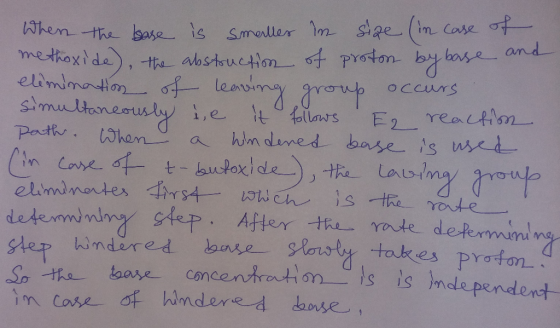
In the reaction below, if the base is t-butoxide, the rate of the reaction is independent of the concentration of th...
Which statements listed below can explain why a chemical reaction does not take place? concentration of...
 Which statements listed below can explain why a chemical reaction does not take place? concentration of reactants is too low the temperature is too low not enough effective collisions are occurring some of these answers all of these answers For a chemical reaction the rate of the forward reaction is at a maximum when when the concentration of the reactants and products is the same a state of equilibrium is reached the reaction begins the concentration of products is greater...
Vmax of an enzyme-catalyzed reaction is A. the rate observed when the enzyme active sites are...
Vmax of an enzyme-catalyzed reaction is A. the rate observed when the enzyme active sites are saturated with substrate B. independent of the amount of enzyme present C. the rate observed at the highest substrate concentration that can be experimentally obtained D. the initial rate observed at very low substrate concentrations
3) Is the plot of nucleophile concentration vs. the rate of reaction (see below) a plot...
 3) Is the plot of nucleophile concentration vs. the rate of reaction (see below) a plot of a Syl or S2 reaction? Please provide an explanation for your choice. (2 points) Kaved (s) 0.0 + 0.0 0.2 0.4 0.8 1.0 1.2 0.6 [Nuc-] (Molar) 4) What is the structure of the compound with the molecular formula C10H 202? (3 points) C10H12O2 TRANSMETTANCE 2000 HAVENUMBERI 2H, t ЗН,t 2H.t 2H.m | 3H,t | 2H, m | | 3H, m | '...
The reaction: The reaction: The rate constant was found to be dependent on the buffer concentration....
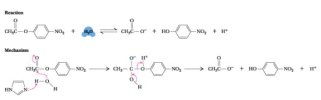 The reaction:
The rate constant was found to be
dependent on the buffer concentration.
Kobs
What does this tell you about the
mechanism of this reaction? Explain.
Reaction o CHsC-0 No, CHsC_0" + HO No, + It' Mechanism o-He o aLC_0 NO2--> CHS-C-0 No,---> CHgC-or + Ho No, +H+ H-O H HN, ,N- O=C
The reaction:
The reaction:
The rate constant was found to be
dependent on the buffer concentration.
Kobs
What does this tell you about the
mechanism of this reaction? Explain.
Reaction o CHsC-0 No, CHsC_0" + HO No, + It' Mechanism o-He o aLC_0 NO2--> CHS-C-0 No,---> CHgC-or + Ho No, +H+ H-O H HN, ,N- O=C
Question two A buffer solution is able to maintain a constant pH when small amounts of...
 Question two
A buffer solution is able to maintain a constant pH when small amounts of acid or base are added to the buffer. Consider what happens when 1 mL of a 5 M solution is added or 0.005 mol of HCl are added to a 100.0 ml solution acetic acid buffer that contains 0.0100 mol of Acetic acid, HC,H,O,, and 0.0100 mol of sodium acetate, NaC,H,O2. The initial concentration of both the acid and the base are 0.0100 mol/0.1000...
Question two
A buffer solution is able to maintain a constant pH when small amounts of acid or base are added to the buffer. Consider what happens when 1 mL of a 5 M solution is added or 0.005 mol of HCl are added to a 100.0 ml solution acetic acid buffer that contains 0.0100 mol of Acetic acid, HC,H,O,, and 0.0100 mol of sodium acetate, NaC,H,O2. The initial concentration of both the acid and the base are 0.0100 mol/0.1000...
Draw the product formed by the reaction of t-butoxide with (1R,2S)-1-bromo-2-methyl-1-phenylbutane (shown below). Draw the correct...
 Draw the product formed by the reaction of t-butoxide with (1R,2S)-1-bromo-2-methyl-1-phenylbutane (shown below). Draw the correct stereoisomer of the product. Draw the product as a skeletal structure. H, Br (CH3),coºk* (CH3),COH Hzclllll CH2 H3C/ Previous Check Answer Next Exit
The best explanation for the shape of the graph below is: Substrate concentration The rate of...
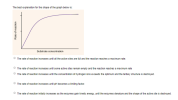 The best explanation for the shape of the graph below is: Substrate concentration The rate of reaction increases until all the active sites are full and the reaction reaches a maximum rate. The rate of reaction increases until some active sites remain empty and the reaction reaches a maximum rate The rate of reaction increases until the concentration of hydrogen ions exceeds the optimum and the tertiary structure is destroyed. The rate of reaction increases until pH becomes a limiting...
Question: The rate of change of concentration in a chemical reaction, F'Dis the sum of the...
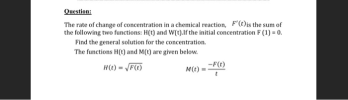 Question: The rate of change of concentration in a chemical reaction, F'Dis the sum of the following two functions: H(t) and (t).If the initial concentration F (1) = 0. Find the general solution for the concentration. The functions H(t) and M(t) are given below. H(t) = F(t) M(t) = -F(t)
The graph below shows an enzyme- controlled reaction. The enzyme concentration is kept constant. At concentrations...
 The graph below shows an enzyme- controlled reaction. The enzyme concentration is kept constant. At concentrations of substrate greater than X, which of the following statements is true? Rate of reaction 0 Concentration of substrate X The rate of reaction is limited by enzyme concentration. The rate of reaction tends towards zero. The substrate has an inhibitory effect. The products have an inhibitory effect.
When dealing with buffer systems, we often use the acid reaction to determine the equilibrium and...
 When dealing with buffer systems, we often use the acid reaction to determine the equilibrium and set up the ICE table. The most common experimental method used to study acid-base systems is titration, which studies the stoichiometric addition of the acid to a base solution or the base to an acid solution to determine the value of K, or K, The value of the pK, or pK, is essential to the understanding of the buffer system, where pK, = -log...
 Which statements listed below can explain why a chemical reaction does not take place? concentration of reactants is too low the temperature is too low not enough effective collisions are occurring some of these answers all of these answers For a chemical reaction the rate of the forward reaction is at a maximum when when the concentration of the reactants and products is the same a state of equilibrium is reached the reaction begins the concentration of products is greater...
 3) Is the plot of nucleophile concentration vs. the rate of reaction (see below) a plot of a Syl or S2 reaction? Please provide an explanation for your choice. (2 points) Kaved (s) 0.0 + 0.0 0.2 0.4 0.8 1.0 1.2 0.6 [Nuc-] (Molar) 4) What is the structure of the compound with the molecular formula C10H 202? (3 points) C10H12O2 TRANSMETTANCE 2000 HAVENUMBERI 2H, t ЗН,t 2H.t 2H.m | 3H,t | 2H, m | | 3H, m | '...
 The reaction:
The rate constant was found to be
dependent on the buffer concentration.
Kobs
What does this tell you about the
mechanism of this reaction? Explain.
Reaction o CHsC-0 No, CHsC_0" + HO No, + It' Mechanism o-He o aLC_0 NO2--> CHS-C-0 No,---> CHgC-or + Ho No, +H+ H-O H HN, ,N- O=C
The reaction:
The reaction:
The rate constant was found to be
dependent on the buffer concentration.
Kobs
What does this tell you about the
mechanism of this reaction? Explain.
Reaction o CHsC-0 No, CHsC_0" + HO No, + It' Mechanism o-He o aLC_0 NO2--> CHS-C-0 No,---> CHgC-or + Ho No, +H+ H-O H HN, ,N- O=C
 Question two
A buffer solution is able to maintain a constant pH when small amounts of acid or base are added to the buffer. Consider what happens when 1 mL of a 5 M solution is added or 0.005 mol of HCl are added to a 100.0 ml solution acetic acid buffer that contains 0.0100 mol of Acetic acid, HC,H,O,, and 0.0100 mol of sodium acetate, NaC,H,O2. The initial concentration of both the acid and the base are 0.0100 mol/0.1000...
Question two
A buffer solution is able to maintain a constant pH when small amounts of acid or base are added to the buffer. Consider what happens when 1 mL of a 5 M solution is added or 0.005 mol of HCl are added to a 100.0 ml solution acetic acid buffer that contains 0.0100 mol of Acetic acid, HC,H,O,, and 0.0100 mol of sodium acetate, NaC,H,O2. The initial concentration of both the acid and the base are 0.0100 mol/0.1000...
 Draw the product formed by the reaction of t-butoxide with (1R,2S)-1-bromo-2-methyl-1-phenylbutane (shown below). Draw the correct stereoisomer of the product. Draw the product as a skeletal structure. H, Br (CH3),coºk* (CH3),COH Hzclllll CH2 H3C/ Previous Check Answer Next Exit
 The best explanation for the shape of the graph below is: Substrate concentration The rate of reaction increases until all the active sites are full and the reaction reaches a maximum rate. The rate of reaction increases until some active sites remain empty and the reaction reaches a maximum rate The rate of reaction increases until the concentration of hydrogen ions exceeds the optimum and the tertiary structure is destroyed. The rate of reaction increases until pH becomes a limiting...
 Question: The rate of change of concentration in a chemical reaction, F'Dis the sum of the following two functions: H(t) and (t).If the initial concentration F (1) = 0. Find the general solution for the concentration. The functions H(t) and M(t) are given below. H(t) = F(t) M(t) = -F(t)
 The graph below shows an enzyme- controlled reaction. The enzyme concentration is kept constant. At concentrations of substrate greater than X, which of the following statements is true? Rate of reaction 0 Concentration of substrate X The rate of reaction is limited by enzyme concentration. The rate of reaction tends towards zero. The substrate has an inhibitory effect. The products have an inhibitory effect.
 When dealing with buffer systems, we often use the acid reaction to determine the equilibrium and set up the ICE table. The most common experimental method used to study acid-base systems is titration, which studies the stoichiometric addition of the acid to a base solution or the base to an acid solution to determine the value of K, or K, The value of the pK, or pK, is essential to the understanding of the buffer system, where pK, = -log...
Most questions answered within 3 hours.
-
Where is the error in this code sequence?
String s1 = "Hello";
String s2 = "ello";...
asked 11 months ago -
Financial data for Joel de Paris, Inc., for last year
follow:
Joel de Paris, Inc.
Balance...
asked 11 months ago -
Consider this reaction:
Al2(SO4)3 (aq)+ BaCl3
(aq) Al2Cl6 (aq)- +
3BaSO4(s) . What is the...
asked 11 months ago -
Suppose that Savneet is considering increasing her
recent random sample from 20 car rentals to 40...
asked 11 months ago -
Trucks arrive at an unloading terminal at an average rate of 120
per hour.
Trucks arrive...
asked 11 months ago -
Why are methanol and ethanol completely soluble in water while
octanol is not very little soluble....
asked 11 months ago -
A facilities manager at a university reads in a research report
that the mean amount of...
asked 11 months ago -
When the CuSO4 is rehydrated by adding water to the anhydrous
compound, is this an endothermic...
asked 11 months ago -
A ray of sunlight is passing from diamond into crown glass; the
angle of incidence is...
asked 11 months ago -
A block of mass 0.249 kg is placed on top of a light, vertical
spring of...
asked 11 months ago -
how do the kidneys compensate in the presences of acidosis
a) trigger hyperventilate
b) reserve acid...
asked 11 months ago -
Question 501 pts
The rental rate of capital to the firm increases. Which of the
following...
asked 11 months ago