Consider the species Cl2+, Cl2,and Cl2−. Which of these species willbe paramagnetic? a. Only Cl2 b. Cl...
| a. | Only Cl2 | b. | Cl2+ and Cl2 | c. | Cl2 andCl2− | d. | Cl2+ andCl2− | e. | All three areparamagnetic. |
Homework Answers
Add Answer to:
Consider the species Cl2+, Cl2,and
Cl2−. Which of these species willbe
paramagnetic?
a.
Only Cl2
b.
Cl...
Consider the species Cl2+, Cl2, and Cl2–. Which of these species will be paramagnetic? [show work] A) Only Cl2 D) Cl2+...
Consider the species Cl2+, Cl2, and Cl2–. Which of these species will be paramagnetic? [show work] A) Only Cl2 D) Cl2+ and Cl2– B) Cl2+ and Cl2 E) All three are paramagnetic. C) Cl2 and Cl2– Work:
Consider the species Cl2+, Cl2, and Cl2-. Which of these species will be paramagnetic?
Consider the species Cl2+, Cl2, and Cl2-. Which of these species will be paramagnetic?
QUESTION 8 1 pointsSave Answer M.1 Consider the species (CI2)+, C12, and (C12)-. According to molecular orbital theory, which of these species will be paramagnetic? Only C12 (C12)+ and C12 C12 and (C...
 QUESTION 8 1 pointsSave Answer M.1 Consider the species (CI2)+, C12, and (C12)-. According to molecular orbital theory, which of these species will be paramagnetic? Only C12 (C12)+ and C12 C12 and (CI12)- o (C12)+ and (C12)- All three are paramagnetic
QUESTION 8 1 pointsSave Answer M.1 Consider the species (CI2)+, C12, and (C12)-. According to molecular orbital theory, which of these species will be paramagnetic? Only C12 (C12)+ and C12 C12 and (CI12)- o (C12)+ and (C12)- All three...
QUESTION 8 1 pointsSave Answer M.1 Consider the species (CI2)+, C12, and (C12)-. According to molecular orbital theory, which of these species will be paramagnetic? Only C12 (C12)+ and C12 C12 and (CI12)- o (C12)+ and (C12)- All three are paramagnetic
QUESTION 8 1 pointsSave Answer M.1 Consider the species (CI2)+, C12, and (C12)-. According to molecular orbital theory, which of these species will be paramagnetic? Only C12 (C12)+ and C12 C12 and (CI12)- o (C12)+ and (C12)- All three...
Version 1 11) Which of the following species would be paramagnetic? A) Fest B) Sr C)...
 Version 1 11) Which of the following species would be paramagnetic? A) Fest B) Sr C) 02 D) Mg E) Zn 12) Place the following in order of increasing radius. Sre Se? Br A) Br <Sr? <Se B) Sr- <Set- <Br C) Se?- < Br<Sr? D) Br <Set- <Sr E) Sr* <Br <Se? 13) Hydrogen peroxide decomposes to water and oxygen at constant pressure by the following reaction: 2 HAO-(I) - 2 HAOI) +O:(g) AH = -196 kg Calculate the...
(a) Draw a molecular orbital energy diagram for Cl2 and show which orbitals are occupied with electrons. (b) How many ba...
(a) Draw a molecular orbital energy diagram for Cl2 and show which orbitals are occupied with electrons. (b) How many bands are expected in the photoelectron spectrum of the valence electrons for Cl2? Why? (c) Draw the shape of the pi* orbital in Cl2. (d) What is the bond order for Cl2? (e) Is Cl2 diamagnetic or paramagnetic?
(a) Draw a molecular orbital energy diagram for Cl2 and show which orbitals are occupied with...
 (a) Draw a molecular orbital energy diagram for Cl2 and show which orbitals are occupied with electrons. (b) How many bands are expected in the photoelectron spectrum of the valence electrons for Cl2? Why? (c) Draw the shape of the r* orbital in Cl2. (d) What is the bond order for Cl2? (e) Is Cl2 diamagnetic or paramagnetic?
Consider the following reaction in basic solution: Cr(OH)3 + ClO- --> Cl2 + CrO42- Which of the...
Consider the following reaction in basic solution: Cr(OH)3 + ClO- --> Cl2 + CrO42- Which of the following statements is/are correct? 1. The oxidizing agent is Cr(OH)3. 2. The oxidation number of the atom being reduced changes from 0 to -2. 3. The oxidation number of the atom being oxidized changes from +3 to +6. 4. When the equation is balanced, the species OH- appears on the right hand side of the equation. A. 3 only B. 3 & 4 only...
A species has the following MO configuration: (σ1s)2(σ1s*)2(σ2s)2(σ2s*)2(σ2p)2(π2p)2 The substance is: A. Paramagnetic with one unpaired...
A species has the following MO configuration: (σ1s)2(σ1s*)2(σ2s)2(σ2s*)2(σ2p)2(π2p)2 The substance is: A. Paramagnetic with one unpaired electron B. Two unpaired electrons C. Three unpaired electrons D. Four unpaired electrons E. Diamagnetic
uestion 8 (1 point Which of the following species is paramagnetic and has exactly two charge-minimized...
 uestion 8 (1 point Which of the following species is paramagnetic and has exactly two charge-minimized resonance structures? NO NO3 N204 NO2
Please explain how you complete this problem. Thanks. Consider the species A) C CL, Cl (B)...
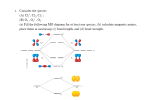 Please explain how you complete this problem. Thanks.
Consider the species A) C CL, Cl (B) O.O.0. (a) Fill the following MO diagram for at least one species, (b) calculate magnetic nature, place them in increasing (c) bond length, and (d) bond strength. 1. 98 0 a,
Please explain how you complete this problem. Thanks.
Consider the species A) C CL, Cl (B) O.O.0. (a) Fill the following MO diagram for at least one species, (b) calculate magnetic nature, place them in increasing (c) bond length, and (d) bond strength. 1. 98 0 a,
 QUESTION 8 1 pointsSave Answer M.1 Consider the species (CI2)+, C12, and (C12)-. According to molecular orbital theory, which of these species will be paramagnetic? Only C12 (C12)+ and C12 C12 and (CI12)- o (C12)+ and (C12)- All three are paramagnetic
QUESTION 8 1 pointsSave Answer M.1 Consider the species (CI2)+, C12, and (C12)-. According to molecular orbital theory, which of these species will be paramagnetic? Only C12 (C12)+ and C12 C12 and (CI12)- o (C12)+ and (C12)- All three...
QUESTION 8 1 pointsSave Answer M.1 Consider the species (CI2)+, C12, and (C12)-. According to molecular orbital theory, which of these species will be paramagnetic? Only C12 (C12)+ and C12 C12 and (CI12)- o (C12)+ and (C12)- All three are paramagnetic
QUESTION 8 1 pointsSave Answer M.1 Consider the species (CI2)+, C12, and (C12)-. According to molecular orbital theory, which of these species will be paramagnetic? Only C12 (C12)+ and C12 C12 and (CI12)- o (C12)+ and (C12)- All three...
 Version 1 11) Which of the following species would be paramagnetic? A) Fest B) Sr C) 02 D) Mg E) Zn 12) Place the following in order of increasing radius. Sre Se? Br A) Br <Sr? <Se B) Sr- <Set- <Br C) Se?- < Br<Sr? D) Br <Set- <Sr E) Sr* <Br <Se? 13) Hydrogen peroxide decomposes to water and oxygen at constant pressure by the following reaction: 2 HAO-(I) - 2 HAOI) +O:(g) AH = -196 kg Calculate the...
 (a) Draw a molecular orbital energy diagram for Cl2 and show which orbitals are occupied with electrons. (b) How many bands are expected in the photoelectron spectrum of the valence electrons for Cl2? Why? (c) Draw the shape of the r* orbital in Cl2. (d) What is the bond order for Cl2? (e) Is Cl2 diamagnetic or paramagnetic?
 uestion 8 (1 point Which of the following species is paramagnetic and has exactly two charge-minimized resonance structures? NO NO3 N204 NO2
 Please explain how you complete this problem. Thanks.
Consider the species A) C CL, Cl (B) O.O.0. (a) Fill the following MO diagram for at least one species, (b) calculate magnetic nature, place them in increasing (c) bond length, and (d) bond strength. 1. 98 0 a,
Please explain how you complete this problem. Thanks.
Consider the species A) C CL, Cl (B) O.O.0. (a) Fill the following MO diagram for at least one species, (b) calculate magnetic nature, place them in increasing (c) bond length, and (d) bond strength. 1. 98 0 a,
Most questions answered within 3 hours.
-
Where is the error in this code sequence?
String s1 = "Hello";
String s2 = "ello";...
asked 10 months ago -
Financial data for Joel de Paris, Inc., for last year
follow:
Joel de Paris, Inc.
Balance...
asked 10 months ago -
Consider this reaction:
Al2(SO4)3 (aq)+ BaCl3
(aq) Al2Cl6 (aq)- +
3BaSO4(s) . What is the...
asked 10 months ago -
Suppose that Savneet is considering increasing her
recent random sample from 20 car rentals to 40...
asked 10 months ago -
Trucks arrive at an unloading terminal at an average rate of 120
per hour.
Trucks arrive...
asked 10 months ago -
Why are methanol and ethanol completely soluble in water while
octanol is not very little soluble....
asked 10 months ago -
A facilities manager at a university reads in a research report
that the mean amount of...
asked 10 months ago -
When the CuSO4 is rehydrated by adding water to the anhydrous
compound, is this an endothermic...
asked 10 months ago -
A ray of sunlight is passing from diamond into crown glass; the
angle of incidence is...
asked 10 months ago -
A block of mass 0.249 kg is placed on top of a light, vertical
spring of...
asked 10 months ago -
how do the kidneys compensate in the presences of acidosis
a) trigger hyperventilate
b) reserve acid...
asked 10 months ago -
Question 501 pts
The rental rate of capital to the firm increases. Which of the
following...
asked 10 months ago