Need as much details as possible. Microeconomics.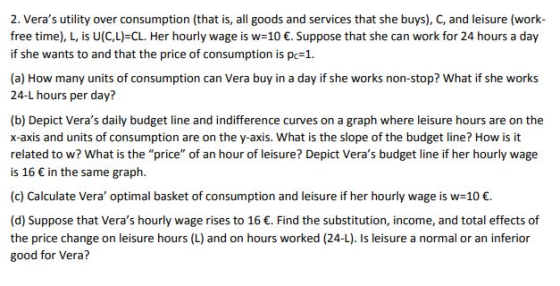
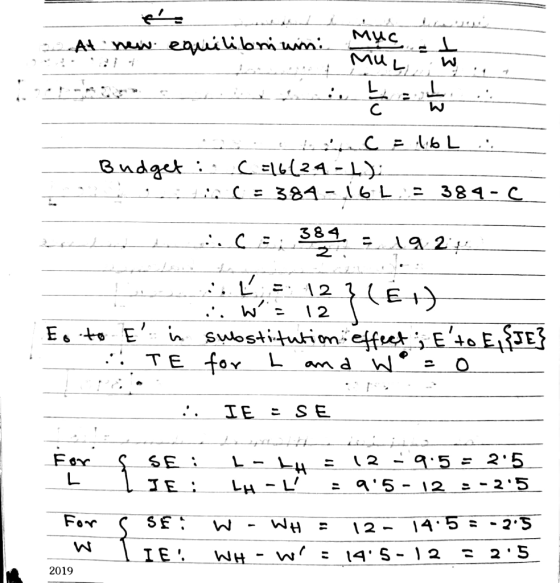
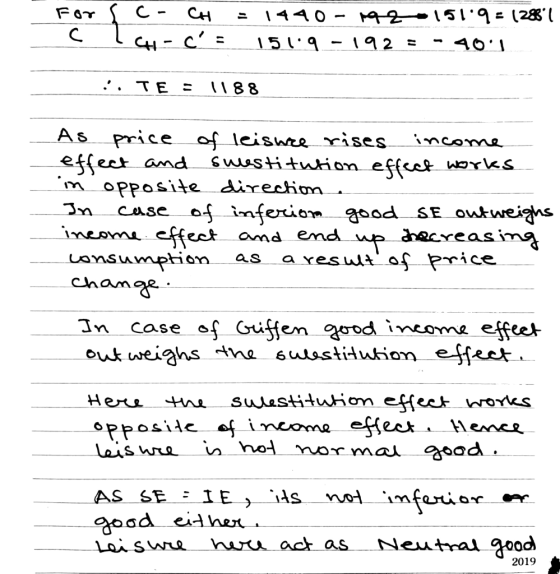
Homework Answers
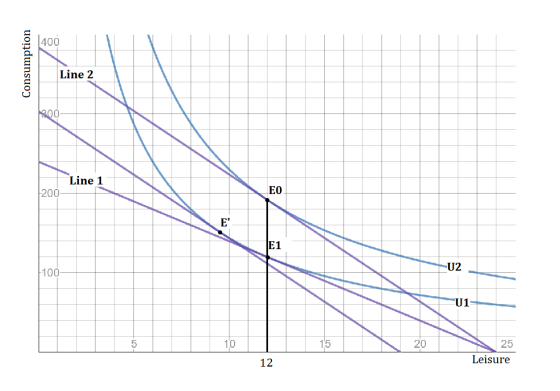
Figure 1

Add Answer to:
Need as much details as possible. Microeconomics. 2. Vera's utility over consumption (that is, all goods and service...
3. Jade is deciding how much to work in 2020. She derives utility from consumption,C, but...
3. Jade is deciding how much to work in 2020. She derives utility from consumption,C, but she also really likes taking leisure time L. She must divide her available hours between work and leisure. For every hour of leisure she takes, she must work one fewer hours (meaning that the price of leisure is her hourly wage). The function that describes her preferences is given by The marginal utilities are U(C, L) = C(1/2)L(1/2) MUC = 1C(−1/2)L(1/2)2 MUL = 1C(1/2)L(−1/2)2...
This problem focuses on the labor supply effects of subsidies. Assume Ann gets utility from consumption...
This problem focuses on the labor supply effects of subsidies. Assume Ann gets utility from consumption c and leisure l. Ann chooses how many hours to supply to the labor market each day (h) but only has 16 hours per day for work and leisure (assuming 8 hours of sleep). For each hour she works, she earns an hourly wage w = 15. Assume Ann has no unearned income v = 0. 1. Write down Ann’s daily budget constraint in...
Clark gains utility from consumption c and leisure l and his preferences for consumption and leisure...
Clark gains utility from consumption c and leisure l and his preferences for consumption and leisure can be expressed as U(c, l) = 2(√ c)(l). This utility function implies that Clark’s marginal utility of leisure is 2√ c and his marginal utility of consumption is l √ c . He has 16 hours per day to allocate between leisure (l) and work (h). His hourly wage is $12 after taxes. Clark also receives a daily check of $30 from the...
Need as much details as possible. Microeconomics. Peter can work 24 hours a day if he...
Need as much details as possible. Microeconomics. Peter can work 24 hours a day if he wants to and gets wage w per hour worked. His utility from leisure (work-free time) and consumption is U(C,L)=CL. If the wage of Peter goes up, which of the following statements is always correct? a. The substitution effect on consumption means that consumption goes up. b. The total effect on leisure means that leisure goes down. c. The income effect on leisure means that...
2. Cindy gains utility from consumption C and leisure L. The most leisure she can consume...
 2. Cindy gains utility from consumption C and leisure L. The most leisure she can consume in any given week is 80 hours. Her utility function is: U(CL)= (1/3) x L (2/3). a) Derive Cindy's marginal rate of substitution (MRS). Suppose Cindy receives $800 each week from her grandmother-regardless of how much Cindy works. What is Cindy's reservation wage? b) Suppose Cindy's wage rate is $30 per hour. Write down Cindy's budget line (including $800 received from her grandmother). Will...
Problem #1: Optimal labor supply Clark gains utility from consumption c and leisure l and his...
Problem #1: Optimal labor supply Clark gains utility from consumption c and leisure l and his preferences for consumption and leisure can be expressed as U(c, l) = 2(√ c)(l). This utility function implies that Clark’s marginal utility of leisure is 2√ c and his marginal utility of consumption is l √ c . He has 16 hours per day to allocate between leisure (l) and work (h). His hourly wage is $12 after taxes. Clark also receives a daily...
Problem #2: A subsidy on earnings This problem focuses on the labor supply eects of subsidies....
Problem #2: A subsidy on earnings This problem focuses on the labor supply eects of subsidies. Assume Ann gets utility from consumption c and leisure l. Ann chooses how many hours to supply to the labor market each day (h) but only has 16 hours per day for work and leisure (assuming 8 hours of sleep). For each hour she works, she earns an hourly wage w = 15. Assume Ann has no unearned income v = 0. Write down...
4. Investment banker chooses between leisure and consumption good. The price of consump tion good is...
 4. Investment banker chooses between leisure and consumption good. The price of consump tion good is p. She has super-ability to work for any amount of time between 0 and 24 hours per day. Her per hour wage is w if she works less than 8 hours, and she gets paid overtime salary w' for each hour she works after the 8th hour. Assume that 0<w< w' Also if her income is higher than M, then she has to pay...
3. Consider a consumer who has well-behaved preferences over leisure (L) and consumption (x) They have...
 3. Consider a consumer who has well-behaved preferences over leisure (L) and consumption (x) They have nonlabor income m and have 24 hours in the day that must be divided between leisure and working. They are initially paid a wage w for each hour of work. The price of x is 1 (a) Suppose they optimally choose to work 8 hours. Draw the consumer's budget set and an indifference curve showing this situation. (b) Now suppose that they are paid...
1. Janet's utility depends on consumption c and leisure l. She earns a wage equal to...
1. Janet's utility depends on consumption c and leisure l. She earns a wage equal to w per hour, has an investment income equal to M(greater than or equal to) 0 and needs to sleep at least 8 hours a night. Normalize the price of consumption goods at $1. (i) Draw her indifference curves between hours of leisure and consumption, her budget line and her equilibrium choice of c and l. What is the slope of the budget line and...
 2. Cindy gains utility from consumption C and leisure L. The most leisure she can consume in any given week is 80 hours. Her utility function is: U(CL)= (1/3) x L (2/3). a) Derive Cindy's marginal rate of substitution (MRS). Suppose Cindy receives $800 each week from her grandmother-regardless of how much Cindy works. What is Cindy's reservation wage? b) Suppose Cindy's wage rate is $30 per hour. Write down Cindy's budget line (including $800 received from her grandmother). Will...
 4. Investment banker chooses between leisure and consumption good. The price of consump tion good is p. She has super-ability to work for any amount of time between 0 and 24 hours per day. Her per hour wage is w if she works less than 8 hours, and she gets paid overtime salary w' for each hour she works after the 8th hour. Assume that 0<w< w' Also if her income is higher than M, then she has to pay...
 3. Consider a consumer who has well-behaved preferences over leisure (L) and consumption (x) They have nonlabor income m and have 24 hours in the day that must be divided between leisure and working. They are initially paid a wage w for each hour of work. The price of x is 1 (a) Suppose they optimally choose to work 8 hours. Draw the consumer's budget set and an indifference curve showing this situation. (b) Now suppose that they are paid...
Most questions answered within 3 hours.
-
Where is the error in this code sequence?
String s1 = "Hello";
String s2 = "ello";...
asked 10 months ago -
Financial data for Joel de Paris, Inc., for last year
follow:
Joel de Paris, Inc.
Balance...
asked 10 months ago -
Consider this reaction:
Al2(SO4)3 (aq)+ BaCl3
(aq) Al2Cl6 (aq)- +
3BaSO4(s) . What is the...
asked 10 months ago -
Suppose that Savneet is considering increasing her
recent random sample from 20 car rentals to 40...
asked 10 months ago -
Trucks arrive at an unloading terminal at an average rate of 120
per hour.
Trucks arrive...
asked 10 months ago -
Why are methanol and ethanol completely soluble in water while
octanol is not very little soluble....
asked 10 months ago -
A facilities manager at a university reads in a research report
that the mean amount of...
asked 10 months ago -
When the CuSO4 is rehydrated by adding water to the anhydrous
compound, is this an endothermic...
asked 10 months ago -
A ray of sunlight is passing from diamond into crown glass; the
angle of incidence is...
asked 10 months ago -
A block of mass 0.249 kg is placed on top of a light, vertical
spring of...
asked 10 months ago -
how do the kidneys compensate in the presences of acidosis
a) trigger hyperventilate
b) reserve acid...
asked 10 months ago -
Question 501 pts
The rental rate of capital to the firm increases. Which of the
following...
asked 10 months ago