DESIGN SECONDARY SEDIMEMTATION TANK TO FIND OUT THE DIAMETER THE DEPTH AND NUMBER OF TANKS FOLLOWING INFORMATION: MLSS =...
DESIGN SECONDARY SEDIMEMTATION TANK TO FIND OUT THE DIAMETER THE DEPTH AND NUMBER OF TANKS FOLLOWING INFORMATION:
MLSS = 2600-2900
DIAMETER = 3-50M
WATER DEPTH = 3-5M
40-50% OF WASTERWATER WILL BE RECIRCULATED TO THE AERATION TANK
Homework Answers
Secondary sedimentation basin generally follows Zone or Hindered settling, for the design of such a system the column test results must be presented. Hence here the basic sedimentation chamber with recirculation is designed.
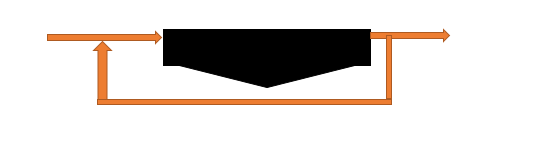
let us assume a design inflow, Qi = 1MLD
MLSS = 2600-2900, that is let X = (2600+2900)/2 = 2750 mg/l
Qr = 50% of Q
therefore, total Q = 1.5Q = 1.5MLD
surface overflow rate for secondary clarifiers are in the range of 16-24 m3/m2-d
SOR = 20 m3/m2-d
Total Area required for the tank,
A=QSOR
A=1.5*106*10-320=75
m2
A = 75m2
Diameter of one tank be 4m
Therefore, area of one tank,
a=π*424=12.56
m2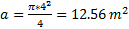
a = 12.56 m2
number of tanks required, n = A/a = 5.97
approximately provide 6 tanks of 4m diameter
detention time of secondary clarifier is in the range of 90-120minutes
let dt = 90minutes
volume required, V = Q*dt
V = 93.75m3
Depth of each tank D
But volume of each tank is v = D * a
V = 6* D*a
D = V/(6*a)
D = 1.244 m
Add Answer to:
DESIGN SECONDARY SEDIMEMTATION TANK TO FIND OUT THE DIAMETER THE DEPTH AND NUMBER OF TANKS FOLLOWING INFORMATION: MLSS =...
A wastewater treatment plant that treats wastewater to secondary treatment standards uses a primary sedimentation process...
 A wastewater treatment plant that treats wastewater to secondary treatment standards uses a primary sedimentation process followed by conventional activated sludge process composed of covered aeration tanks and secondary clarifiers. You are asked to calculate the different operation parameters to make sure that the system is operated within normal process ranges listed in the reference tables below. Table 5-20 Typical design information for primary sedimentation tanks U.S. customary units Item Unit Range Typical Primary sedimentation tanks followed by secondary treatment...
You have been assigned the job of designing a rapid mix tank for a new water...
You have been assigned the job of designing a rapid mix tank for a new water treatment plant. The design flow rate is 1.0 m3/sec. The average water temperature is 10 oC. The following design assumptions have been made: 1. Number of tanks = 1 (with 1 backup) 2. Tank configuration: Circular with liquid depth of 1.0m. 3. Detention time = 40 sec. 4. Velocity gradient = 750 s-1 Design the rapid mix by providing the following: a) Water power...
4. (40 pts) You need to design a set of activated sludge aeration tanks. The flow...
 4. (40 pts) You need to design a set of activated sludge aeration tanks. The flow rate to treat is 5.6 MGD and the BOD concentration is 150 mg/L. The design solids concentration (X) at steady-state is 2,000 mg/L. The design MCRT is 7 days. The kinetic coefficients are as follows: k = 2 g BOD!g cells*day; K = 25 mg BOD/L; k, = 0.06 1/day; Y = 0.5 g cells/G BOD. The influent ammonia concentration is 40 mg/L and...
Q3) [15 points] Design a horizontal flow rectangular sedimentation basin for a maximum flowrate of 43,200...
 Q3) [15 points] Design a horizontal flow rectangular sedimentation basin for a maximum flowrate of 43,200 m3/d. Assume an overflow rate of 40 m3/d.m2 and a water temperature of 12 °C. Provide the following in your summary of the design: Qdesign; Number of tanks; Width of each tank; Length of each tank; Side water depth; Depth of sludge zone; L:D; vf; Reynolds number; Froude Number; Number of Launders; Launder Length; Wier Loading; Type of sludge collector.
1. Consider the following figure below that shows two brine tanks r galmin fresh water Tank 1 ank...
 1. Consider the following figure below that shows two brine tanks r galmin fresh water Tank 1 anks 2 containing and V, gallons of brine respectively. Fresh water flows into tank 1, while mixed brine flows from tank l into tank 2· Let x(1) denote the amount (in pounds) ofsalt in tank i at time for i-1,2. Ifeach flow rate is r gallons per minute, then a simple account of salt concentration yields the first-order system where 1,2 If V-50,...
1. Consider the following figure below that shows two brine tanks r gal/min fresh water Tank 1 an...
 1. Consider the following figure below that shows two brine tanks r gal/min fresh water Tank 1 anks 2 containing V and V gallons of brine respectively. Fresh water flows into tank 1, while mixed brine flows from tank 1 into tank 2. Let x,() denote the amount (in pounds) of salt in tank i at time for i-1,2. If each flow rate is r gallons per minute, then a simple account of salt concentration yields the first-order system where...
Secondary Treatment Based on a plant flow rate of 40 mgd, design an activated sludge, secondary t...
 Secondary Treatment Based on a plant flow rate of 40 mgd, design an activated sludge, secondary treatment system with recycle which maintains a MLVSS = 2,000 mg/L in the aeration reactor and has an average Solids Retention Time (SRT)-4 days. The biota kinetic constants are Kinetic Coefficients for the Activated-sludge Process for the Removal of Organic Matter from Domestic Wastewater Endogenous Decay Coefficient- k(d) 0.1 Half-velocity constant- K(s VSS/qVss-da 15 Mg/L bsCOD Max. Specific Substrate Utilization Rate-k 6 G bsCOD/gVSS-da...
B. Set up a system of equations for the following situation and then use MATLAB to solve the system Tank A contains 50 gallons of water in which 25 pounds of salt are dissolved. A second tank, B, con...
 B. Set up a system of equations for the following situation and then use MATLAB to solve the system Tank A contains 50 gallons of water in which 25 pounds of salt are dissolved. A second tank, B, contains 50 gallons of pure water. Liquid is pumped in and out of the tanks at the rates shown in Figure 8.9. Derive the differential equations taerihe themuunds and B, respectively d tm in tanks A mixture pure water 3 gal/min 1...
Design a flocculation basin by determining the basin volume, tank dimensions, required input power, and impeller...
Design a flocculation basin by determining the basin volume, tank dimensions, required input power, and impeller location using the following data: Flocculation basin = 2 unit Design flowrate = 12 m3/min Detention time = 30 min Water depth = 4 m Compartment = 3 Velocity Gradient, G in eah compartment = 70, 50 and 30 s-l Dynamic viscosity at 24oC = 0.000911 Pa.s Efficiency of transfer of motor power to water power = 80% Impeller placement at one-third of water...
5. (30 points) Initially, two large tanks A and B each hold 50 gallons of brine. The well-mixed l...
 5. (30 points) Initially, two large tanks A and B each hold 50 gallons of brine. The well-mixed liquid is pumped between the tanks as shown below. Use the information on the figure to construct a mathematical model for the number of pounds of salt x, (t) and x2(t) at time t in the tanks A and B pure water 3 gal/min mixture I gal/min 50 gal mixture mixture 4 gal/min 3 gal/min Solve the system subject to the initial...
 A wastewater treatment plant that treats wastewater to secondary treatment standards uses a primary sedimentation process followed by conventional activated sludge process composed of covered aeration tanks and secondary clarifiers. You are asked to calculate the different operation parameters to make sure that the system is operated within normal process ranges listed in the reference tables below. Table 5-20 Typical design information for primary sedimentation tanks U.S. customary units Item Unit Range Typical Primary sedimentation tanks followed by secondary treatment...
 4. (40 pts) You need to design a set of activated sludge aeration tanks. The flow rate to treat is 5.6 MGD and the BOD concentration is 150 mg/L. The design solids concentration (X) at steady-state is 2,000 mg/L. The design MCRT is 7 days. The kinetic coefficients are as follows: k = 2 g BOD!g cells*day; K = 25 mg BOD/L; k, = 0.06 1/day; Y = 0.5 g cells/G BOD. The influent ammonia concentration is 40 mg/L and...
 Q3) [15 points] Design a horizontal flow rectangular sedimentation basin for a maximum flowrate of 43,200 m3/d. Assume an overflow rate of 40 m3/d.m2 and a water temperature of 12 °C. Provide the following in your summary of the design: Qdesign; Number of tanks; Width of each tank; Length of each tank; Side water depth; Depth of sludge zone; L:D; vf; Reynolds number; Froude Number; Number of Launders; Launder Length; Wier Loading; Type of sludge collector.
 1. Consider the following figure below that shows two brine tanks r galmin fresh water Tank 1 anks 2 containing and V, gallons of brine respectively. Fresh water flows into tank 1, while mixed brine flows from tank l into tank 2· Let x(1) denote the amount (in pounds) ofsalt in tank i at time for i-1,2. Ifeach flow rate is r gallons per minute, then a simple account of salt concentration yields the first-order system where 1,2 If V-50,...
 1. Consider the following figure below that shows two brine tanks r gal/min fresh water Tank 1 anks 2 containing V and V gallons of brine respectively. Fresh water flows into tank 1, while mixed brine flows from tank 1 into tank 2. Let x,() denote the amount (in pounds) of salt in tank i at time for i-1,2. If each flow rate is r gallons per minute, then a simple account of salt concentration yields the first-order system where...
 Secondary Treatment Based on a plant flow rate of 40 mgd, design an activated sludge, secondary treatment system with recycle which maintains a MLVSS = 2,000 mg/L in the aeration reactor and has an average Solids Retention Time (SRT)-4 days. The biota kinetic constants are Kinetic Coefficients for the Activated-sludge Process for the Removal of Organic Matter from Domestic Wastewater Endogenous Decay Coefficient- k(d) 0.1 Half-velocity constant- K(s VSS/qVss-da 15 Mg/L bsCOD Max. Specific Substrate Utilization Rate-k 6 G bsCOD/gVSS-da...
 B. Set up a system of equations for the following situation and then use MATLAB to solve the system Tank A contains 50 gallons of water in which 25 pounds of salt are dissolved. A second tank, B, contains 50 gallons of pure water. Liquid is pumped in and out of the tanks at the rates shown in Figure 8.9. Derive the differential equations taerihe themuunds and B, respectively d tm in tanks A mixture pure water 3 gal/min 1...
 5. (30 points) Initially, two large tanks A and B each hold 50 gallons of brine. The well-mixed liquid is pumped between the tanks as shown below. Use the information on the figure to construct a mathematical model for the number of pounds of salt x, (t) and x2(t) at time t in the tanks A and B pure water 3 gal/min mixture I gal/min 50 gal mixture mixture 4 gal/min 3 gal/min Solve the system subject to the initial...
Most questions answered within 3 hours.
-
Where is the error in this code sequence?
String s1 = "Hello";
String s2 = "ello";...
asked 11 months ago -
Financial data for Joel de Paris, Inc., for last year
follow:
Joel de Paris, Inc.
Balance...
asked 11 months ago -
Consider this reaction:
Al2(SO4)3 (aq)+ BaCl3
(aq) Al2Cl6 (aq)- +
3BaSO4(s) . What is the...
asked 11 months ago -
Suppose that Savneet is considering increasing her
recent random sample from 20 car rentals to 40...
asked 11 months ago -
Trucks arrive at an unloading terminal at an average rate of 120
per hour.
Trucks arrive...
asked 11 months ago -
Why are methanol and ethanol completely soluble in water while
octanol is not very little soluble....
asked 11 months ago -
A facilities manager at a university reads in a research report
that the mean amount of...
asked 11 months ago -
When the CuSO4 is rehydrated by adding water to the anhydrous
compound, is this an endothermic...
asked 11 months ago -
A ray of sunlight is passing from diamond into crown glass; the
angle of incidence is...
asked 11 months ago -
A block of mass 0.249 kg is placed on top of a light, vertical
spring of...
asked 11 months ago -
how do the kidneys compensate in the presences of acidosis
a) trigger hyperventilate
b) reserve acid...
asked 11 months ago -
Question 501 pts
The rental rate of capital to the firm increases. Which of the
following...
asked 11 months ago