Question

Interpret the pareto diagram. Pls show your working, thanks!
Homework Answers
Answer #1
I have used excel. following the steps
- Input the data in the sheet and then sort it in descending order.
| Amt. of Floor Space(sq. ft.) | No. of Tenants |
| 4000 - 30000 | 806 |
| <1500 | 725 |
| 10000 - 30000 | 230 |
| 1500 - 30000 | 67 |
| <30000 | 20 |
| Sum | 1848 |
- Get percentages and its cumulative
Cumulative for 1st remains same and for 2nd = previous + 39.2%
| Amt. of Floor Space(sq. ft.) | No. of Tenants | Cumulative | % |
| 4000 - 30000 | 806 | 43.6% | 43.6% |
| <1500 | 725 | 82.8% | 39.2% |
| 10000 - 30000 | 230 | 95.3% | 12.4% |
| 1500 - 30000 | 67 | 98.9% | 3.6% |
| <30000 | 20 | 100% | 1.1% |
- Select the data till cumulative and insert ' Column- 2-d Clustered'
- Select on any bar and right click and select 'Change Series Chart Type '
- In the dilogue box select 'Combo'
- Make the change 'Amt. of floor space - Clustered Column'
cumulative - line (check for secondary axis as well)
For Excel 2010 or 2007, it will be a two-step process. First, change the chart type to a line chart and then right click on the line chart and select Format Data Series and select Secondary Axis in Series Option
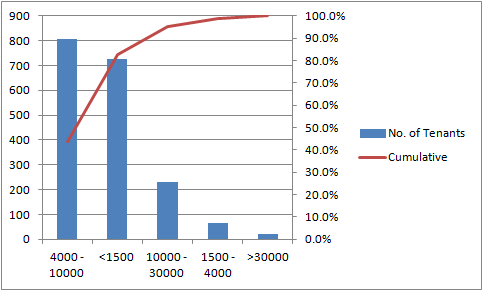
Interpretation: This diagram shows that around 80% of tenants have a space of 4000-10000 and <1500 sq. ft. A very few people have >30000sq ft. space.
Pareto diagram is used for anaysing the cases(causes) with highest frequency(problems) and which takes up about 80% of the total number of problems.
900 100.0% 90.0% 800 80.0% 700 70.0% 600 60.0% 500 50.0% No. of Tenants 40.0%-Cumulative 300 30.0% 200 20.0% 100 10.0% 0.0% 4000<1500 10000150030000 10000 30000 4000
Know the answer?
Add Answer to:
Interpret the pareto diagram. Pls show your working, thanks! One aspect of a study involved describing the type of tena...
Not the answer you're looking for?
Ask your own homework help question.
Our experts will answer your question WITHIN MINUTES for Free.
Similar Homework Help Questions
ADVERTISEMENT
Need Online Homework Help?
Ask
a QuestionGet Answers For Free
Most questions answered within 3 hours.
Most questions answered within 3 hours.
ADVERTISEMENT
Active Questions
-
Where is the error in this code sequence?
String s1 = "Hello";
String s2 = "ello";...
asked 10 months ago -
Financial data for Joel de Paris, Inc., for last year
follow:
Joel de Paris, Inc.
Balance...
asked 10 months ago -
Consider this reaction:
Al2(SO4)3 (aq)+ BaCl3
(aq) Al2Cl6 (aq)- +
3BaSO4(s) . What is the...
asked 10 months ago -
Suppose that Savneet is considering increasing her
recent random sample from 20 car rentals to 40...
asked 10 months ago -
Trucks arrive at an unloading terminal at an average rate of 120
per hour.
Trucks arrive...
asked 10 months ago -
Why are methanol and ethanol completely soluble in water while
octanol is not very little soluble....
asked 10 months ago -
A facilities manager at a university reads in a research report
that the mean amount of...
asked 10 months ago -
When the CuSO4 is rehydrated by adding water to the anhydrous
compound, is this an endothermic...
asked 10 months ago -
A ray of sunlight is passing from diamond into crown glass; the
angle of incidence is...
asked 10 months ago -
A block of mass 0.249 kg is placed on top of a light, vertical
spring of...
asked 10 months ago -
how do the kidneys compensate in the presences of acidosis
a) trigger hyperventilate
b) reserve acid...
asked 10 months ago -
Question 501 pts
The rental rate of capital to the firm increases. Which of the
following...
asked 10 months ago
ADVERTISEMENT