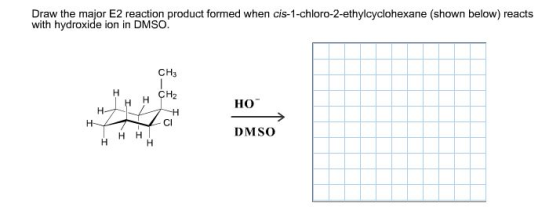
Draw the major E2 reaction product formed when cis-1-chloro-2-ethylcyclohexane (shown below) reacts with hydroxide ion in DMSO.
Homework Answers
An E2 elimination reaction is a bi-molecular elimination reaction. This elimination process is single-step process which follows a concerted mechanism. In an E2 elimination reaction, the intermediate is in transition state. The rate of the reaction depends on both the base and the substrate; therefore, an E2 elimination reaction is known as a bi-molecular elimination reaction.
In an E2 elimination reaction, the alkene product is based on the base used in the reaction to attract the acidic proton in the substrate. If a bulky base that is steric crowded is used, a Hoffman alkene is the product; if the base is not steric hindered, then a highly substituted alkene is the product according to Zaitsev’s rule.
The given substrate is cis-1-chloro-2-ethylcyclohexane
The structure of the substrate is shown below.

The ring flip of the given substrate is shown below.

Given base is
The base attack on the given substrate cis-1-chloro-2-ethylcyclohexane is shown below.

The eliminated product of the given substrate is shown below.

The complete reaction

Add Answer to:
Draw the major E2 reaction product formed when
cis-1-chloro-2-ethylcyclohexane (shown below) reacts with hydroxide
i...
Draw the major E2 reaction product formed when cis-1-chloro-2-ethylcyclohexane (shown below) reacts with hydroxide ion in...
 Draw the major E2 reaction product formed when
cis-1-chloro-2-ethylcyclohexane (shown below) reacts with hydroxide
ion in DMSO.
Draw the major E2 reaction product formed when
cis-1-chloro-2-ethylcyclohexane (shown below) reacts with hydroxide
ion in DMSO.
Draw the major E2 reaction product formed when trans-1-chloro-2-ethylcyclohexane (shown below) reacts with hydroxide i...
 Draw the major E2 reaction product formed when
trans-1-chloro-2-ethylcyclohexane (shown below) reacts with
hydroxide ion in DMSO.
Draw the major E2 reaction product formed when trans-1-chloro-2-ethylcyclohexane (shown below) reacts with hydroxide ion in DMSO.
Draw the major E2 reaction product formed when
trans-1-chloro-2-ethylcyclohexane (shown below) reacts with
hydroxide ion in DMSO.
Draw the major E2 reaction product formed when trans-1-chloro-2-ethylcyclohexane (shown below) reacts with hydroxide ion in DMSO.
Draw the major E2 reaction product formed when cis-1-chloro-2-ethylcyclohexane (shown below) reacts with hydroxide ion...
 Draw the major E2 reaction product formed when cis-1-chloro-2-ethylcyclohexane (shown below) reacts with hydroxide ion in DMSO. DMSO is just a solvent and plays no role in what product is formed. Draw the product as a planar cyclohexane skeletal structure (framework provided). CHз HO ..HAH Ý CH2 CI DMSO Ń HH ! H 7 Hint Previous Check Answer Next Exit
Draw the major E2 reaction product formed when trans-1-chloro-2-ethylcyclohexane (shown below) reacts with hydroxide ion in...
 Draw the major E2 reaction product formed when trans-1-chloro-2-ethylcyclohexane (shown below) reacts with hydroxide ion in DMSO. CH3 HO CH2 CI DMSO
Draw the major E2 reaction product formed when trans-1-chloro-2-ethylcyclohexane reacts with...
Draw the major E2 reaction product formed when trans-1-chloro-2-ethylcyclohexane reacts with hydroxide ion in DMSO.
Draw the major E2 reaction product formed when trans-1-chloro-2-ethylcyclohexane (shown below) reacts with hydroxide ion in...
 Draw the major E2 reaction product formed when trans-1-chloro-2-ethylcyclohexane (shown below) reacts with hydroxide ion in DMSO. DMSO is a solvent and plays no role in what product is formed. Draw the product as a planar cyclohexane skeletal structure (framework provided). н ., сн. H CH₃ HO H H H CH2 Vlci DMSO HH 7 Hint Previous Check Answer Next Exit
Draw the major E2 reaction product formed when trans-1-chloro-2-ethylcyclohexane (shown below) reacts with hydroxido ion in...
 Draw the major E2 reaction product formed when trans-1-chloro-2-ethylcyclohexane (shown below) reacts with hydroxido ion in DMSO.
(a) When cis-1-bromo-2-methylcyclohexane undergoes an E2 reaction, two products (cycloalkenes) are formed. What are these two...
 (a) When cis-1-bromo-2-methylcyclohexane undergoes an E2 reaction, two products (cycloalkenes) are formed. What are these two cycloalkenes, and which would you expect to be the major product? Write conformational structures showing how each is formed. (b) When trans-1-bromo-2-methylcyclohexane reacts in an E2 reaction, only one cyclo- alkene is formed. What is this product? Write conformational structures showing why it is the only product.
7. Shown below are the major product formed and the proposed mechanism when 1- methylcyclohexanol reacts...
 7. Shown below are the major product formed and the proposed mechanism when 1- methylcyclohexanol reacts with 85% H3PO4 at 150 °C. Name all curved arrows shown in each step as either "lone pair to bond" or "bond to long pair". Specify the atom that donates/accepts the lone pair. [1 Mark] Step 1 -H O ro-H + Ho + H2O H H Commons Kagamo Step 2 + H2O Step 3 = + H,PO. H HAPO Zaitsev product 6. Given below...
#15 14) Draw the product that is formed when (S)-2-iodopentane reacts with 15) Draw the major...
 #15
14) Draw the product that is formed when (S)-2-iodopentane reacts with 15) Draw the major product of the following reaction: NaCN 16) Provide the major organic product of the reaction below. OCH CHCHCH.MoBred) Hac 17) Provide the major organic product of the reaction below.
#15
14) Draw the product that is formed when (S)-2-iodopentane reacts with 15) Draw the major product of the following reaction: NaCN 16) Provide the major organic product of the reaction below. OCH CHCHCH.MoBred) Hac 17) Provide the major organic product of the reaction below.
 Draw the major E2 reaction product formed when
cis-1-chloro-2-ethylcyclohexane (shown below) reacts with hydroxide
ion in DMSO.
Draw the major E2 reaction product formed when
cis-1-chloro-2-ethylcyclohexane (shown below) reacts with hydroxide
ion in DMSO.
 Draw the major E2 reaction product formed when
trans-1-chloro-2-ethylcyclohexane (shown below) reacts with
hydroxide ion in DMSO.
Draw the major E2 reaction product formed when trans-1-chloro-2-ethylcyclohexane (shown below) reacts with hydroxide ion in DMSO.
Draw the major E2 reaction product formed when
trans-1-chloro-2-ethylcyclohexane (shown below) reacts with
hydroxide ion in DMSO.
Draw the major E2 reaction product formed when trans-1-chloro-2-ethylcyclohexane (shown below) reacts with hydroxide ion in DMSO.
 Draw the major E2 reaction product formed when cis-1-chloro-2-ethylcyclohexane (shown below) reacts with hydroxide ion in DMSO. DMSO is just a solvent and plays no role in what product is formed. Draw the product as a planar cyclohexane skeletal structure (framework provided). CHз HO ..HAH Ý CH2 CI DMSO Ń HH ! H 7 Hint Previous Check Answer Next Exit
 Draw the major E2 reaction product formed when trans-1-chloro-2-ethylcyclohexane (shown below) reacts with hydroxide ion in DMSO. CH3 HO CH2 CI DMSO
 Draw the major E2 reaction product formed when trans-1-chloro-2-ethylcyclohexane (shown below) reacts with hydroxide ion in DMSO. DMSO is a solvent and plays no role in what product is formed. Draw the product as a planar cyclohexane skeletal structure (framework provided). н ., сн. H CH₃ HO H H H CH2 Vlci DMSO HH 7 Hint Previous Check Answer Next Exit
 Draw the major E2 reaction product formed when trans-1-chloro-2-ethylcyclohexane (shown below) reacts with hydroxido ion in DMSO.
 (a) When cis-1-bromo-2-methylcyclohexane undergoes an E2 reaction, two products (cycloalkenes) are formed. What are these two cycloalkenes, and which would you expect to be the major product? Write conformational structures showing how each is formed. (b) When trans-1-bromo-2-methylcyclohexane reacts in an E2 reaction, only one cyclo- alkene is formed. What is this product? Write conformational structures showing why it is the only product.
 7. Shown below are the major product formed and the proposed mechanism when 1- methylcyclohexanol reacts with 85% H3PO4 at 150 °C. Name all curved arrows shown in each step as either "lone pair to bond" or "bond to long pair". Specify the atom that donates/accepts the lone pair. [1 Mark] Step 1 -H O ro-H + Ho + H2O H H Commons Kagamo Step 2 + H2O Step 3 = + H,PO. H HAPO Zaitsev product 6. Given below...
 #15
14) Draw the product that is formed when (S)-2-iodopentane reacts with 15) Draw the major product of the following reaction: NaCN 16) Provide the major organic product of the reaction below. OCH CHCHCH.MoBred) Hac 17) Provide the major organic product of the reaction below.
#15
14) Draw the product that is formed when (S)-2-iodopentane reacts with 15) Draw the major product of the following reaction: NaCN 16) Provide the major organic product of the reaction below. OCH CHCHCH.MoBred) Hac 17) Provide the major organic product of the reaction below.
Most questions answered within 3 hours.
-
Where is the error in this code sequence?
String s1 = "Hello";
String s2 = "ello";...
asked 10 months ago -
Financial data for Joel de Paris, Inc., for last year
follow:
Joel de Paris, Inc.
Balance...
asked 10 months ago -
Consider this reaction:
Al2(SO4)3 (aq)+ BaCl3
(aq) Al2Cl6 (aq)- +
3BaSO4(s) . What is the...
asked 10 months ago -
Suppose that Savneet is considering increasing her
recent random sample from 20 car rentals to 40...
asked 10 months ago -
Trucks arrive at an unloading terminal at an average rate of 120
per hour.
Trucks arrive...
asked 10 months ago -
Why are methanol and ethanol completely soluble in water while
octanol is not very little soluble....
asked 10 months ago -
A facilities manager at a university reads in a research report
that the mean amount of...
asked 10 months ago -
When the CuSO4 is rehydrated by adding water to the anhydrous
compound, is this an endothermic...
asked 10 months ago -
A ray of sunlight is passing from diamond into crown glass; the
angle of incidence is...
asked 10 months ago -
A block of mass 0.249 kg is placed on top of a light, vertical
spring of...
asked 10 months ago -
how do the kidneys compensate in the presences of acidosis
a) trigger hyperventilate
b) reserve acid...
asked 10 months ago -
Question 501 pts
The rental rate of capital to the firm increases. Which of the
following...
asked 10 months ago