General Equilibrium: Consider an economy that can produce tacos (X) and hamburgers (Y). Let the production possibilities...
General Equilibrium: Consider an economy that can produce tacos (X) and hamburgers (Y). Let the production possibilities frontier (PPF) be
Y2 = 100-4X2 (Eq. 1)
or, equivalently
? = √100 − 4?2 (Eq. 2)
(for positive values of tacos and hamburgers).
This means that the rate of product transformation (RPT), the number of hamburgers that must be given up to get one more taco along the PPF, is
− ??/?? = 4?/(√100−4?2)
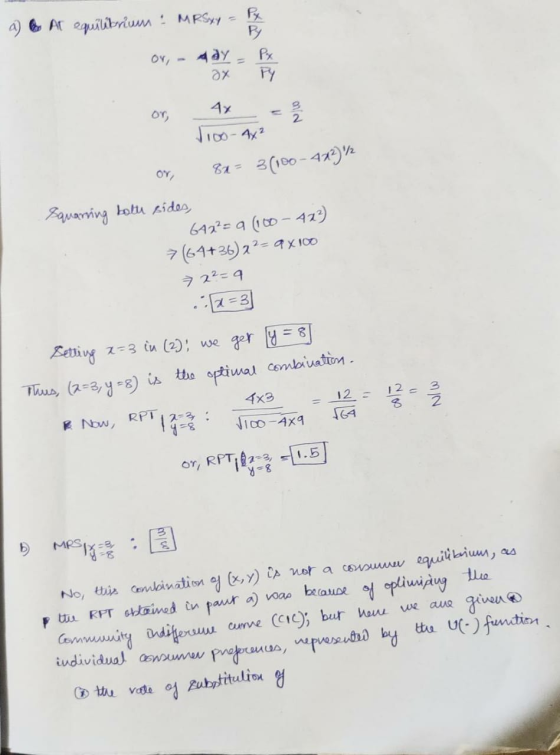
a. Suppose initially that the price of X = 3 and the price of Y = 2. If the total value of hamburgers and tacos produced is maximized, given these prices, what combination of tacos (X) and hamburgers (Y) will be produced? What is the RPT at this combination of tacos and hamburgers?
b. Now consider consumer preferences for tacos and hamburgers. Suppose the aggregate utility function across all consumers is ? = √??. This means that the marginal rate of substitution, the slope of this indifference curve, is
???= (??/??)/(??/?Y) = (.5(??).5?) / (.5(??).5X) = Y/?. (Eq.4)
What is the marginal rate of substitution at the levels of production of X and Y that you found in (a)? Will this combination of (X,Y) and prices be an equilibrium – specifically, will it maximize utility given this utility function and these prices? Explain.
c. To achieve general equilibrium, we need three ratios to be equal to each other: MRS = RPT = ?X/PY
And we need this to occur somewhere along the PPF. We can find the equilibrium values of tacos (X) and hamburgers (Y) by writing the MRS from Eq. 4, substituting in for Y from Eq. 2 (to get an expression in X alone), setting this ratio equal to the RPT (Eq. 3) (which is an expression in X alone), solving for X, and deriving Y from that solution and Equation 2. Use this approach to find the values of X and Y that equalize the RPT and the MRS along the PPF. What are these values? What is the price ratio at these values of X and Y – the price ratio that draws out production of tacos and hamburgers in just the right combination to maximize utility given the constraint of the PPF?
Homework Answers

Add Answer to:
General Equilibrium: Consider an economy that can produce tacos (X) and hamburgers (Y). Let the production possibilities...
Need this answered as soon as possible 5. General Equilibrium: Consider an economy that can produce bowls of chili...
 Need this answered as soon as possible
5. General Equilibrium: Consider an economy that can produce bowls of chili (X) and hot dogs (Y). Let the production possibilities frontier (PPF) be Y = 100-4X (Eq. 1) or equivalently Y = V100 - 4X2 (Eq. 2) (for positive values of chili and hot dogs). This means that the rate of product transformation (RPT), the number of hot dogs that must be given up to get one more bowl of chili along...
Need this answered as soon as possible
5. General Equilibrium: Consider an economy that can produce bowls of chili (X) and hot dogs (Y). Let the production possibilities frontier (PPF) be Y = 100-4X (Eq. 1) or equivalently Y = V100 - 4X2 (Eq. 2) (for positive values of chili and hot dogs). This means that the rate of product transformation (RPT), the number of hot dogs that must be given up to get one more bowl of chili along...
Consider a consumer whose utility function is given by U(x, y) = x^1/3 y^2/3, where x...
Consider a consumer whose utility function is given by U(x, y) = x^1/3 y^2/3, where x and y represent quantities of consumption of two consumer goods. (a) If the consumer’s income is $100 and the prices of x and y are both $1, how should the consumer maximize her utility? What is her maximum level of utility? (b) If the price of y rose to $2, what would be the resulting income and substitution effects? Illustrate your answer.
4. Let the household utility function be given by U(x,y) = Vxy. a. Find the marginal...
 4. Let the household utility function be given by U(x,y) = Vxy. a. Find the marginal utilities of X and Y and write the expression for the marginal rate of substitution between X and Y. b. Let I = $100, Px = $10 and Ry = $10 be the set of prices and income. Find the utility maximizing combination of X and Y given the prices and income. c. What is the level of utility of the chosen bundle of...
Suppose an individual’s utility function for two goods X and Y is givenby U(X,Y) = X^(3/4)Y^(1/4)...
Suppose an individual’s utility function for two goods X and Y is givenby U(X,Y) = X^(3/4)Y^(1/4) Denote the price of good X by Px, price of good Y by Py and the income of the consumer by I. a) (2 points) Write down the budget constraint for the individual. b) (4 points) Derive the marginal utilities of X and Y. c) (3 points) Derive the expression for the marginal rate of substitution of X for Y. Write down the tangency...
5. Consider the utility function U(x, y) = 2/x + y. 1) Is the assumption that...
 5. Consider the utility function U(x, y) = 2/x + y. 1) Is the assumption that "more is better” satisfied for both goods? 2) What is MRS, for this utility function? 3) Is the marginal rate of substitution diminishing, constant, or increasing in x as the consumer substitutes x for y along an indifference curve? 4) Will the indifference curve corresponding to this utility function be convex to the origin, concave to the origin, or straight lines? Explain.
Consider a firm operating two plants. It can produce good X and Y in either plant,...
 Consider a firm operating two plants. It can produce good X and Y in either plant, and the PPF of each plant is listed below. • Plant 1: y = 100 - 0.5X Plant 2: y2 + 400 -0.01x2? The firm currently produces only good X in plant 1 and only good Y in plant 2. Follow the steps below to find out if the current output bundle is on the PPF of the firm. The firm currently produces units...
Suppose that a fast-food junkie derives utility from three goods-soft drinks (x), hamburgers (y), and ice...
 Suppose that a fast-food junkie derives utility from three goods-soft drinks (x), hamburgers (y), and ice cream sundaes (z)-according to the Cobb- Douglas utility function: Suppose also that the prices for these goods are given by Px-1,py-4, and pz-8 and this consumer's income is given by 1-8 If z-0, then the combination of x and y that optimize utility involve x*- utility U and y*- , These values of x* and y result in a level of If z- 1,...
Consider a consumer whose utility function is given by U(x, y) = x^1/4y^1/2, where x and...
Consider a consumer whose utility function is given by U(x, y) = x^1/4y^1/2, where x and y represent quantities of consumption of two consumer goods. (a) Derive and interpret the consumer’s Marshallian demand functions for x and y. (b) Derive and interpret the consumer’s Indirect Utility Function. (c) If the consumer’s income is $1000 and the prices of x and y are both $5, how should the consumer maximize her utility? What is her maximum level of utility? (d) Suppose...
Mitchell‘s money income is $150, the price of X is $2, and the price of Y...
Mitchell‘s money income is $150, the price of X is $2, and the price of Y is $2. Given these prices and income, Mitchell buys 50 units of X and 25 units of Y. Call this combination of X and Y bundle J. At bundle J, Mitchell’s MRS is 2. Given these prices and income, what is Mitchell‘s equilibrium consumption of X? A. X < 50 B. X = 50 C. X > 50 D. None of the preceding statements...
can you please explain this deeply? thank you Question 7 Consider a consumer with preferences over...
 can you please explain this deeply? thank you
Question 7 Consider a consumer with preferences over two goods 1 and 2. Assume that the horizontal axis pertains to the amount of good 1 and the vertical axis pertains to the amount of good 2. Suppose that, given the consumption bundle r = 10 and y = 10, a consumer's MRS (marginal rate of substitution) is equal (in absolute value) to 4. The price of good 1 is $1, the price...
can you please explain this deeply? thank you
Question 7 Consider a consumer with preferences over two goods 1 and 2. Assume that the horizontal axis pertains to the amount of good 1 and the vertical axis pertains to the amount of good 2. Suppose that, given the consumption bundle r = 10 and y = 10, a consumer's MRS (marginal rate of substitution) is equal (in absolute value) to 4. The price of good 1 is $1, the price...
 Need this answered as soon as possible
5. General Equilibrium: Consider an economy that can produce bowls of chili (X) and hot dogs (Y). Let the production possibilities frontier (PPF) be Y = 100-4X (Eq. 1) or equivalently Y = V100 - 4X2 (Eq. 2) (for positive values of chili and hot dogs). This means that the rate of product transformation (RPT), the number of hot dogs that must be given up to get one more bowl of chili along...
Need this answered as soon as possible
5. General Equilibrium: Consider an economy that can produce bowls of chili (X) and hot dogs (Y). Let the production possibilities frontier (PPF) be Y = 100-4X (Eq. 1) or equivalently Y = V100 - 4X2 (Eq. 2) (for positive values of chili and hot dogs). This means that the rate of product transformation (RPT), the number of hot dogs that must be given up to get one more bowl of chili along...
 4. Let the household utility function be given by U(x,y) = Vxy. a. Find the marginal utilities of X and Y and write the expression for the marginal rate of substitution between X and Y. b. Let I = $100, Px = $10 and Ry = $10 be the set of prices and income. Find the utility maximizing combination of X and Y given the prices and income. c. What is the level of utility of the chosen bundle of...
 5. Consider the utility function U(x, y) = 2/x + y. 1) Is the assumption that "more is better” satisfied for both goods? 2) What is MRS, for this utility function? 3) Is the marginal rate of substitution diminishing, constant, or increasing in x as the consumer substitutes x for y along an indifference curve? 4) Will the indifference curve corresponding to this utility function be convex to the origin, concave to the origin, or straight lines? Explain.
 Consider a firm operating two plants. It can produce good X and Y in either plant, and the PPF of each plant is listed below. • Plant 1: y = 100 - 0.5X Plant 2: y2 + 400 -0.01x2? The firm currently produces only good X in plant 1 and only good Y in plant 2. Follow the steps below to find out if the current output bundle is on the PPF of the firm. The firm currently produces units...
 Suppose that a fast-food junkie derives utility from three goods-soft drinks (x), hamburgers (y), and ice cream sundaes (z)-according to the Cobb- Douglas utility function: Suppose also that the prices for these goods are given by Px-1,py-4, and pz-8 and this consumer's income is given by 1-8 If z-0, then the combination of x and y that optimize utility involve x*- utility U and y*- , These values of x* and y result in a level of If z- 1,...
 can you please explain this deeply? thank you
Question 7 Consider a consumer with preferences over two goods 1 and 2. Assume that the horizontal axis pertains to the amount of good 1 and the vertical axis pertains to the amount of good 2. Suppose that, given the consumption bundle r = 10 and y = 10, a consumer's MRS (marginal rate of substitution) is equal (in absolute value) to 4. The price of good 1 is $1, the price...
can you please explain this deeply? thank you
Question 7 Consider a consumer with preferences over two goods 1 and 2. Assume that the horizontal axis pertains to the amount of good 1 and the vertical axis pertains to the amount of good 2. Suppose that, given the consumption bundle r = 10 and y = 10, a consumer's MRS (marginal rate of substitution) is equal (in absolute value) to 4. The price of good 1 is $1, the price...
Most questions answered within 3 hours.
-
Where is the error in this code sequence?
String s1 = "Hello";
String s2 = "ello";...
asked 10 months ago -
Financial data for Joel de Paris, Inc., for last year
follow:
Joel de Paris, Inc.
Balance...
asked 10 months ago -
Consider this reaction:
Al2(SO4)3 (aq)+ BaCl3
(aq) Al2Cl6 (aq)- +
3BaSO4(s) . What is the...
asked 10 months ago -
Suppose that Savneet is considering increasing her
recent random sample from 20 car rentals to 40...
asked 10 months ago -
Trucks arrive at an unloading terminal at an average rate of 120
per hour.
Trucks arrive...
asked 10 months ago -
Why are methanol and ethanol completely soluble in water while
octanol is not very little soluble....
asked 10 months ago -
A facilities manager at a university reads in a research report
that the mean amount of...
asked 10 months ago -
When the CuSO4 is rehydrated by adding water to the anhydrous
compound, is this an endothermic...
asked 10 months ago -
A ray of sunlight is passing from diamond into crown glass; the
angle of incidence is...
asked 10 months ago -
A block of mass 0.249 kg is placed on top of a light, vertical
spring of...
asked 10 months ago -
how do the kidneys compensate in the presences of acidosis
a) trigger hyperventilate
b) reserve acid...
asked 10 months ago -
Question 501 pts
The rental rate of capital to the firm increases. Which of the
following...
asked 10 months ago