
Homework Answers
Add Answer to:
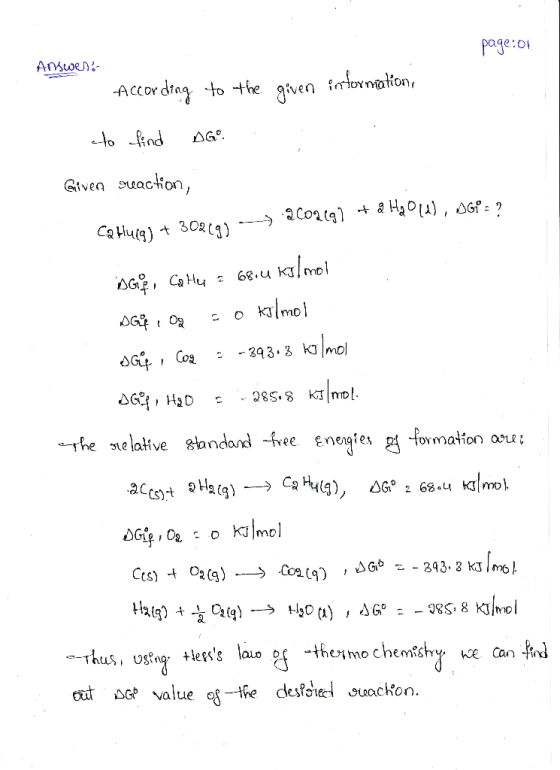
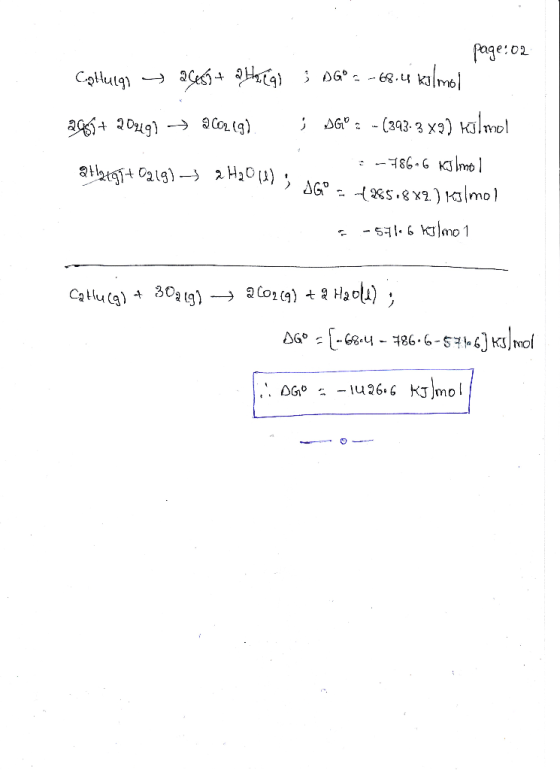
For the following reaction: C2H4(9) +302(g) + 2C02(g) + 2H2O(1) What is the change in free energy in kJ ? The relevant...
Consider a fuel cell that uses the reaction C2H4(g) + 302(g) + 2C02(g) + 2H2O(1) Using...
 Consider a fuel cell that uses the reaction C2H4(g) + 302(g) + 2C02(g) + 2H2O(1) Using the standard free energies of formation, what is the value of Eº for the cell reaction? Substance and State AG (kJ/mol) C2H4 (8) 68.1 CO2(g) -394.4 H2O(1) -237.2 O2(g) 0 Express your answer with the appropriate units. C: HÅR O a ? Eº = 0.0138 Submit Previous Answers Request Answer X Incorrect; Try Again; 4 attempts remaining
Consider a fuel cell that uses the reaction C2H4(g) + 302(g) → 2C02(g) + 2H2O(1) Using...
 Consider a fuel cell that uses the reaction C2H4(g) + 302(g) → 2C02(g) + 2H2O(1) Using the standard free energies of formation, what is the value of Eº for the cell reaction? Substance and State AG(kJ/mol) C2H4(g) 68.1 CO2(g) -394.4 H2O(1) -237.2 02(g) 0 Express your answer with the appropriate units. I HÅR O 2 ? E° = 3.45 V Submit Previous Answers Request Answer X Incorrect; Try Again; One attempt remaining
Find the enthalpy of combustion of C2H4(g), C2H4(g) + 302(g) → 2CO2(g) + 2H2O(1) given the...
 Find the enthalpy of combustion of C2H4(g), C2H4(g) + 302(g) → 2CO2(g) + 2H2O(1) given the following data: AHºf[C2H4(g)] = 52 kJ/mol; -285.8 kJ/mol AHºf[CO2(g)]=-393.5 kJ/mol ; AHºf[H2O(1)] = -1331 kJ/mol -731 kJ/mol .BO 2287 kJ/mol .CO -1410.6 kJ/mol.Do
Part A Consider a fuel cell that uses the reaction C2H4 (g)302(g) -2CO2(g) 2H20(1 Using the...
 Part A Consider a fuel cell that uses the reaction C2H4 (g)302(g) -2CO2(g) 2H20(1 Using the standard free energies of formation, what is the value of E° for the cell reaction? Substance and StateAG C2H4(g) CO2 (g) (kJ/mol) 68.1 -394.4 H20() O2(g) -237.2 0 Express your answer with the appropriate units. HA ? Value Units E° Previous Answers Request Answer Submit
For the following reaction: 4HCN(l)+5O2(g)⟶2H2O(g)+4CO2(g)+2N2(g) What is the change in free energy in kJmol? The relevant standard...
For the following reaction: 4HCN(l)+5O2(g)⟶2H2O(g)+4CO2(g)+2N2(g) What is the change in free energy in kJmol? The relevant standard free energies of formation are: ΔG∘f,HCN=120.1kJmolΔG∘f,O2=0kJmolΔG∘f,H2O=-228.4kJmolΔG∘f,CO2=-394.6kJmolΔG∘f,N2=0kJmol Your answer should includ
Given the following reaction, calculate the standard free energy change. PC15(9) + H2O(g) + POC13(g) +...
 Given the following reaction, calculate the standard free energy change. PC15(9) + H2O(g) + POC13(g) + 2HCl(9) AG298,PC1s(0) = -305.0 kJ AG 298,820() = -228.59€ AG298,POCI3(g) = -512.9% mol AGO mol *298.HCl(a) = -95.299_ mol • Your answer should include four significant figures.
(9) A spontaneous process has the change of free energy (a) AG>0 (c) AG = 0...
 (9) A spontaneous process has the change of free energy (a) AG>0 (c) AG = 0 (b) AG <O (d) AH>0 and AS <O (10) A chemical reaction has AH = 10 kJ. AS = 50 J/K at temperature T = 300 K. the reaction AG = J. (a) 5000 (b) -5000 (c) 10000 (d) 50 (11) For reaction: Ag (s) + 2 Cl2 (g) Ag° (aq) +CI (aq), the standard free energy of formation: AGf° (Ag*) = 77.1 kJ/mol,...
Calculate the standard free energy change for the reaction below. P4($+ 6C12(g) → 4PC13(g) kJ AG...
 Calculate the standard free energy change for the reaction below. P4($+ 6C12(g) → 4PC13(g) kJ AG 298.Pals) = 24.44 mol AG298.PC136) = -267.86 mol Your answer should include five significant figures. Do not include commas in your answer.
The standard free energy change, AGo, for the reaction C2H5OH(g) C2H4(g) + H20(g) is +8.25 kJ/mol...
 The standard free energy change, AGo, for the reaction C2H5OH(g) C2H4(g) + H20(g) is +8.25 kJ/mol at 25°C. Calculate Kp for the equilibrium.
Calculate standard free energy change using AG values. Consider the reaction 2CO2(g) + 3H2(g) C2H2() +...
 Calculate standard free energy change using AG values. Consider the reaction 2CO2(g) + 3H2(g) C2H2() + 4H2O(g) Use standard free energies of formation to calculate the standard free energy change for this reaction at 25°C. AG9rxn = kJ/mol
 Consider a fuel cell that uses the reaction C2H4(g) + 302(g) + 2C02(g) + 2H2O(1) Using the standard free energies of formation, what is the value of Eº for the cell reaction? Substance and State AG (kJ/mol) C2H4 (8) 68.1 CO2(g) -394.4 H2O(1) -237.2 O2(g) 0 Express your answer with the appropriate units. C: HÅR O a ? Eº = 0.0138 Submit Previous Answers Request Answer X Incorrect; Try Again; 4 attempts remaining
 Consider a fuel cell that uses the reaction C2H4(g) + 302(g) → 2C02(g) + 2H2O(1) Using the standard free energies of formation, what is the value of Eº for the cell reaction? Substance and State AG(kJ/mol) C2H4(g) 68.1 CO2(g) -394.4 H2O(1) -237.2 02(g) 0 Express your answer with the appropriate units. I HÅR O 2 ? E° = 3.45 V Submit Previous Answers Request Answer X Incorrect; Try Again; One attempt remaining
 Find the enthalpy of combustion of C2H4(g), C2H4(g) + 302(g) → 2CO2(g) + 2H2O(1) given the following data: AHºf[C2H4(g)] = 52 kJ/mol; -285.8 kJ/mol AHºf[CO2(g)]=-393.5 kJ/mol ; AHºf[H2O(1)] = -1331 kJ/mol -731 kJ/mol .BO 2287 kJ/mol .CO -1410.6 kJ/mol.Do
 Part A Consider a fuel cell that uses the reaction C2H4 (g)302(g) -2CO2(g) 2H20(1 Using the standard free energies of formation, what is the value of E° for the cell reaction? Substance and StateAG C2H4(g) CO2 (g) (kJ/mol) 68.1 -394.4 H20() O2(g) -237.2 0 Express your answer with the appropriate units. HA ? Value Units E° Previous Answers Request Answer Submit
 Given the following reaction, calculate the standard free energy change. PC15(9) + H2O(g) + POC13(g) + 2HCl(9) AG298,PC1s(0) = -305.0 kJ AG 298,820() = -228.59€ AG298,POCI3(g) = -512.9% mol AGO mol *298.HCl(a) = -95.299_ mol • Your answer should include four significant figures.
 (9) A spontaneous process has the change of free energy (a) AG>0 (c) AG = 0 (b) AG <O (d) AH>0 and AS <O (10) A chemical reaction has AH = 10 kJ. AS = 50 J/K at temperature T = 300 K. the reaction AG = J. (a) 5000 (b) -5000 (c) 10000 (d) 50 (11) For reaction: Ag (s) + 2 Cl2 (g) Ag° (aq) +CI (aq), the standard free energy of formation: AGf° (Ag*) = 77.1 kJ/mol,...
 Calculate the standard free energy change for the reaction below. P4($+ 6C12(g) → 4PC13(g) kJ AG 298.Pals) = 24.44 mol AG298.PC136) = -267.86 mol Your answer should include five significant figures. Do not include commas in your answer.
 The standard free energy change, AGo, for the reaction C2H5OH(g) C2H4(g) + H20(g) is +8.25 kJ/mol at 25°C. Calculate Kp for the equilibrium.
 Calculate standard free energy change using AG values. Consider the reaction 2CO2(g) + 3H2(g) C2H2() + 4H2O(g) Use standard free energies of formation to calculate the standard free energy change for this reaction at 25°C. AG9rxn = kJ/mol
Most questions answered within 3 hours.
-
Where is the error in this code sequence?
String s1 = "Hello";
String s2 = "ello";...
asked 11 months ago -
Financial data for Joel de Paris, Inc., for last year
follow:
Joel de Paris, Inc.
Balance...
asked 11 months ago -
Consider this reaction:
Al2(SO4)3 (aq)+ BaCl3
(aq) Al2Cl6 (aq)- +
3BaSO4(s) . What is the...
asked 11 months ago -
Suppose that Savneet is considering increasing her
recent random sample from 20 car rentals to 40...
asked 11 months ago -
Trucks arrive at an unloading terminal at an average rate of 120
per hour.
Trucks arrive...
asked 11 months ago -
Why are methanol and ethanol completely soluble in water while
octanol is not very little soluble....
asked 11 months ago -
A facilities manager at a university reads in a research report
that the mean amount of...
asked 11 months ago -
When the CuSO4 is rehydrated by adding water to the anhydrous
compound, is this an endothermic...
asked 11 months ago -
A ray of sunlight is passing from diamond into crown glass; the
angle of incidence is...
asked 11 months ago -
A block of mass 0.249 kg is placed on top of a light, vertical
spring of...
asked 11 months ago -
how do the kidneys compensate in the presences of acidosis
a) trigger hyperventilate
b) reserve acid...
asked 11 months ago -
Question 501 pts
The rental rate of capital to the firm increases. Which of the
following...
asked 11 months ago