 please explain
Homework Answers

Add Answer to:
please explain 2. (A) Draw the products of the acid/base reaction, (B) determine the position of the equilibrium, (C) us...
6) For the reaction shown below: H-5 H + NHL a. Draw the products AND label...
 6) For the reaction shown below: H-5 H + NHL a. Draw the products AND label acids and bases on BOTH sides of the reaction. b. Predict the equilibrium position for the reaction. Briefly explain your answer. c. Show a detailed, stepwise mechanism for the FORWARD reaction. Use curved arrows to show the flow of electrons. To receive full credit, show all lone pairs.
2. For the following acid-base equilibrium H-BH + Acid Base Conjugate Base Conjugate Acid (a) Draw...
 2. For the following acid-base equilibrium H-BH + Acid Base Conjugate Base Conjugate Acid (a) Draw a curved arrow mechanism above to show the transfer of a proton from the starting acid "acetylene" to the starting base "n-butyllithium"(two curved arrows are necessary). (b) Draw the conjugate base of acetylene and the conjugate acid of n-butyllithium, indicating all counter ions and formal charges in the rectangles provided above. (c) Which side. Left or Right, of this equilibrium is favored thermodynamically? What...
5. For the following acid-base reactions, complete the products, show the mechanism (curved arrows), and label...
 5. For the following acid-base reactions, complete the products, show the mechanism (curved arrows), and label the acid, base, conjugate acid, and conjugate base. A) ? O:N H B) :- ? H Page 2 of 3 6. For the reaction in question 5 (A and B), write the pk, values of the acid and conjugate acid underneath them and then circle the side of the equilibrium that is favored. If neither side is favored, write "neither." Briefly explain quantitatively (using...
B. Determine the major product of part A. Explain. 2. Consider the following reaction. A. Draw...
 B. Determine the major product of part A. Explain.
2. Consider the following reaction. A. Draw the mechanism of the reaction to predict All constitutional products. Show all bonds being made and broken. Show all steps with curved arrows that are necessary to form the products. :B: H H.
B. Determine the major product of part A. Explain.
2. Consider the following reaction. A. Draw the mechanism of the reaction to predict All constitutional products. Show all bonds being made and broken. Show all steps with curved arrows that are necessary to form the products. :B: H H.
draw the products formed by the following acid base reaction without consideration of the equilibrium position:
 draw the products formed by the following acid base
reaction without consideration of the equilibrium position:
draw the products formed by the following acid base
reaction without consideration of the equilibrium position:
3. Draw a stepwise, detailed mechanism for the acid-catalyzed hydration reaction in question 2 above. Use...
 3. Draw a stepwise, detailed mechanism for the acid-catalyzed hydration reaction in question 2 above. Use curved arrows to indicate the flow of electrons. (Note: use hydronium ion, H307, in your mechanism to indicate "acidic water"). (6 pts) 4. Draw a stepwise, detailed mechanism for the reaction below. Use curved arrows to indicate the flow of electrons. (Hint: think of this reaction as a combination of addition of HX (step 1) and hydration (step 2)]. In the second step, an...
IV) Acid/Base Reaction - Answer the next few questions about Molecule B, shown below. a) Circle...
 IV) Acid/Base Reaction - Answer the next few questions about Molecule B, shown below. a) Circle the terms that correctly describe the molecule. H-bond acceptor dextrorotatory contains ketone racemic has enantiomer H-bond donor Molecule B [a] = -27.8° optically active contains aldehyde levorotatory b) Molecule B can react with another molecule in an acid/base reaction (shown below). olgan In the spaces provided, please do the following: i) Draw the structure of the missing molecule in the space provided. ii) Circle...
draw curved arrows to show the movement of electrons in this step of the reaction mechanism...
 draw curved arrows to show the movement of electrons in this step
of the reaction mechanism
HCI H2O NH,CI -CEN ОН Acid catalyzed hydrolysis of a nitrile to give a carboxylic acid occurs by initial protonation of the nitrogen atom, fo Draw curved arrows to show the movement of electrons in this step of the reaction mechanism Arrow-pushing Instructions O: x H -CI: -NH₂ SLIDE ty Another Mansion 1 terrattuttomat
draw curved arrows to show the movement of electrons in this step
of the reaction mechanism
HCI H2O NH,CI -CEN ОН Acid catalyzed hydrolysis of a nitrile to give a carboxylic acid occurs by initial protonation of the nitrogen atom, fo Draw curved arrows to show the movement of electrons in this step of the reaction mechanism Arrow-pushing Instructions O: x H -CI: -NH₂ SLIDE ty Another Mansion 1 terrattuttomat
Complete the reaction by writing the products of the acid base reaction (do not forget to...
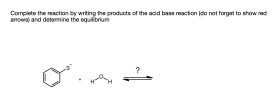 Complete the reaction by writing the products of the acid base reaction (do not forget to show red arrows) and determine the equilibrium ? o + Н
Q 33 - (2 pts) Predict the position of equilibrium for the following acid-base reaction. +...
 Q 33 - (2 pts) Predict the position of equilibrium for the following acid-base reaction. + A) reactants side (Keq <1); B) products side (Keq >1); C) reactants and products are at the equilibrium (Keq =1);
 6) For the reaction shown below: H-5 H + NHL a. Draw the products AND label acids and bases on BOTH sides of the reaction. b. Predict the equilibrium position for the reaction. Briefly explain your answer. c. Show a detailed, stepwise mechanism for the FORWARD reaction. Use curved arrows to show the flow of electrons. To receive full credit, show all lone pairs.
 2. For the following acid-base equilibrium H-BH + Acid Base Conjugate Base Conjugate Acid (a) Draw a curved arrow mechanism above to show the transfer of a proton from the starting acid "acetylene" to the starting base "n-butyllithium"(two curved arrows are necessary). (b) Draw the conjugate base of acetylene and the conjugate acid of n-butyllithium, indicating all counter ions and formal charges in the rectangles provided above. (c) Which side. Left or Right, of this equilibrium is favored thermodynamically? What...
 5. For the following acid-base reactions, complete the products, show the mechanism (curved arrows), and label the acid, base, conjugate acid, and conjugate base. A) ? O:N H B) :- ? H Page 2 of 3 6. For the reaction in question 5 (A and B), write the pk, values of the acid and conjugate acid underneath them and then circle the side of the equilibrium that is favored. If neither side is favored, write "neither." Briefly explain quantitatively (using...
 B. Determine the major product of part A. Explain.
2. Consider the following reaction. A. Draw the mechanism of the reaction to predict All constitutional products. Show all bonds being made and broken. Show all steps with curved arrows that are necessary to form the products. :B: H H.
B. Determine the major product of part A. Explain.
2. Consider the following reaction. A. Draw the mechanism of the reaction to predict All constitutional products. Show all bonds being made and broken. Show all steps with curved arrows that are necessary to form the products. :B: H H.
 draw the products formed by the following acid base
reaction without consideration of the equilibrium position:
draw the products formed by the following acid base
reaction without consideration of the equilibrium position:
 3. Draw a stepwise, detailed mechanism for the acid-catalyzed hydration reaction in question 2 above. Use curved arrows to indicate the flow of electrons. (Note: use hydronium ion, H307, in your mechanism to indicate "acidic water"). (6 pts) 4. Draw a stepwise, detailed mechanism for the reaction below. Use curved arrows to indicate the flow of electrons. (Hint: think of this reaction as a combination of addition of HX (step 1) and hydration (step 2)]. In the second step, an...
 IV) Acid/Base Reaction - Answer the next few questions about Molecule B, shown below. a) Circle the terms that correctly describe the molecule. H-bond acceptor dextrorotatory contains ketone racemic has enantiomer H-bond donor Molecule B [a] = -27.8° optically active contains aldehyde levorotatory b) Molecule B can react with another molecule in an acid/base reaction (shown below). olgan In the spaces provided, please do the following: i) Draw the structure of the missing molecule in the space provided. ii) Circle...
 draw curved arrows to show the movement of electrons in this step
of the reaction mechanism
HCI H2O NH,CI -CEN ОН Acid catalyzed hydrolysis of a nitrile to give a carboxylic acid occurs by initial protonation of the nitrogen atom, fo Draw curved arrows to show the movement of electrons in this step of the reaction mechanism Arrow-pushing Instructions O: x H -CI: -NH₂ SLIDE ty Another Mansion 1 terrattuttomat
draw curved arrows to show the movement of electrons in this step
of the reaction mechanism
HCI H2O NH,CI -CEN ОН Acid catalyzed hydrolysis of a nitrile to give a carboxylic acid occurs by initial protonation of the nitrogen atom, fo Draw curved arrows to show the movement of electrons in this step of the reaction mechanism Arrow-pushing Instructions O: x H -CI: -NH₂ SLIDE ty Another Mansion 1 terrattuttomat
 Complete the reaction by writing the products of the acid base reaction (do not forget to show red arrows) and determine the equilibrium ? o + Н
 Q 33 - (2 pts) Predict the position of equilibrium for the following acid-base reaction. + A) reactants side (Keq <1); B) products side (Keq >1); C) reactants and products are at the equilibrium (Keq =1);
Most questions answered within 3 hours.
-
Where is the error in this code sequence?
String s1 = "Hello";
String s2 = "ello";...
asked 10 months ago -
Financial data for Joel de Paris, Inc., for last year
follow:
Joel de Paris, Inc.
Balance...
asked 10 months ago -
Consider this reaction:
Al2(SO4)3 (aq)+ BaCl3
(aq) Al2Cl6 (aq)- +
3BaSO4(s) . What is the...
asked 10 months ago -
Suppose that Savneet is considering increasing her
recent random sample from 20 car rentals to 40...
asked 10 months ago -
Trucks arrive at an unloading terminal at an average rate of 120
per hour.
Trucks arrive...
asked 10 months ago -
Why are methanol and ethanol completely soluble in water while
octanol is not very little soluble....
asked 10 months ago -
A facilities manager at a university reads in a research report
that the mean amount of...
asked 10 months ago -
When the CuSO4 is rehydrated by adding water to the anhydrous
compound, is this an endothermic...
asked 10 months ago -
A ray of sunlight is passing from diamond into crown glass; the
angle of incidence is...
asked 10 months ago -
A block of mass 0.249 kg is placed on top of a light, vertical
spring of...
asked 10 months ago -
how do the kidneys compensate in the presences of acidosis
a) trigger hyperventilate
b) reserve acid...
asked 10 months ago -
Question 501 pts
The rental rate of capital to the firm increases. Which of the
following...
asked 10 months ago